Publication details
First published . Series dates place related notes together in the reading archive.
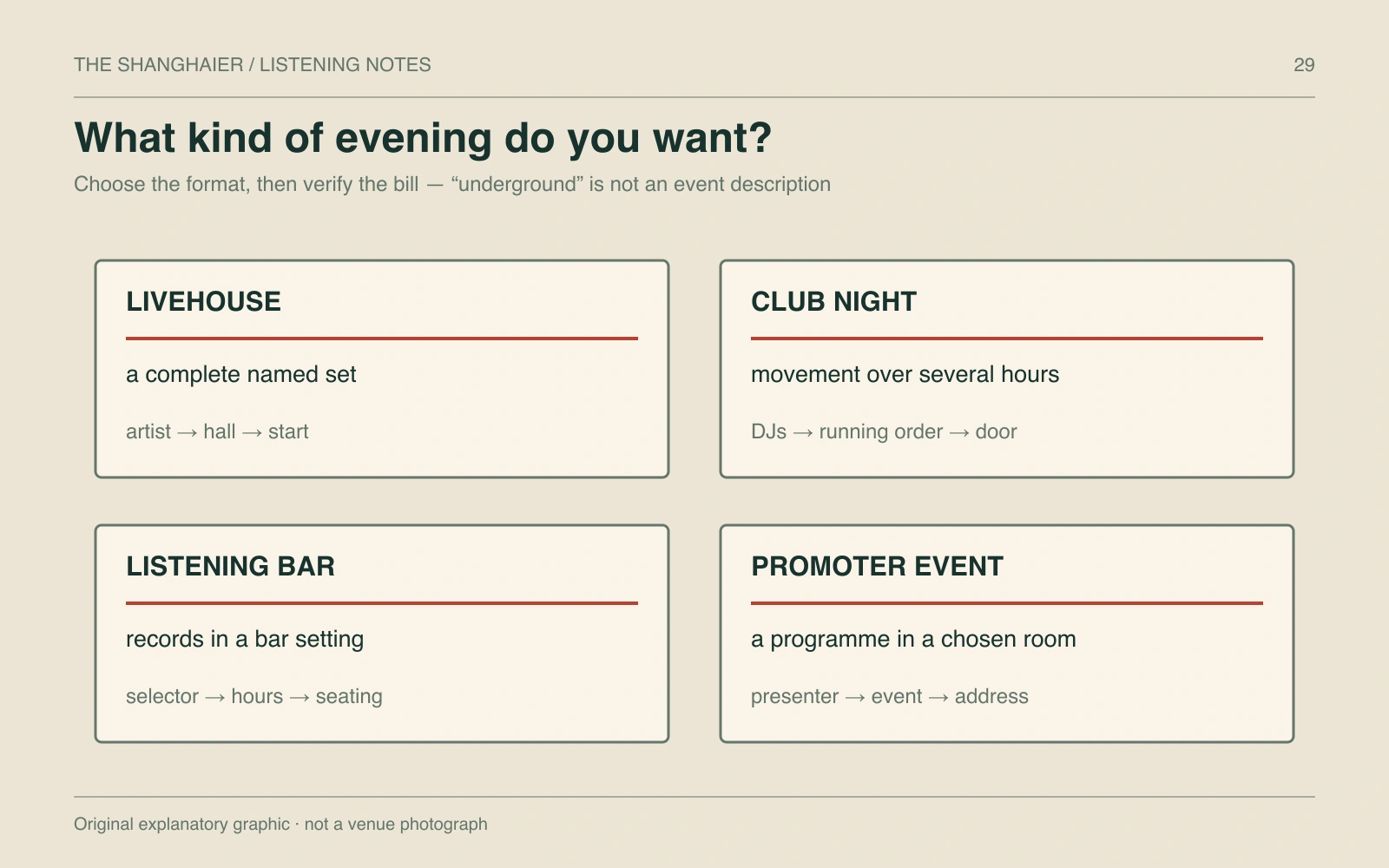
Choose the kind of attention you want
A livehouse generally puts a named performance at the centre of the evening. A club programme may revolve around several DJs and a changing dance floor. A listening bar can give recordings a prominent role while still being a bar. A promoter is an organiser, not necessarily a permanent room. These distinctions are broad starting points; read the particular event before relying on any of them.
Ask yourself a concrete question: do you want to hear a band’s complete set, dance for several hours, sit with a selector’s records or follow an experimental performance? The answers lead to different bills. Wanting an early finish or a seat is not a failure of adventurousness. A good recommendation fits both the music and the physical evening you can comfortably have.
Put the artist ahead of the adjective
Listen through an artist, label or presenter’s authorised link. One complete track, or a useful section of a mix, gives you more information than “edgy,” “hidden” or “authentic.” Then inspect the rest of the bill. A supporting act, local selector or collaborative format might be the feature that makes a particular date interesting rather than merely available.
An unfamiliar name is an opportunity, not a guarantee. You can decide that the music does not suit you. If it does, save the artist before buying so you can find the work again. This shifts the outing from consuming an atmosphere to following people making something. It is also more resilient than a list of fashionable rooms: artists and promoters can continue working when addresses change.
Use current ticket inventory as an anchor
Current listings offer concrete leads at JZ Club in Hengshan8 Water Tower Plaza and Yuyintown Cube in C-Park. They demonstrate active, date-specific programmes, not that either room supplies every kind of night. JZ might have several separately ticketed sets; Yuyintown’s hall letter matters. Check the current event’s full Chinese venue field before travelling.
Do not turn an older list of Shelter, ALL, Elevator, SYSTEM or another much-discussed name into a claim of present operation. Equally, a confusing directory is not proof of closure. The useful standard is simpler: can you match a current presenter, a dated bill and a usable address? If not, keep the reference as music history and choose a better-evidenced event for tonight.
A basement is not automatically a secret
C-Park’s music cluster is interesting because several businesses and rooms are connected, not because going downstairs grants access to a hidden city. A room can be independently run and publicly ticketed. A prominent online profile does not make it inauthentic, while a difficult entrance does not make the music better. Separate the pleasure of discovery from a need to prove that nobody else has discovered it.
This also changes how you behave on arrival. Buy the correct ticket, follow house rules and listen. You do not need to announce that you are looking for the real Shanghai or ask strangers to validate the night for you. A visitor can participate through ordinary attention, consideration and support without turning a working music community into an encounter staged for the trip.
Match the room to the group
Check standing versus seated admission, likely duration and any age conditions. Ask about step-free access where it matters, including the actual entrance and route to the audience area. If a loud amplified room will be difficult, take hearing protection or choose another format. The quality of the music does not remove the physical conditions in which you will hear it.
For a group, establish whether everyone is choosing the same evening. Somebody who wants dinner with quiet background sound may be miserable at the event another person finds thrilling. It is better to split plans courteously than choose an uneasy compromise and talk over the performance. A useful guide offers that possibility rather than pretending one underground recommendation satisfies every traveller.
Keep the final address and the final train
Save the hall name, floor, Chinese street address and admission instructions offline. A large complex’s map pin may not lead to the correct door, especially late at night. Allow time to find staff and signs without missing the first set. Check whether re-entry is allowed before planning to leave between acts; a cluster of nearby businesses does not automatically imply shared access.
Plan your return for the likely end of your own evening. Check the last useful metro in the right direction and a practical taxi pickup point if needed. Keep the return destination in Chinese and enough battery to use it. Logistics should not dominate the night, but leaving them entirely to the last moment is a dependable way to make the ending worse.
Let one night open another question
After the show, save one artist, promoter or label you want to follow. An independent music visit becomes more valuable when it continues beyond a venue photograph. Buy a release or merchandise if you want it, use official channels and ask before photographing people closely. Nobody owes a visitor a backstage story, and a short public conversation is a possibility rather than an itinerary inclusion.
If you want me to help choose, give me a date, two or three musical references and your preferred kind of room. That is enough to start a useful search. “Underground” can stay as a loose ambition, but the final recommendation should be specific: this bill, in this room, on this date, for reasons you can actually hear.