Publication details
First published . Series dates place related notes together in the reading archive.
Shanghai is a starting point, not a border
Bandcamp’s 2024 label interview traces SVBKVLT’s foundation in Shanghai in 2013 and its growth through local club activity into an international network. That is useful historical context. It should not be converted into a claim that every artist on the current roster lives in Shanghai, or that a club named in an older account is available to visit now. The catalogue is a more durable first destination than a legacy venue address.
The city connection matters because people, rooms and repeated encounters can make work possible. It does not impose a common nationality, residence or musical vocabulary on everyone involved. When a release names artists working in several places, keep that geography intact. “Shanghai-connected” is often a more informative description than “Shanghai music” if the shorter phrase hides the collaboration you are trying to understand.
Start with a compilation: Cache 01
Cache 01 is a useful opening because a compilation places several artists beside one another. Read the individual credits while sampling, and save the names that make you want to hear more. The label’s own page is the place to verify the sequence and versions. A compilation can suggest relationships, but it does not prove that every contributor belongs to a single scene in the same way.
For your first pass, avoid trying to identify a genre for each track. Notice a simpler difference: the way a piece establishes movement, the density of its sounds, or how much space it leaves. Then choose two contributions that seem far apart and follow each artist’s release page. That is a practical way for an unfamiliar catalogue to become navigable without requiring a critic’s complete history before pressing play.
Follow a solo statement: Rusted Silicon
Gooooose’s Rusted Silicon offers a different scale of attention from a compilation. One project can develop its own ideas across a release, including relationships that a single playlist track obscures. Use the official credits to separate original pieces from remixes and look at the order before shuffling. Sequencing is one of the ways an album can ask you to move through it.
A useful listening question is where you feel a pulse and whether that feeling remains stable as other elements change. Do not worry if a sound cannot be named as an instrument. Electronic music often makes that uncertainty productive. You can describe an attack, a sustained texture, a repeated figure or a change in register without inventing a technological explanation for how the artist made it.
Then hear a collaboration: JAC
JAC is credited to Gooooose and DJ Scotch Egg. Its release notes document a Shanghai studio collaboration and distinguish the original material from later remixes. The credits make it a particularly useful counterexample to the idea that a local label merely exports a sealed local sound. The work is already connected to people and encounters elsewhere before it reaches the listener.
Listen to the title track through the label’s authorised page, then compare its listed remix. A remix is not a test in which one version must defeat the other. Ask what is retained, what is reorganised and what new emphasis becomes possible. Reading the two credits carefully can reveal a chain of work that a streaming interface’s single artist field sometimes compresses.
Let disagreement remain audible
It is easy to make a label profile sound coherent by giving every release the same adjectives. “Dark,” “futuristic” and “experimental” can become a substitute for describing anything. Try a smaller comparison instead. Which part of a piece gives you a sense of repetition? Where does a new event interrupt it? What would be lost if the texture were smoother or the rhythm more predictable?
You are allowed to prefer one release and dislike another. A catalogue is useful partly because it contains choices that do not all serve the same listener. A scene worthy of attention is not one in which every record confirms a tourist’s expectation. Give a difficult piece enough time to become specific, then decide whether you want to continue. Curiosity does not require unconditional approval.
Artwork is another contributor’s work
Electronic labels can have a strong visual identity, but a release image is not a free illustration resource because it accompanies a record. Read artist and design credits, and distinguish cover art from event artwork. A similar look across several releases may come from collaborators making deliberate decisions; it should not be described as an anonymous city aesthetic.
For a listener, cover art can be a useful memory aid and another route into an artist’s work. For a visitor, it may also make a physical edition attractive. I would still hear the music before deciding that a sleeve is the souvenir. The best purchase joins image and sound without forcing either to function as packaging for an idea of underground credibility.
A record and a live set are related, not identical
A live electronic performance, a DJ set and playback of a studio album are different propositions. An artist’s name on a poster does not automatically tell you which is offered. Read the event description and format. The version you heard online can help you decide, but it cannot promise the same sequence, duration or construction in a room.
If you find an event connected to the label, verify the date, venue and actual bill through the current presenter. Do not arrive at a club named in a 2019 or 2024 profile expecting the history to remain physically available. Cultural work can continue while institutions move or close. Following artists and promoters is usually a more resilient method than treating a celebrated basement as a permanent landmark.
Support can be modest and direct
Use the artist or label’s authorised listening and sales links. If you want a download, check which release and format you are buying. If you want a physical copy, read shipping, stock and edition information at the point of purchase. A catalogue page can show an older edition whose availability has changed; there is no reason to promise a visitor that a particular disc will be waiting in a local shop.
One purchase you will return to is enough. You can also follow the artist, read credits and attend a verified show. What matters is that the connection is to work you have actually chosen, not just to the label’s reputation. A thoughtful small purchase is more meaningful than collecting a stack of objects you cannot distinguish once the trip ends.
The city continues through the connections
SVBKVLT is useful for a Shanghai visitor because it unsettles the idea that cultural tourism must point backwards. Records, collaborations and changing performance formats provide a present-tense subject. That does not mean dismissing the city’s older musical histories. It means refusing to let one familiar vintage image stand in for everything happening after it.
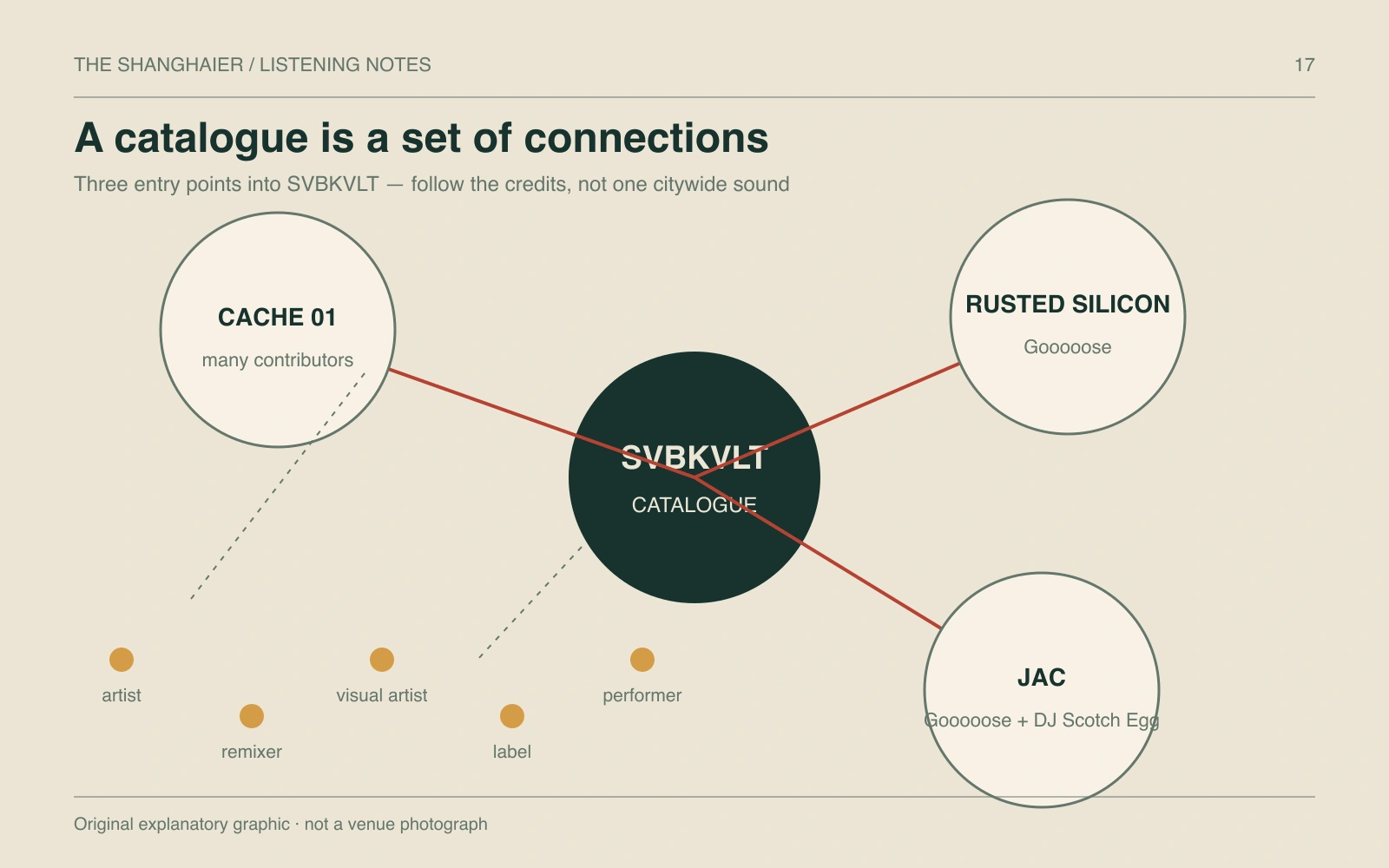
My suggested route is therefore a listening route: Cache 01 for several voices, Rusted Silicon for a sustained project, and JAC for a documented collaboration. Hear enough to make your own distinctions, then follow one artist beyond this selection. You will not have summarised Shanghai. You will have found a line of work worth continuing, which is a better reason to keep listening.