Publication details
First published . Series dates place related notes together in the reading archive.
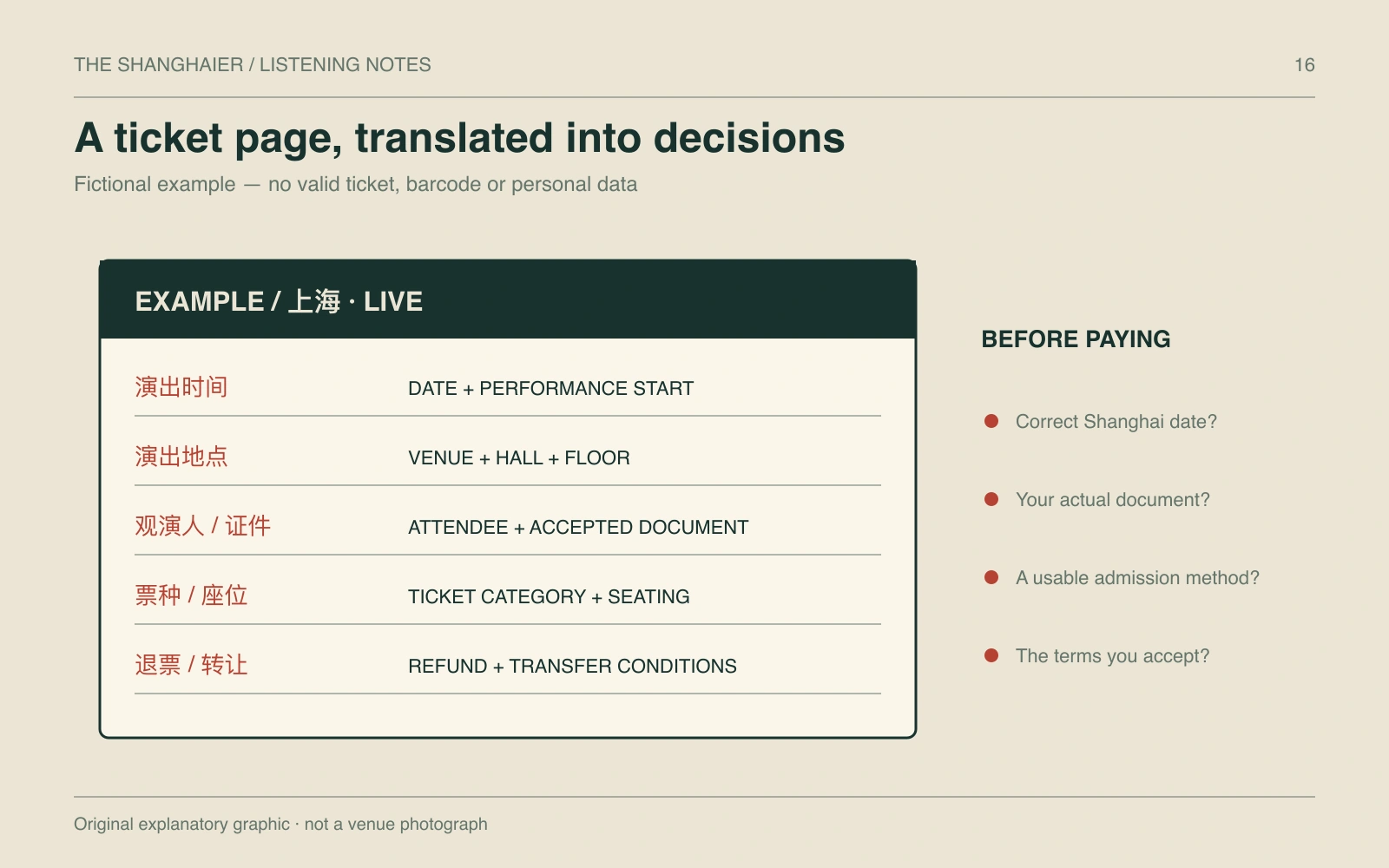
Find the event through its presenter
Begin with the artist, venue or promoter’s current announcement, then follow its named ticket channel. Search results can surface a past tour, an unofficial reseller or a similarly titled event in another city. Compare the date and presenter across the announcement and ticket page. A large platform’s name is helpful, but it does not make the first result the event you intended to buy.
Keep the original event title in Chinese when one is supplied. English translations can be shortened or changed across platforms, particularly for a tour subtitle. For a national tour, check Shanghai explicitly; the same artwork may be used for several cities. If one page cannot be matched to the presenter’s announcement, resolve that mismatch before handing over identity information or payment.
Separate the five pieces of timing
Look for event date, door time, performance start, any published running order and expected finish. They answer different questions. 开场 or 演出时间 usually helps identify the start, while 入场 indicates admission; the exact page’s wording should decide. A poster time is not permission to arrive at any point in an evening, and a finish may be an estimate rather than a guarantee.
Decide which timing matters to your plan. If you need the final metro, work backwards from the last useful train in your direction, including the walk to the station. If you want to hear every act, arrive before the first performance with time for checks. Avoid fitting a second appointment against an assumed end time that no organiser has actually promised.
Match city, venue and room
Save the Chinese street address and the full hall label. Shanghai’s complexes can contain several rooms, and an institution can present events away from its contact address. Current listings illustrate the problem: JZ is identified at Hengshan8 Water Tower Plaza, while Yuyintown Cube is C Hall at C-Park, Building D, B1, 658 Zhaohua Road. Those are examples to verify against your own event, not universal directions for every related show.
A map pin may place you at a site boundary rather than an audience entrance. Letter, floor and gate information can matter at the end of the journey. Compare the map’s Chinese place name to the ticket and allow time to follow signs. If the event information and map disagree, ask the official organiser; do not resolve it by choosing the more familiar English venue name.
Identity rules are event-specific
实名 means a real-name arrangement. 观演人 refers to the attendee, which may be distinct from the person paying. Before selecting a ticket, check whether the event accepts your actual identity document and how the name must be entered. A foreign passport can be accepted by a particular show without being supported by every event on the same platform. A ticketing form is not a place to improvise an identity number.
Read whether each attendee needs a separate document record and whether that record can be changed after purchase. An order for several tickets does not necessarily mean one passport covers the party. Ask the official channel if there is no appropriate document option. Keep personal data within the legitimate booking process; do not send passport scans to a stranger who offers to bypass the form.
Phone and payment are separate obstacles
Account registration, identity verification, payment and admission can each involve a different step. Successfully logging into a platform does not prove that your selected event supports your document. Likewise, a payment app working in a restaurant does not guarantee a particular online ticket checkout will accept the same card. Work through the official flow with time to ask for help before the event sells out.
If a box office offers an alternative booking channel, get the conditions directly from it. Confirm how the payment will be linked to the attendee and where the ticket will be retrieved. Do not assume a bank debit alone is the admission credential. Keep the order confirmation and check that the ticket is actually issued or that collection is explicitly arranged.
Read the category before comparing price
单人票 describes a single-person ticket, while 双人票 generally indicates a two-person category; still read the exact conditions and attendee requirements. 预售 is advance sale and 现场 is door sale when offered. 早鸟 indicates an early category, often limited. A cheap price visible in search may belong to a concession, a special allocation or a category no longer available.
For seating, look for whether a seat is assigned, unreserved or absent. An event in a bar may have a different table arrangement from a concert hall. A package may include a drink or other item, but do not infer an inclusion from the venue type. If you need adjacent seats, step-free access or a place to sit throughout, establish that before payment rather than treating it as a request to negotiate at the door.
Know what cancellation would mean
Read 退票 for refund information and 转让 for transfer rules. Deadlines, charges and eligibility may vary by event. A rescheduled or cancelled performance can have a separate process from a customer simply deciding not to attend. Save the terms visible when purchasing, especially if the date is central to your trip. A general platform help page may not override a specific event’s conditions.
Do not buy a spare ticket on the assumption that it can easily be passed to a friend. Where identity is attached, a screenshot and a friendly handover may be useless. Use the official transfer procedure if one exists. If it does not, treat the ticket as potentially non-transferable. That question should be resolved while there is still a choice about buying it.
Build an entrance packet, not a public post
Keep the order reference, venue address, room name and relevant entry instructions available even if mobile reception is poor. Check whether the admission credential is static, dynamic or tied to the original document. A screenshot can preserve useful information while still failing to function as a ticket. Where original ID is required, a photograph of it may not meet the condition.
Do not post a live barcode, QR code or full identity details to social media. If you want to share the show, use the public poster or an official link. At the entrance, have the necessary screen ready without displaying unrelated personal information. A little preparation keeps the queue moving and reduces the chance that a translation problem becomes everybody else’s delay.
Have a plan for the final hour
Before leaving for the venue, save the return destination in Chinese, check battery and decide how late you can comfortably stay. A livehouse’s final act may end after your preferred train, while a concert hall can release a large audience at once. Pick a sensible pickup point if a taxi is likely. Check actual transport information for the date and direction rather than relying on a citywide closing-time rule.
Then let the practical work recede. The point of reading a ticket carefully is to make more room for the performance. If you need help, send the public event link and the specific question—passport support, room location, seating or timing—without broadcasting private documents. One well-understood ticket is a much better start to a Shanghai music evening than five saved posters and a guess.