Publication details
First published . Series dates place related notes together in the reading archive.
A cluster is not one venue
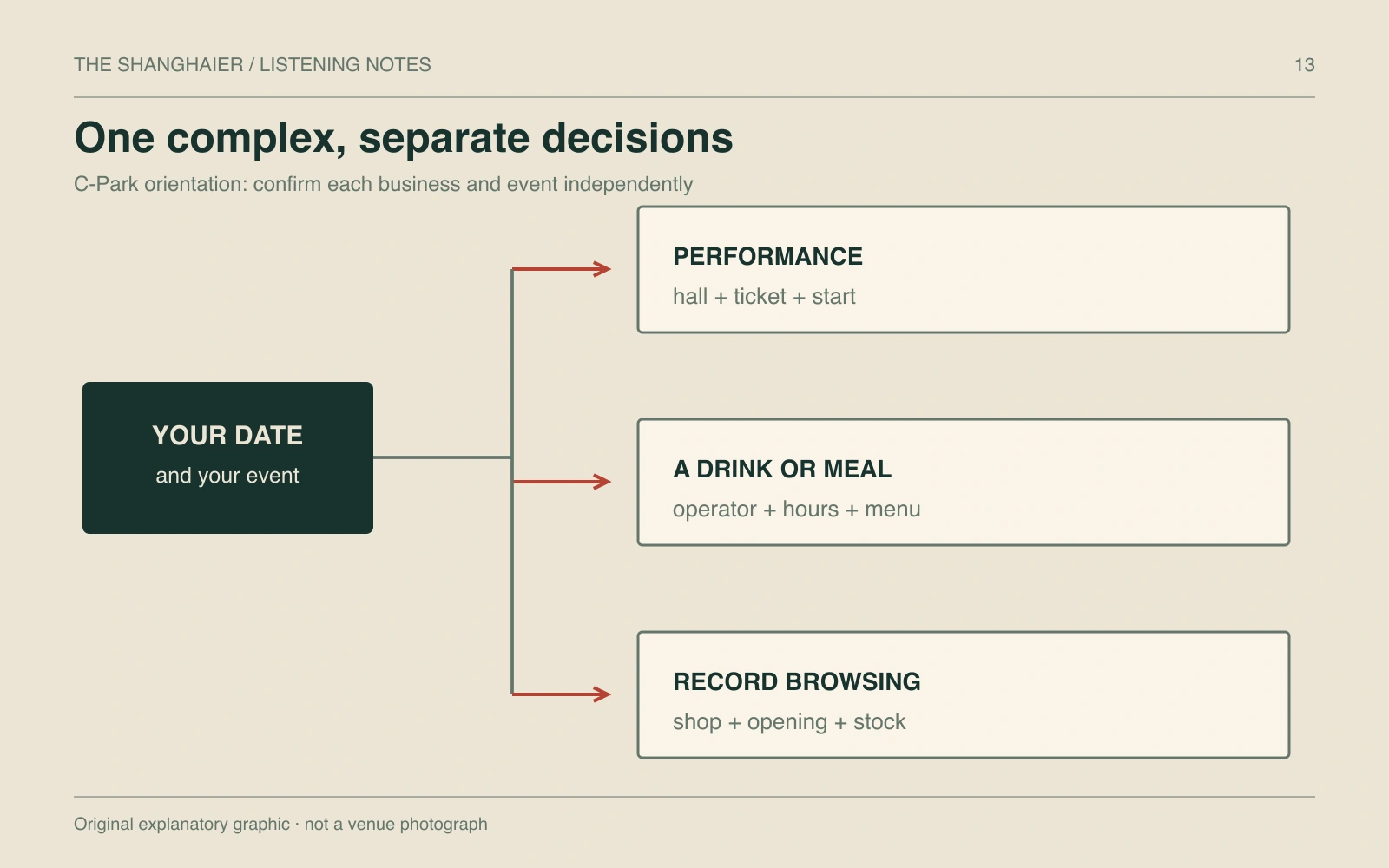
C-Park in Changning brings music-related spaces into one broader development. The reason to understand that arrangement is practical, not just atmospheric. A livehouse, a record shop, a bar and a club can be close together while running different hours, admissions and programmes. A ticket to one does not turn the whole basement into an all-access festival.
Current ShowStart inventory provides a firm starting point for Yuyintown Cube, explicitly C Hall: 育音堂小镇C厅,昭化路658号CPARK D栋地下一层. In English, use C-Park, Building D, B1, 658 Zhaohua Road. That is a particular hall’s listing. Do not turn the building address into an assurance that every other tenant uses the same doorway or is open whenever a show is on.
Separate a dated report from tonight’s offer
A May 2026 City News Service report describes the broader Yuyintown cluster and several neighbouring businesses. It is useful evidence that the project is more than a single stage. It is not a permanent operating directory. A development announcement can also include spaces planned for later opening. The existence of a name in a report does not establish tonight’s hours, ticket policy or physical access.
For a visitor, the sensible hierarchy is a current event from its presenter, a matching ticket page and the hall’s Chinese address. General reporting comes after those as context. If you are travelling especially to shop or eat, confirm that business separately. A gig can proceed while a nearby booth is shut, and there is no reason to make the success of your evening depend on both behaving identically.
Pick a room through the music
Read the full hall name, including any letter or English subtitle. A translated poster may shorten a venue name until several spaces appear to be one. Keep a screenshot of the original Chinese event information. At a complex with several performance rooms, asking staff for the artist and hall is more precise than saying you are looking for “the music.”
The bill should also help you decide whether to go. Hear an artist’s recording before buying, read the support lineup and check whether the programme is a seated concert, a standing livehouse show or a late DJ event. The physical experience changes with the format. A basement address cannot tell you whether the night is suitable for someone who wants a quiet seat and an early finish.
Arrival is part of the plan
Save Building D and B1 with the street number before leaving your hotel. Once at the complex, follow current signs and staff directions rather than treating a pin at the site boundary as the final entrance. Allow extra time for orientation on a first visit. A small hall letter can matter more than a large development name when several queues and doors are close together.
For step-free access, ask the specific event organiser about the route from street level to the hall and the audience arrangement inside. Do not infer it from the presence of a lift elsewhere in the development. Similarly, a map’s walking route establishes neither the correct late entrance nor which doors will remain open after a performance. These details need the operator’s current answer.
One show is enough of a commitment
I would choose one event and make the surrounding stops optional. That gives you room to arrive early, eat if the options suit you, and listen to the full programme. Treating the cluster as a challenge to visit every business can make each encounter superficial. The scene is carried by particular people and work, not by the number of doors you manage in one evening.
If two events genuinely interest you, check their schedules and admissions separately. Start time, end time and re-entry are different questions. A door stamp from one event may mean nothing at another, and an advertised time does not guarantee that you can catch exactly half of each set. Letting one performance occupy the night is often more rewarding than engineering a hurried relay.
Look after your ears and attention
Live music in a relatively close room can be physically intense. Take suitable hearing protection if needed and choose a position where you can remain comfortable without obstructing others. There is no virtue in standing directly by a speaker if it makes the set painful. Ask staff about seating or a quieter position when that affects whether you can attend.
Keep recording and photography within the performer’s and venue’s rules. A short clip can be a memory, but holding a bright screen up for an entire song imposes your memory on everyone behind you. Pay attention to opening acts as well as the headliner. The strongest reason to seek an independent bill is the opportunity to hear work you did not already know.
Plan the journey out before the late set
Look at transport for the time you expect to leave, not the time you arrive. Metro service varies by line, direction and date; a station still being open does not guarantee the train you need. If a taxi is likely, save the return destination and choose a sensible pickup point above ground. Do not leave that decision until battery and patience are both low.
C-Park can make an evening feel connected because several music businesses share a location. The guide’s job is to preserve that attraction while making the actual visit specific. Choose the event, verify its hall, establish access and keep the rest flexible. That is a more dependable way into a music community than a claim that the whole complex is a hidden, always-open night out.