Publication details
First published . Series dates place related notes together in the reading archive.
A release, not a forthcoming promise
Blue Note Records China’s release announcement is dated 23 October 2026. It presents a six-track compilation with production involving Don Was, Zhang Yadong and JZ Music founder Ren Yuqing. This note follows that release date. A current recording is a useful place to begin precisely because you can hear a complete project without needing a concert to coincide with your travel dates.
Use the label’s authorised listening links and read the track credits as you go. An anthology is a selection, not a census. Its six pieces cannot stand for every musician, region or approach working in China, and there is no need to demand that they do. The more interesting question is what becomes audible when these particular people and pieces are placed together.
Keep the geography open
The project connects Shanghai and Beijing in its production story, and its contributors belong to a wider musical network. Do not call every participant Shanghai-based simply because you encountered the record through a Shanghai guide. A musician can collaborate in the city, record there, perform there or live there; each connection deserves its own wording.
That precision helps visitors too. You can use the record to find names to follow, then check which of those names appears on a current local programme. A record made through several places may lead you to a Shanghai performance without becoming a wholly Shanghai object. The point is connection, not claiming a complete national scene for one city’s tourism story.
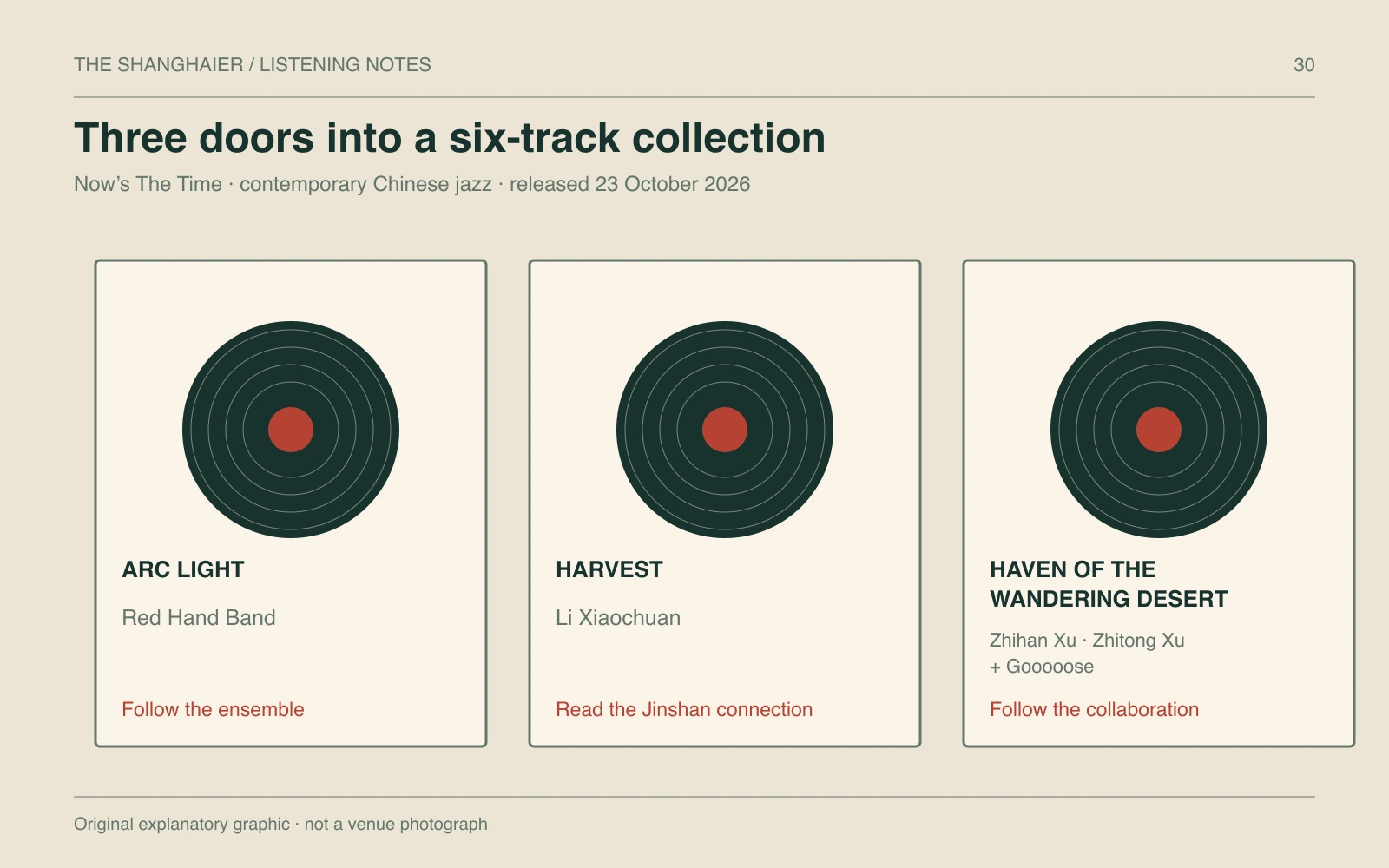
First door: Arc Light
Begin with the opening track, Red Hand Band’s Arc Light, and keep the composer and performing group distinct in your notes. An opening piece has a structural job in a compilation: it is the first sustained musical proposition the listener encounters. Hear it once before reading the rest of the promotional explanation. Let a phrase or an ensemble interaction give you your first reference point.
On another pass, ask which element makes the group cohere. Follow the pulse, then the movement of the leading line against it. If improvisation is unfamiliar, do not try to identify every harmonic choice. Notice how the sense of direction develops and whether a return changes your understanding of something heard earlier. These are listening questions you can test for yourself, rather than adjectives borrowed from a press announcement.
Second door: Harvest
Li Xiaochuan’s Harvest gives another entry point. The release notes connect the piece to Jinshan’s folk arts, a Shanghai regional connection worth keeping specific. That is an invitation to ask how a stated inspiration enters musical work, not permission to identify every gesture as a direct transcription of a local tradition. The composer’s account and the listener’s impression should remain distinguishable.
Listen first without trying to picture a landscape or illustration. Then reread the contextual note and hear whether it changes the details you attend to. A title can guide attention strongly; the second listen helps you recognise that influence. You do not have to hear exactly what the programme suggests to take the connection seriously. Music can respond to another art without becoming a literal audio caption for it.
Third door: Haven of the Wandering Desert
The collaboration between Zhihan Xu, Zhitong Xu and Gooooose offers a different set of names and working relationships to follow. Read all three credits. When musicians associated with different practices work together, the useful result is not necessarily a neat division between “jazz” and “electronic” parts. Listen for how the piece organises time and attention before assigning those borders.
Compare this piece with one of Gooooose’s credited releases outside the compilation. Do not expect identical material. A collaboration can create conditions that differ from a solo project, and hearing the difference is a reason to follow both. The relevant question is what the shared work makes possible, not whether one contributor can be heard winning a stylistic contest.
Hear the remaining pieces on their own terms
Do not let three suggested doors become a substitute for hearing the whole six-track collection. Follow the sequence, then return to the piece that made you most curious. A quieter gesture can disappear after a more immediately assertive track on a distracted first listen. Give the album at least one stretch of attention that is not spent navigating, translating a menu or answering messages.
Keep a small note of the ensemble format and the credited players for each selection. This makes it easier to find another recording without treating a leader’s name as the sole author of everything audible. If a particular instrument or pairing interests you, that can become the route into another release. You do not need a comprehensive jazz vocabulary to make a precise next choice.
A label does not settle the identity question
The Blue Note name gives the project an internationally recognisable frame. It does not remove the need to hear the work, and it should not be treated as permission to decide in advance what Chinese jazz must become. Musicians can use a shared musical language while making individual decisions about repertoire, improvisation, collaboration and form. A national category is useful for discovery but too large to be a musical description.
I would resist two equally limiting expectations: that a piece must announce a recognisable Chinese reference to belong here, or that international recognition makes those references unnecessary. The individual work is the right scale for judgement. Ask what a piece does, how its players work together and whether you want to hear it again. Identity can be part of that discussion without becoming its compulsory answer.
From the record to a Shanghai evening
Once a name catches your attention, search the musician’s current announcements and the venue’s actual programme. JZ’s current ticket inventory is one practical place to look for a changing Shanghai jazz bill, but the compilation is not a promise that any contributor will appear there during your trip. Check the performer, format, date and address as a new decision.
A live set may use another group or repertoire. That is a reason to read the bill, not a disappointment to pre-empt. The record has introduced work and collaborators; the performance can introduce another stage of it. Choose the evening because the actual programme interests you, rather than trying to recreate an album in the room where you happen to have a reservation.
Let the present tense stay present
Shanghai has good reasons to preserve older musical memories. It also has musicians who should not have to arrive dressed as history to earn a visitor’s attention. A new anthology is a compact way to make space for that fact. You can enjoy the Peace Hotel’s particular proposition and still spend another hour with people making different work now.
My recommendation is one full listen followed by one deliberate return. Choose the piece you want to hear again, save its full credits and follow a musician beyond the compilation. That modest act produces more useful knowledge than a claim to have discovered the sound of modern China. The collection offers several directions; the value is in taking one far enough for it to become your own informed choice.