Publication details
First published . Series dates place related notes together in the reading archive.
Keep the names, lose the assumption
Yuyintang’s 6 October 2026 operator statement makes one correction particularly useful: the former music-park venue at 1398 Yuyuan Road stopped operating on 1 September after its lease expired. The operator says the subsequent business at that address is not affiliated with Yuyintang. Keep that old location separate from the current Yuyintown halls; a familiar name in a directory can otherwise send you to the wrong evening.
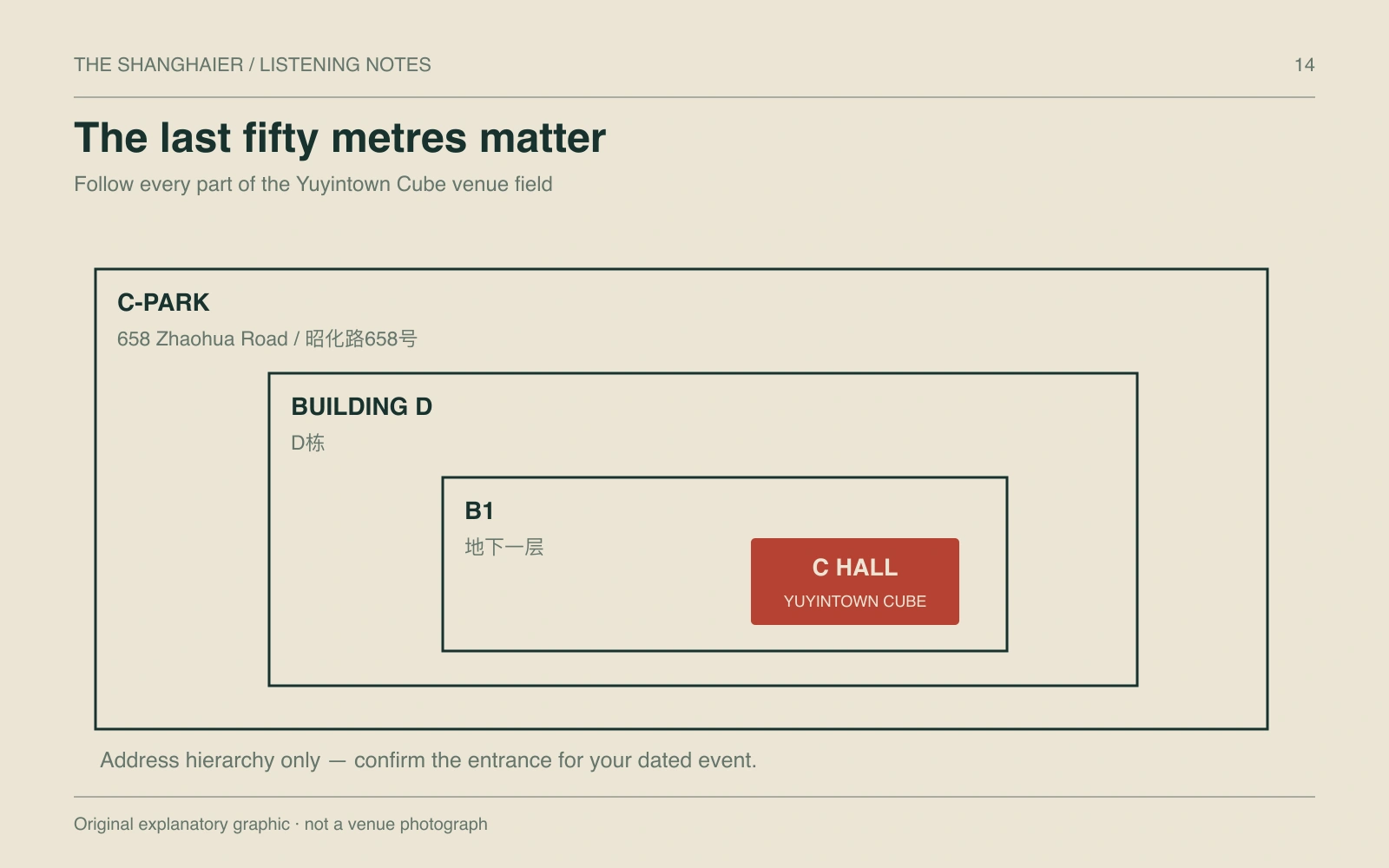
The current ticket inventory checked for this note identifies 育音堂小镇C厅 YUYINTOWN CUBE at C-Park, Building D, B1, 658 Zhaohua Road: 昭化路658号CPARK D栋地下一层. October and November 2026 dates are attached to that listing. Save the whole address with the C Hall label. If your event names B Hall or another space, verify that room on its own listing.
Let the artist choose the night
A livehouse is a container for different sorts of music. The strongest reason to go is an actual bill you want to hear, not a general obligation to see a famous name in the scene. Listen through the artist’s or label’s authorised page, then look at the date, city and supporting acts. A national tour poster can put Shanghai among many stops; choose the right one before payment.
For a first visit, be honest about your preferences. A standing rock show, a quieter songwriter set and an experimental performance can ask for different kinds of attention and stamina. “Independent” does not promise a uniform sound or a particular level of intimacy. A very unfamiliar act can make a good evening when you have made a conscious choice to hear it rather than expected a familiar bar soundtrack.
The support act is part of the ticket
Arrive with the intention of hearing the first performer. Supporting sets can give you a more local point of entry than the name at the top of a touring poster. They also affect the evening’s shape: a short set can establish one mood, then leave you to hear the headliner in relation to it. Skipping everything except a presumed headline time discards some of what you bought.
If the bill lists several acts, check whether published times are doors, first performance or an estimated running order. Do not construct a precise arrival from a guessed set length. Delays and changes happen, but “live music runs late” is a poor reason to arrive after the start. An organiser’s specific information is more useful than a traveller’s general theory about how gigs work.
Save a compact entrance packet
Before travelling, keep the event name, date, hall, Chinese address and admission instructions together offline. Include the order reference in the official ticket account, while keeping personal information private. A screenshot of a poster can help you ask directions; it may not be a valid ticket. Check whether entry requires an app, a dynamic code, an identity check or box-office collection.
At C-Park, follow current signage to the exact room. A map pin may stop at the development’s street edge. Read letters and floor information, and ask staff for the artist’s show rather than walking through any open door. This is a useful habit in Shanghai generally: the final fifty metres through a large complex can contain more ambiguity than the preceding cross-city journey.
What matters inside a livehouse
Choose a position where you can hear comfortably and see enough to stay engaged. The front is not automatically the best place for every listener. Leave routes clear and make space for people moving through. If you need a seat or step-free access, arrange that with the organiser before buying. A small venue’s reputation for friendliness is not a substitute for a specific physical arrangement.
Use hearing protection when appropriate and respect the performer’s photography rules. A phone held overhead can block several people’s view in a compact room. I would rather keep one brief image and hear a whole song without the screen. The experience you came for involves the sound in that room, not only evidence that you occupied it.
Do not confuse scene loyalty with visitor entitlement
An independent venue does not owe a visitor backstage access, an introduction to the band or an impromptu interview. Buy a ticket, pay attention and support merchandise if something interests you. Ask before photographing a table, a person or a private working area. The most ordinary forms of consideration are also the most useful way to participate in a room where people may know each other well.
If you want to speak to a musician, choose an appropriate public moment and accept that the answer may be brief or that they may be busy. A short conversation is a possibility, not an itinerary inclusion. The same applies to requests for English help: ask clearly, keep the event information visible and give staff time. Preparation reduces the amount of translation you need during a queue.
Leave with a name you want to follow
Afterwards, save the artist’s official page or buy a release through an authorised channel. This is where a single gig can become an ongoing relationship with a city’s music without requiring a fictional insider connection. A band’s next show might be at another room; a support act might become the main reason for returning. Follow the work rather than collecting venue names.
For the immediate journey home, check the last useful train or arrange a sensible pickup point in advance. Keep enough battery for tickets and transport. My preferred result is simple: you reach the right hall in time for the first set, hear something you want to hear again, and leave without the avoidable confusion created by an old address. That is more valuable than calling any night a secret Shanghai experience.