Publication details
First published . Series dates place related notes together in the reading archive.
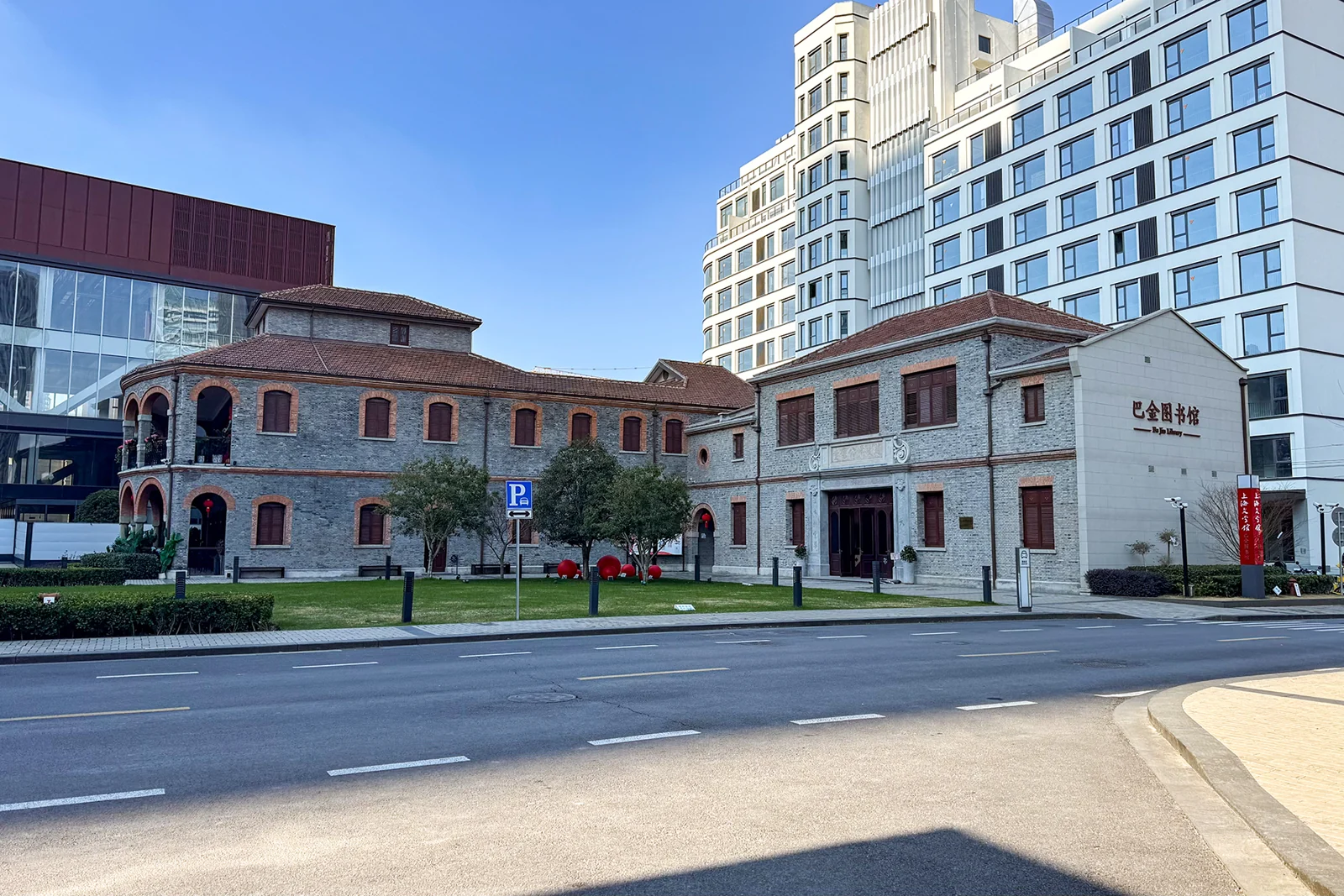

A new museum, not Ba Jin’s Wukang Road house
Shanghai Literature Museum opened fully on 27 August 2026. The date matters if you are comparing older guides: the Ba Jin Library opened earlier as a forerunner, while the complete institution is a newer visit. This is not Ba Jin's Wukang Road home. The latest district notice explicitly says that the former residence remains closed for repairs. I would choose the open museum for a substantial literary visit rather than send you across town hoping to enter a closed house.
The official entrances are 418 North Jiangxi Road and 455 Wujin Road, both in Hongkou. Save 上海文学馆 with 上海市虹口区江西北路418号 or 上海市虹口区武进路455号. The September 2026 district guide gives free admission without reservation, 9:30–17:30, last entry 17:00, and Monday closure except public holidays. Those are straightforward arrangements. I would still check the current notice for an event day, but there is no need to invent a complicated ticketing ritual where the institution advertises open access.
The buildings make a claim about public literature
The museum combines three historically protected buildings with a new building. The Ba Jin Library occupies the Zhao Qifeng Memorial Hall and Yihong Garden parts of the complex. I would look at how the visitor moves between old and new before beginning an exhaustive reading of exhibition labels. A literary museum is making an architectural claim: writing belongs in the public city, with spaces for display, study and encounter as well as an author's private room.
That makes this a better fit for some visitors than a house museum. A former home anchors you in one person's life and a particular period. A literature museum can compare writers, forms and networks. Neither is inherently more authentic. If you are interested in literary Shanghai but have not read many Chinese novels, I would start here for a structure, then choose an author and a neighbourhood to follow. An introduction becomes valuable when it helps you make that next choice.
Five subjects are more useful than a parade of portraits
The permanent display is organized around five areas: Time Shanghai, Left-wing Shanghai, Urban Shanghai, Screen Shanghai and World Shanghai. The categories allow literature to appear as several kinds of activity. Writing participates in political and artistic movements, describes urban life, crosses into performance and film, and moves between languages. You do not need to recognize every author to ask a productive question about one of those activities. A familiar interest is a reasonable way into an unfamiliar subject.
I would choose two areas for close attention. If you love cinema, begin with adaptation. If modern politics interests you, examine publishing and literary networks. If you read translated fiction, follow the exchange between languages. The point is to give the exhibits something to answer. A rapid circuit can show you that Shanghai has a long literary history; a selective visit can reveal one of the processes that made it possible. I think the latter is more likely to stay with you.
A manuscript and a printed edition do different jobs
The gallery accounts identify manuscripts, books, historical images and personal objects. Read the captions for whether you are seeing an original, a later edition or a reproduction. A manuscript offers evidence of drafting and revision. A printed book shows a text made public in a particular format. A reproduction makes material accessible without being the original object. Those distinctions are part of what makes a literary collection interesting. They show writing passing through different kinds of work and custody.
Choose a page and look at its scale, arrangement and relationship to the finished publication. Even if you cannot read the whole text, the format can be legible. Then ask what the museum is using it to explain: an author's process, a publisher, a readership or the later reputation of a work. I find literature more compelling when the physical book is allowed to be as important as the name on its cover. Someone had to make that object available to a reader.
Screen Shanghai can connect books with something you already love
The Screen Shanghai area examines exchanges between literature, theatre and cinema. This is where I would steer a visitor who feels intimidated by rooms full of unread novels. Adaptation is a concrete problem: words become bodies, voices, sets, images and cuts. Look at what the display pairs together—a work, a poster, a still or a stage image—and ask which part of the story each medium can make immediate. You can begin that comparison without arriving as a specialist.
My interest is in what changes, rather than simply whether a film is faithful. A page can withhold an image; a camera may have to supply one. A performer can make a pause meaningful without a narrator explaining it. If a work catches your attention, note the title and read a short passage later. That creates a more substantial connection than recognizing a famous face in a poster. The museum does not need to finish the subject; it can make a good next encounter possible.
Leave time to use a reading room
The Ba Jin Library includes magazine and Shanghai-literature reading spaces. The museum also offers Hai Shang Shu Fang and a children's picture-book area. I would save time for one of these settings. Literary culture is not only a sequence of important first editions. It is also the ordinary act of someone opening a book, staying with it and returning later. A reading room shows the institution continuing to work after the gallery has made its historical argument.
Pick up a periodical where access permits and examine its contributors, genres and sequencing. A magazine is a collective object: editors, writers and design decisions participate in the experience. Even a short look makes the idea of a literary scene more concrete than a row of portraits. If you cannot read Chinese, bring a translated passage or examine a book's format and illustrations. I would rather read three pages attentively than photograph three reading rooms without using any of them.
Translation is work, not a transparent window
World Shanghai addresses translation and literary exchange. As a Chinese American, I am interested in this because a city can be local without being closed. A translated book is not a foreign idea arriving unchanged. Someone chooses it, finds a language for it, publishes it and makes a case for its readers. That work can reshape a conversation on both sides of the exchange. Look for which part of the process the displayed objects actually establish.
I would use this section to ask which Shanghai is available in English and which requires more effort to find. Which writers are translated often? What do a title, cover and introduction suggest about the audience a translation expects? You need not answer every question during the visit. Let the exhibits supply names, then choose one book instead of assuming the best-known international title can represent the whole city. Translation should multiply the possibilities for reading, not close the subject down.
Take one question into the neighbourhood
Allow two hours or longer if the reading spaces hold you. Afterwards, I would walk nearby with one question: how does a network of writers become a neighbourhood story? Publishing, meeting, reading and living do not happen in the same kinds of space. The museum helps distinguish those functions; an actual street reminds you that they occupied an ordinary working city. Use documented addresses and public routes. A writer's former home is not automatically an accessible museum interior.
If Ba Jin is your main interest, stay with the library and his books today rather than forcing the closed Wukang house into the programme. Its exterior can be a separate, clearly labelled street stop. My choice would be a half-day that leaves you with a short reading list and one fresh way to look at Hongkou. The most persuasive literary journey shows exactly where a writer, a text and a place begin making one another more interesting. It does not need to keep declaring that every street has stories.