Publication details
First published . Series dates place related notes together in the reading archive.
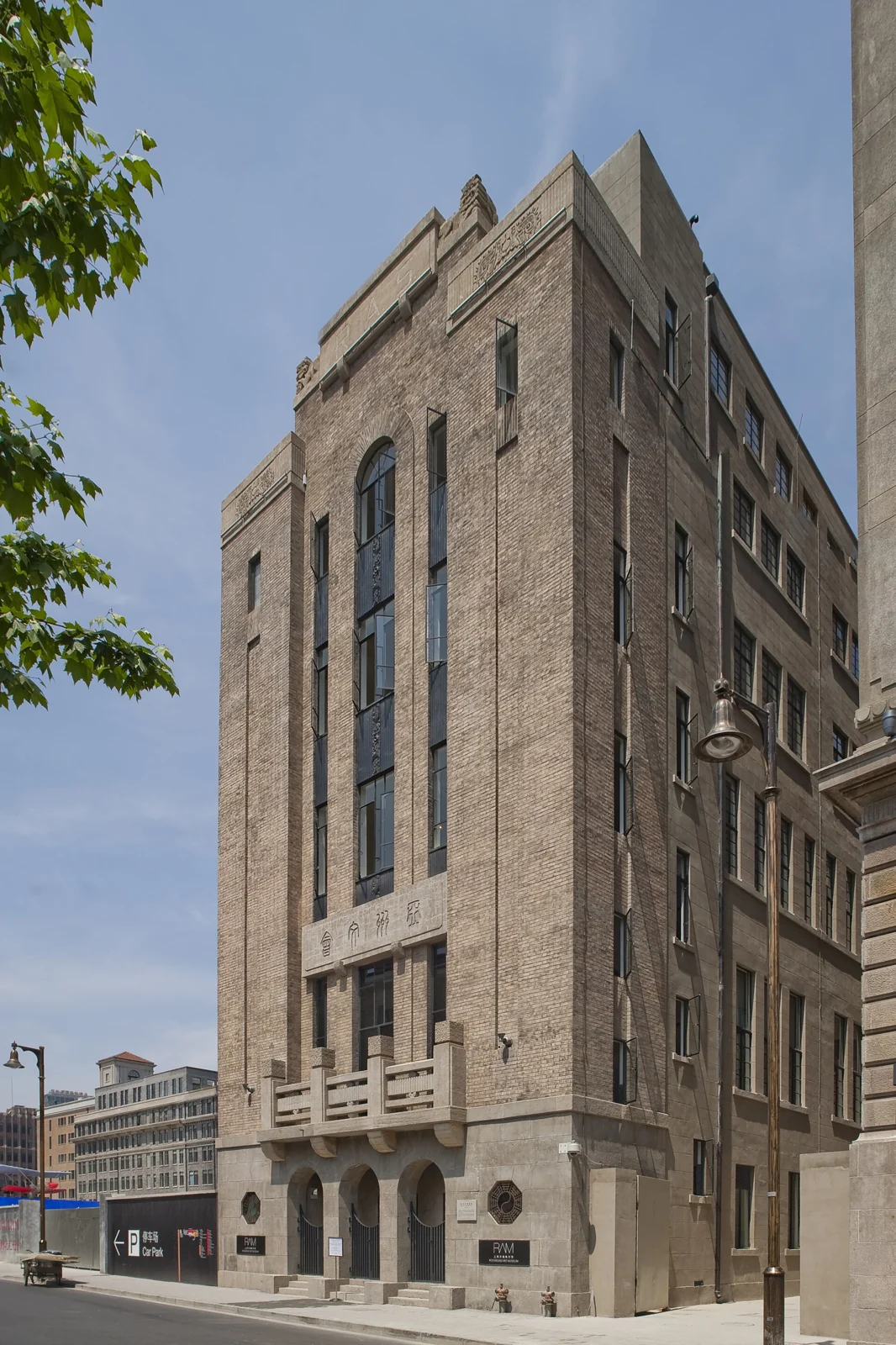

Enter from the plaza, not the street image
The address is 20 Huqiu Road, Huangpu District, 上海市黄浦区虎丘路20号. The museum’s visitor page places the main entrance at Museum Plaza, just east of Huqiu Road. I would save that detail along with the address, because a historic facade and a working entrance are not always the same thing. Metro Lines 2 and 10 to East Nanjing Road, Exit 6, put you about a ten-minute walk away according to the museum. It is a practical detour from the northern Bund, rather than a separate cross-city expedition.
Public opening is Wednesday–Sunday 11:00–18:00, last admission 17:30. Tuesday 12:00–18:00 is a members’ day. I would not recommend Tuesday to an ordinary visitor simply because another museum has Monday closure. The distinctions sound small until you arrive at a closed door. Rockbund’s current hours also supersede older city articles advertising later evening access. This is a place where using the institution’s visitor page makes the plan substantially better.
The collection behind the old building was not today’s programme
Rockbund’s institutional history traces the Royal Asiatic Society’s permanent premises here to 1874, with a library, lecture hall and museum. The present Art Deco building was designed by George L. Wilson and dates from 1932 in the museum’s own account. David Chipperfield’s practice was commissioned for its renovation in 2007, and Rockbund opened as a contemporary-art institution in 2010. Those are different moments in the same address, not one unbroken institution displaying the same kinds of things.
I find that distinction productive. A historical natural-history and cultural collection proposed ways to categorise a place and its people. A contemporary-art museum can ask who gets to describe a place now. That does not mean every exhibition explicitly argues with the building’s past. It means the setting gives a visitor another question to carry. I would be wary of treating the Royal Asiatic Society history as simply a charming origin story, or of assuming the current institution automatically speaks with the same voice.
Art Deco is a way of organising attention
From the outside, I would look at the facade’s vertical organisation, its window rhythm and the way ornament is concentrated. Try following the building from pavement level to the top before reaching for a style label. The label Art Deco can become so broad that it stops helping you see. Here the useful exercise is to identify where a strong overall order is interrupted by a more particular detail. A museum building can be recognisable without spreading decoration equally over every surface.
Inside, I would compare that public image with the rooms’ current use. Renovation has to make a historical structure usable for art, circulation and contemporary services. A restrained interior is a decision about the encounter between building and work, not the absence of design. What interests me is whether you continue to sense the old structure as you move through, or whether a room temporarily allows an artwork to establish a different world. Both can be valuable; they produce different kinds of attention.
Do not ask for a permanent greatest-hits room
Rockbund’s value is its exhibition-making, research and commissioned practice, rather than a predictable circuit of familiar collection highlights. I would arrive willing to spend time with someone whose name means nothing to me yet. That is a different proposition from visiting Shanghai Museum East for a broad introduction to Chinese historical objects. Neither needs to be ranked above the other. They answer different kinds of curiosity, and a good Shanghai itinerary should make that difference clear.
A smaller footprint does not necessarily mean a quicker encounter. A film, a performance-related work or a single sustained installation can require more time than a room of paintings. I would ask about the exhibition’s structure at the desk, then decide where to give my attention. Looking at one work properly can be more useful than passing every floor without forming a response. A museum visit is not improved by translating its entire floor plan into a personal obligation.
Free admission changes the bargain
The museum made its exhibitions free from May 2, 2025. Its current rules allow walk-in entry Wednesday–Friday without a reservation. On weekends and public holidays, visitors can book a time slot through the 上海外滩美术馆 WeChat mini-programme for priority entry or join the on-site queue. That is more flexible than an old description of compulsory paid tickets. I would use a weekend reservation if timing mattered, but I would not tell a weekday visitor they must solve a booking system before trying the museum.
What interests me is how free entry changes the expectation of a visit. You can leave with a question instead of needing to declare that a ticket was worth its price. You can also return. Those are substantial cultural possibilities, especially for people who are not already confident around contemporary art. I still think the museum owes you clarity and care; free admission does not make every curatorial choice exempt from judgement. It simply removes one reason to demand that an unfamiliar work reward you immediately.
Time can become a subject of value
The free-admission decision was introduced alongside Irena Haiduk’s Nula Economy, an institutional experiment around participation, attention, repeated action and generosity. The museum distinguishes it from a conventional exhibition. I would understand that as a question about what counts as value in a cultural space, rather than reduce it to a clever alternative currency. Money is not the only thing a visitor brings; time, effort and the willingness to participate are also unevenly distributed resources.
My response would be to ask what participation actually requires on the day. Is it an action, a conversation, a return visit or a way of attending to another person? You should be able to decide whether and how you want to take part. A museum can invite without making your presence feel like an unpaid performance of enthusiasm. That is where I think the experiment becomes interesting: in the actual encounter between an institution’s proposition and the freedom of the people who enter it.
A method for unfamiliar work
I would begin with three concrete questions. What is here? What does it ask me to do? What changes if I give it more time? Materials, duration and position are often more helpful than an abstract theme at the beginning. If a work uses a recording, find out how long it runs. If it rearranges a familiar object, look for the consequence of that rearrangement. If it uses a document, ask who made the original and what the artist has changed about its context.
Then read the label and see whether it sharpens the encounter. You are allowed to find a work persuasive, evasive, funny or disappointing. The point is to support the opinion with something you can name. I would rather hear that a sound work makes you aware of a particular distance than that an exhibition was immersive. Precise responses keep the conversation open. Generic praise closes it almost as effectively as a refusal to look.
Take the question back into Waitanyuan
Allow roughly ninety minutes to two hours, with more time for a programme that includes long-duration work. Afterwards, I would walk the surrounding Waitanyuan streets and compare the museum with the neighbouring commercial uses of heritage buildings. A restored facade can hold a shop, an office, hospitality or an arts institution. The differences appear in access, signage and what you are invited to do once inside. The whole block becomes more legible when you ask about use as well as architectural period.
This pairs naturally with a northern Bund walk, where you can move from a specific contemporary question to the city’s broader trading-port landscape. I would avoid turning the museum into a weather shelter visited only if the river is unpleasant. It deserves an intentional hour. Equally, I would not insist everyone spend a whole day here. Rockbund is strongest as a concentrated encounter: one building with a particular history, one current programme and enough room in the schedule for you to develop an opinion of your own.