Publication details
First published . Series dates place related notes together in the reading archive.
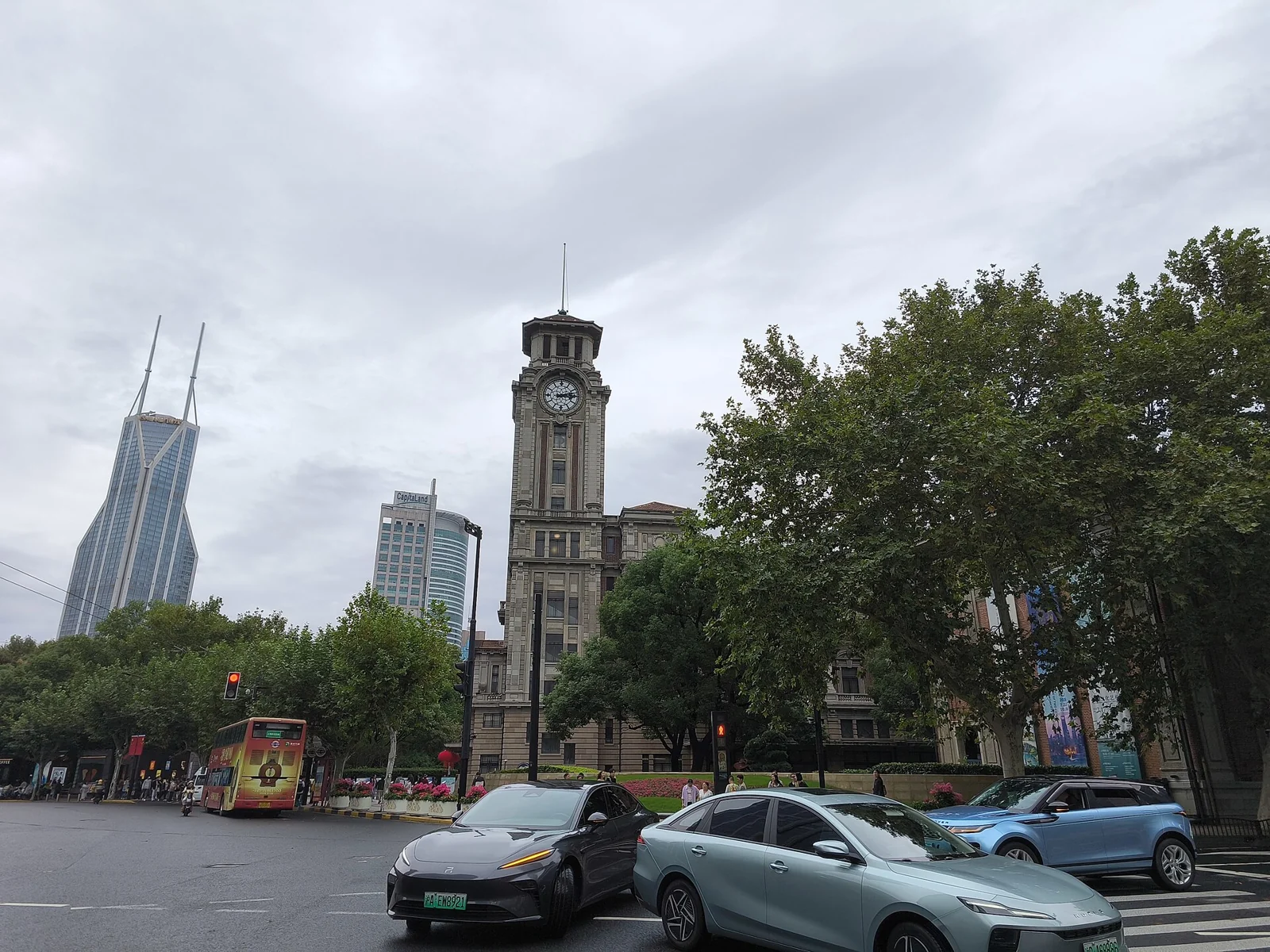

First, make sure you have the right museum
Shanghai History Museum is at 325 West Nanjing Road, on the edge of People's Square. It is different from Shanghai Museum, whose collections focus on Chinese art and which has both People's Square and Pudong branches. Names that look interchangeable on a phone screen lead to very different afternoons. Here I would come for urban history: the development of a place, its institutions, its commerce and its political struggles.
The Chinese name to show a driver is 上海市历史博物馆, with 上海市黄浦区南京西路325号 underneath. The museum is also called Shanghai Revolution History Museum. That second name matters: revolutionary history is part of its stated subject, rather than an incidental room at the end. Go expecting a civic account of Shanghai, with an institutional point of view, and read the display as deliberately as you would read a history book.
The former Race Club is already an exhibit
Before looking at a case, look at what sort of building you have entered. This was the Shanghai Race Club building. Its relationship to the former racecourse, now the People's Square and People's Park area, makes the address itself historical evidence. A museum about urban change is occupying a building whose purpose and audience have changed. For me, that is a stronger opening than another panoramic skyline photograph.
The useful question is who this architecture originally expected to welcome. A club establishes an inside and an outside, with controlled entrances, shared rooms and an idea of membership. A public museum reuses that structure for a much broader audience. You do not need to romanticize the earlier institution to appreciate its surviving design. In fact, I think the building becomes more interesting once elegance and exclusion are allowed into the same discussion.
Give the staircase a proper look
A small detail carries the earlier use particularly well: the iron staircase balustrades include horse-head forms. Look for how the curved ironwork gathers into an animal profile, then follow the repetition along the stair. This is decoration doing a specific job. It gives a circulation space the identity of the club, even when the visitor is simply moving between floors. The building quietly tells you what mattered to its original users.
I like this sort of detail because it brings architectural history down to a manageable scale. You can compare the repeated motif with the larger rhythm of doors, windows and landings. Does the handrail make movement feel ceremonial, efficient or intimate? There is no single correct adjective to collect. The point is to notice that a staircase has been designed, then carry that habit back to the hotel, bank or apartment entrance you pass later.
The bronze lions connect this room to the Bund
The former HSBC bronze lions are among the museum's important objects. They create a useful bridge between a museum visit and a Bund walk: a monumental financial frontage becomes something whose materials, scale and changing custody can be examined more closely. I would look at the modeled surface and the physical presence before reaching for symbolism. A bank chose substantial guardian animals for a reason; the effect is partly bodily, not just heraldic.
It is also worth distinguishing an original object in a museum from a version encountered at an architectural site. Those are different experiences, with different claims to context. On the street, a sculpture participates in an entrance and a public image. In a gallery, it acquires labels, conservation conditions and comparison with other artifacts. Neither setting is automatically more truthful. Together they make you ask what has been retained, moved, copied or reframed.
Do not rush past the ceremonial sedan chair
The elaborate Republican-era ceremonial sedan chair offers a different account of wealth from the bank lions. Here the visual argument is concentrated in carving, ornament and the performance of an important occasion. Let your eye settle on a small area before trying to take in the whole. Repetition can make a richly worked object dissolve into a general impression of gold and intricacy; selecting one figure or border gives you a way back in.
My interest would be in the work as much as the ceremony. What did it take to make an object that announced status through such dense detail? How did a public occasion create demand for specialist craft? These questions keep social history attached to a beautiful object. I would rather leave able to explain one relationship between skill and display than remember a superlative about how magnificent the chair is supposed to be.
Follow the chronology without surrendering to it
The basic displays move through ancient and modern Shanghai, with the ancient material on the second floor and modern history above. That order is useful if your mental picture starts with treaty-port buildings and jumps straight to Pudong. It makes room for a much longer regional history. Give the earlier galleries enough attention to challenge the idea that Shanghai appeared fully formed when foreign banks began building grand facades.
At the same time, chronology should support the visit rather than dictate your reading speed. I would choose one earlier object, one object connected to trade or urban institutions, and one piece of political history. Ask how the scale changes between them: household, city, state, international network. You can learn a surprising amount by following that shift. Reading every label with the same intensity can leave you tired without making the relationships any clearer.
Read the museum's argument, including its emphasis
A city museum has to choose a narrative. This one explicitly joins local history with revolutionary history. Notice the transitions: which developments receive a room, which are compressed into a panel, and which objects are asked to stand for a much larger event? I think this is part of the pleasure of historical museums. You are examining evidence and also watching an institution decide how that evidence should be arranged.
That need not become a suspicious exercise in rejecting every label. It is a more attentive way to use them. Separate the date attached to an artifact from the interpretation built around it. A clear question helps: how did Shanghai's urban life make political organization possible? Or how did commercial prosperity distribute power and visibility? Choose the question that interests you, then take it to a smaller house museum where the national story contracts into a few rooms.
Make this a beginning, not a whole museum marathon
Allow about two hours for a selective first visit. The published normal schedule is Tuesday to Sunday, 9:00–17:00, with last admission at 16:00; Monday and public-holiday arrangements should be checked against the museum's current notice. I would avoid arriving at the last-entry time with the ambition of understanding the entire city. Pick a shorter route if time is limited, and be honest about what that route can cover.
Afterwards, walk through the People's Square area and look again at the relationship between large civic spaces and older buildings. If you want a second museum, the Urban Planning Exhibition Center makes an intelligent comparison, but I would separate them with a meal. One presents the city's past; the other sets out planning ambitions. Holding those two perspectives together is valuable. Trying to absorb both at full speed on the same empty stomach is less so.