Publication details
First published . Series dates place related notes together in the reading archive.
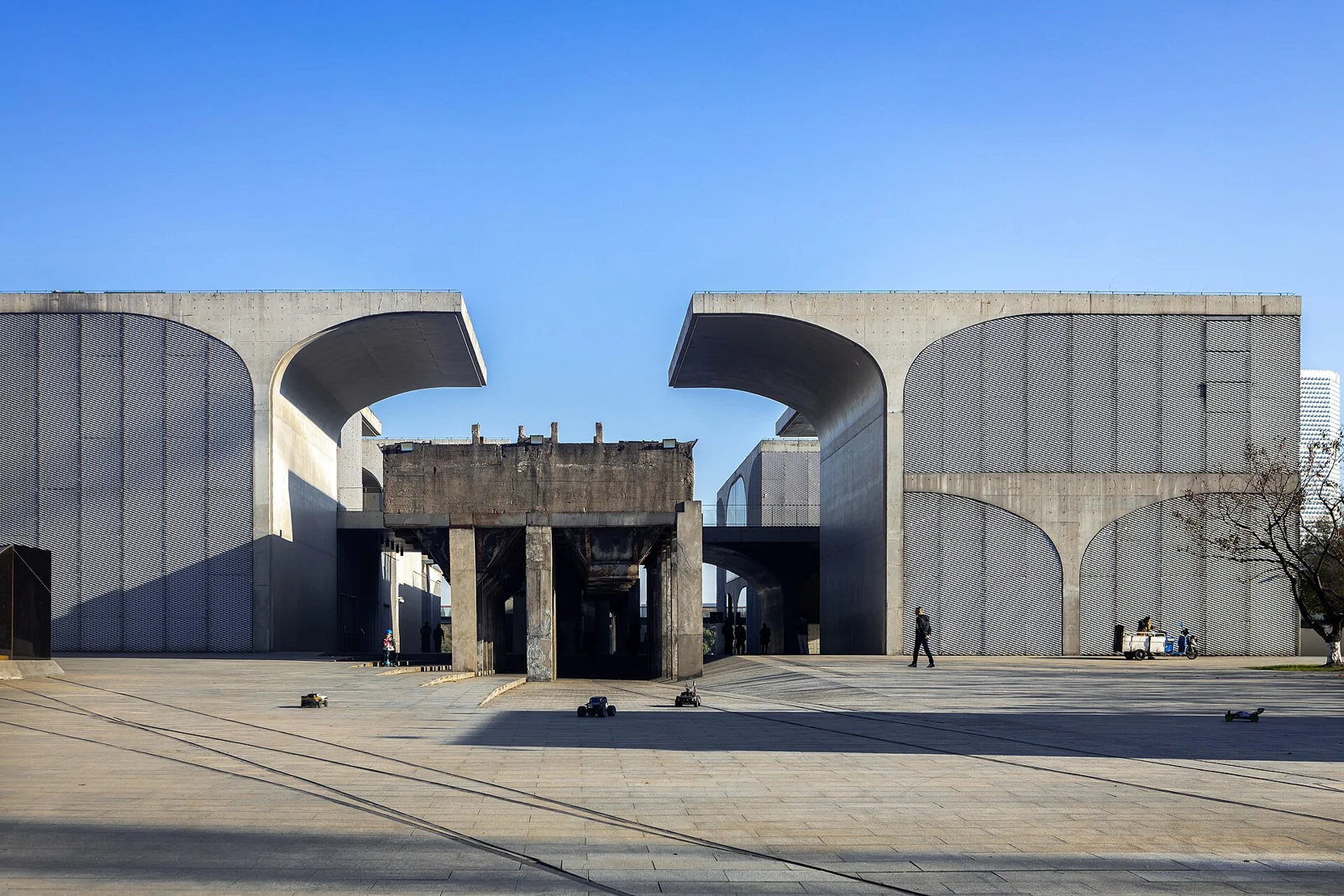

Three different things share the site
Long Museum West Bund stands at 3398 Longteng Avenue in Xuhui, on the former Beipiao Wharf site. The museum opened in 2014 and was designed by Liu Yichun and the Shanghai practice Atelier Deshaus. Their project description begins with an existing 1950scoal-hopper unloading bridge and a more recent underground car park. That combination matters. This is neither a perfectly preserved factory nor a completely blank site supplied with a new cultural landmark. The design has to work with remains of different ages and purposes.
I would separate those layers while looking. The coal-handling remains belong to the port landscape. The underground structure constrained what could be built above and reused below. The museum’s concrete forms are a new architectural response, not industrial relics disguised as contemporary art. Once you can distinguish those three things, the site becomes easier to read. Calling all of it industrial style would erase the very differences that make the project interesting.
The coal hopper is useful evidence
The retained unloading bridge is approximately 110 metres long in the architects’ account. I would look at its repeated supports, its elevated body and the route it cuts across the site. It was built to handle material, not to frame a cultural promenade. That difference between original function and present experience is worth holding onto. An industrial remnant can be visually compelling without having been intended as sculpture, and it can remain historically meaningful after its work has stopped.
My preference is to see some ground around it. A tight image of a weathered surface tells you very little about what the structure did. Its height, length and relationship to routes are the more useful clues. You can then compare how the new museum responds: where it sits apart, where it echoes a heavy overhead form and where it opens a different passage. The strongest reading is in the relationship, rather than a hunt for one old detail to prove the development has heritage.
Why the vault-umbrella form matters
Atelier Deshaus describes the principal structure as vault-umbrellas: curving concrete elements that combine wall and roof. I would follow one of them from its vertical support into the overhead surface. That continuity makes it harder to see the building as a conventional box to which a dramatic ceiling has been added. The structural idea participates in how a room is formed. Look for places where one curve ends and another begins, and for the narrow light gaps between elements.
I find those transitions more persuasive than a general claim that exposed concrete is beautiful. Concrete can be dull, oppressive, finely controlled or unexpectedly light depending on its form and what is placed beside it. Here the interest lies in the tension between mass and a canopy-like gesture. Stand at a point where you can see two orientations at once. The building can begin to feel less like a row of rooms than a set of intersecting possibilities for moving and looking.
Daylight is part of the arrangement
The museum’s concrete architecture changes the background against which art is seen. A curved wall, an overhead gap and a long view can create a visual emphasis before a curator places a work in the room. I would notice that relationship without assuming the building always improves the exhibition. Some works gain force from a strong spatial setting. Others may compete with it. The useful question is whether the architecture allows the work to establish its own scale or insists on being the most important thing in every view.
Try comparing an artwork from two positions: one where the room’s curve dominates your sightline and one where it recedes. Does the work become clearer, smaller, more isolated or more theatrical? That is an opinion you can support with what you see. I prefer that kind of judgement to declaring that every gallery is either an ideal neutral container or a distracting architectural ego. The relationship changes with the installation, and the same room can behave differently in another exhibition.
A private collection is a set of decisions
Liu Yiqian and Wang Wei founded the Long Museum. Its stated collection strands include traditional Chinese art, modern Chinese art, works often grouped as Red Classics, and Chinese and international contemporary art. Those are collecting areas, not a guaranteed daily checklist. I would avoid arriving with an image of one expensive painting and assuming it must be present. A collection’s reputation and the selection available during a particular visit are different things.
What interests me about a private museum is how individual taste becomes a public arrangement. Which works receive space? Which historical periods appear alongside one another? Does a sequence encourage continuity, comparison or a sharp break? You do not need to know auction prices to ask those questions. In fact, leaving prices out of the first encounter usually helps. A work can be important to a market and still require its own visual argument in a room. The museum is where that argument becomes available to a visitor.
If you are interested in political imagery
The collection’s Red Classics strand gives a possible way into the relationship between art and modern Chinese public history when relevant works are exhibited. I would look closely at the organisation of bodies, labour, landscape and the implied audience. A heroic figure can be made through scale, viewpoint and lighting as much as through an identifying caption. A crowd can be differentiated into individuals or fused into one collective direction. Those decisions are visible even before you settle the historical context.
I would then use dates and the label to distinguish an event from its later representation. Commemoration is an action in its own time. A painting made decades after a political turning point may tell you as much about later memory as about the event depicted. That does not make it worthless as history; it changes the historical question. I prefer an account that can hold artistic decisions and political purpose together, rather than deciding that one cancels the other out.
The practical visit has seasonal hours
The destination is Long Museum West Bund, 上海龙美术馆(西岸馆), 上海市徐汇区龙腾大道3398号. The city’s 2026 museum directory gives summer hours from April 1 to October 31: Tuesday–Thursday 10:00–18:00 and Friday–Sunday 10:00–21:00, with last entry one hour before closing. Winter hours from November 1 to March 31 end at 17:30 Tuesday–Thursday and 20:00 Friday–Sunday. Monday is the normal closure day except holidays. The tourism authority repeated the summer schedule in a September 2026 walking-route notice.
This is a ticketed museum, with the exhibition programme determining the offer. I would use the institution’s 龙美术馆 WeChat account or contact the venue at 021-64227636 for the current exhibition ticket rather than repeat a price attached to an old programme. The concrete exterior and riverside setting can be considered separately from paid gallery entry. That distinction is useful if architecture is your principal interest.
Make the riverfront the second chapter
For a selective museum-and-architecture visit, I would allow around two to three hours and keep time for the public riverside route. From outside, the building’s mass and the retained coal structure can be seen in relation to people moving through the site. That is where an architectural argument becomes an urban one. A museum can collect visitors within paid galleries while the surrounding area serves a much wider public. I find that coexistence more interesting than treating the entire waterfront as an extended museum lobby.
West Bund Museum is another institution at 2600 Longteng Avenue; the similar names are not evidence that they share tickets or a collection. If we combine them, I would plan the route around one exhibition you actually want and an architectural comparison, rather than two complete museum circuits. Long’s interlocking concrete vaults make a strong counterpart to West Bund Museum’s separate gallery volumes. One looks for continuity through a structural field; the other organises a central point and several directions. That is enough for a thoughtful day without adding every museum along the water.