Publication details
First published . Series dates place related notes together in the reading archive.
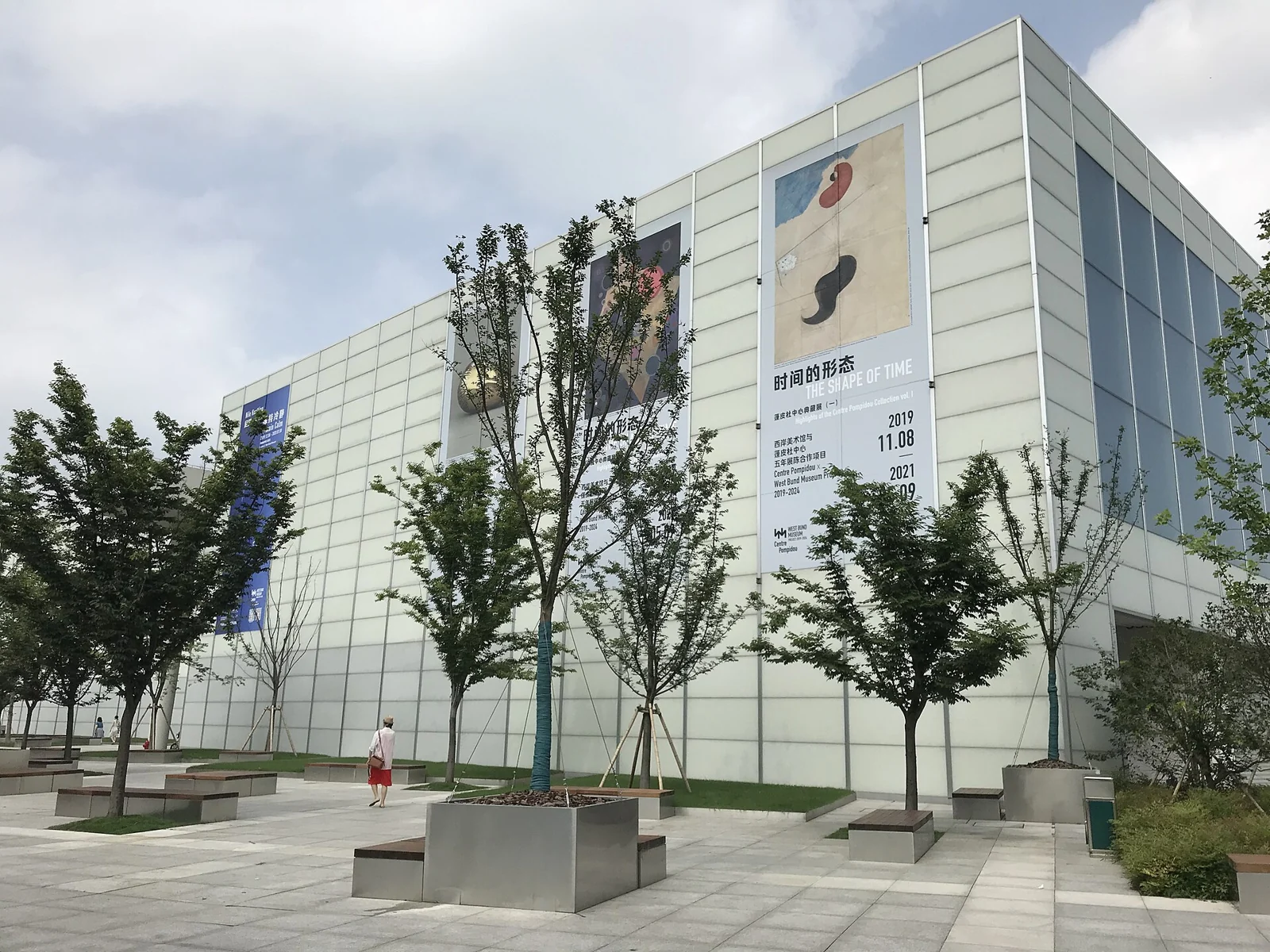

First distinguish three similar names
West Bund Museum is at 2600 Longteng Avenue, Xuhui District, 上海市徐汇区龙腾大道2600号. It is not the Long Museum West Bund at 3398 Longteng Avenue and not the West Bund Art Center used for fairs and events. Those names frequently appear together in art itineraries, but they do not share one entrance, ticket or permanent programme. I would pick the actual exhibition you want before allowing the general idea of a museum mile to organise the day.
The museum is open Tuesday–Sunday 11:00–18:00, last admission 17:00. Monday closure includes public areas, restaurants and the bookshop, with holiday arrangements stated separately by the museum. Both Longteng Avenue and the riverside provide entrances. Metro Line 11 to Yunjin Road is the institution’s listed approach, followed by roughly ten minutes on foot. If I were already walking the water’s edge, I would arrive from the river and let that approach explain the plan.
The central lobby is a decision point
Chipperfield’s practice describes three gallery volumes arranged in a pinwheel around a central lobby. I would look for that organisation before becoming absorbed in the exhibition. The point is not to admire a diagram you cannot see; it is to notice how a person is offered different directions from a shared centre. A sequence of rooms makes you follow. A central space with several destinations asks you to choose, then lets you return and choose again.
My preference is for museum architecture that makes those decisions legible without excessive signs. The test is practical: can you understand where you have been and where another gallery might begin? A clear plan can give you freedom to look selectively. It can also make separate exhibitions feel deliberately different instead of blending them into one long corridor. I would use that freedom rather than assume every doorway must become part of a complete circuit.
Look at how light reaches different levels
The architect’s account identifies top-lit upper galleries and partially sunken lower spaces receiving light through high windows. Recycled-glass cladding gives the external volumes a translucent character, while the projecting canopies announce the entrances. I would compare those kinds of light instead of stopping at the familiar phrase minimalist building. Minimalism tells you very little about where a daylight source is located or what it allows an object and a visitor to do.
A useful exercise is to notice the moment you become aware of a room’s edge. Does the light pull your attention upwards, keep it on a wall or reveal a view beyond the work? For me, the best museum daylight does not simply make a room bright. It changes the relationship between close looking and orientation. You can concentrate on something small, then recover a sense of the larger building. That is a more demanding achievement than producing a uniformly photogenic interior.
The landscape exhibition has ended
A number of guides still describe Reinventing Landscape, the fourth Centre Pompidou collection presentation, as a standing reason to visit. That exhibition ended on October 18, 2026. The current programme lists Computer Worlds in Gallery 3, from September 24, 2026 to February 14, 2027. I would not travel expecting the previous landscape display to remain in Galleries 1 and 2. A named partnership can continue while its particular selection changes, and the familiar exhibition images online may belong to an earlier chapter.
The Centre Pompidou collaboration is important to the museum’s programme, but I would avoid describing the whole institution as a fixed small version of Paris. What matters on a visit is the actual works, curatorial question and room arrangement present in Shanghai. That is also a better basis for choosing a ticket. Buy access to the exhibition you intend to see rather than assuming a general institutional label tells you everything that is included.
Computer Worlds: the useful surprise is its long history
The museum presents Computer Worlds as a history of digital creation stretching over seventy-five years, through art, design, architecture, objects and archival material. Its announced selection includes Archigram’s 1964 Computer City, algorithmic works associated with artists such as Vera Molnar and Manfred Mohr, and Chinese contributions including Wan Yang, Lin Ke and Lu Yang. I would give the historical material real time. It can interrupt the idea that computers entered art only when software became easy for the general public to use.
My opinion is that the exhibition becomes most interesting when you distinguish a computer as a tool from a computer as an idea. A drawing of a connected city can imagine a technological social order without being a demonstration of the latest hardware. A rule-based image can make its procedure visible rather than hide it behind a seamless effect. Ask what the system permits, what it excludes and what a person has chosen before the machine begins. Those questions remain useful across very different generations of technology.
A pixel, a pattern and a material object
The programme moves through subjects including algorithmic form, pixels, digital craft, networks and intelligent data. I would compare a flat image with a designed or fabricated object. What has to change when a pattern becomes something that occupies space? Does the work make its underlying units obvious, or does it try to erase them? A pixel and a structural component are not the same thing, but both can make the relationship between a part and a whole visible.
That comparison also keeps digital art from becoming an argument conducted entirely through screen size. A small process diagram may reveal more than a large moving image. A physical object can expose a limit that a rendering hides: weight, support, texture or a decision about how to end a form. I would look for those consequences before accepting the claim that a work is innovative. Newness becomes much more interesting when you can say what has actually become possible, difficult or strange.
Put Chinese work into the conversation
The museum explicitly places Chinese artists within this international history. I would resist treating them as a separate local footnote appended to a Western technological timeline. The better question is how a particular work changes the conversation: through a different image culture, relationship to the internet, use of the body or treatment of identity. The title and materials can help establish the specific case. Nationality alone is not an explanation of what an artwork does.
I also prefer to keep the present AI debate open to the older material rather than let it consume everything. An earlier algorithmic work can be useful because its rules are constrained and unusually legible. A contemporary system may make much more spectacular output while making its own operations harder to grasp. That difference is worth arguing about. You do not have to decide whether machines can create in order to notice where a human choice sits, or how a work asks its audience to trust a system.
How I would make the afternoon work
Allow roughly two to three hours for a serious exhibition visit and a short architectural look. The museum’s official WeChat account and mini-programme provide ticketing and public-tour reservations. A reserved free public tour still requires the relevant day’s exhibition ticket; it is not a free replacement for admission. The museum asks participants to meet at the first-floor desk shortly before the tour. If you prefer to look at your own pace, I would spend that time with one sequence of works rather than rush to fit a scheduled talk.
Afterwards, take the riverside route as the second part of the visit. The raised esplanade and changing levels make the building’s relationship to the Huangpu visible in a way the gallery rooms cannot. If we pair West Bund Museum with Long Museum, I would use the contrast between separate volumes and continuous concrete forms as our architectural subject, then choose only one full exhibition. A day with two distinct ideas is more memorable than one with five museum names and little attention left for any of them.