Publication details
First published . Series dates place related notes together in the reading archive.
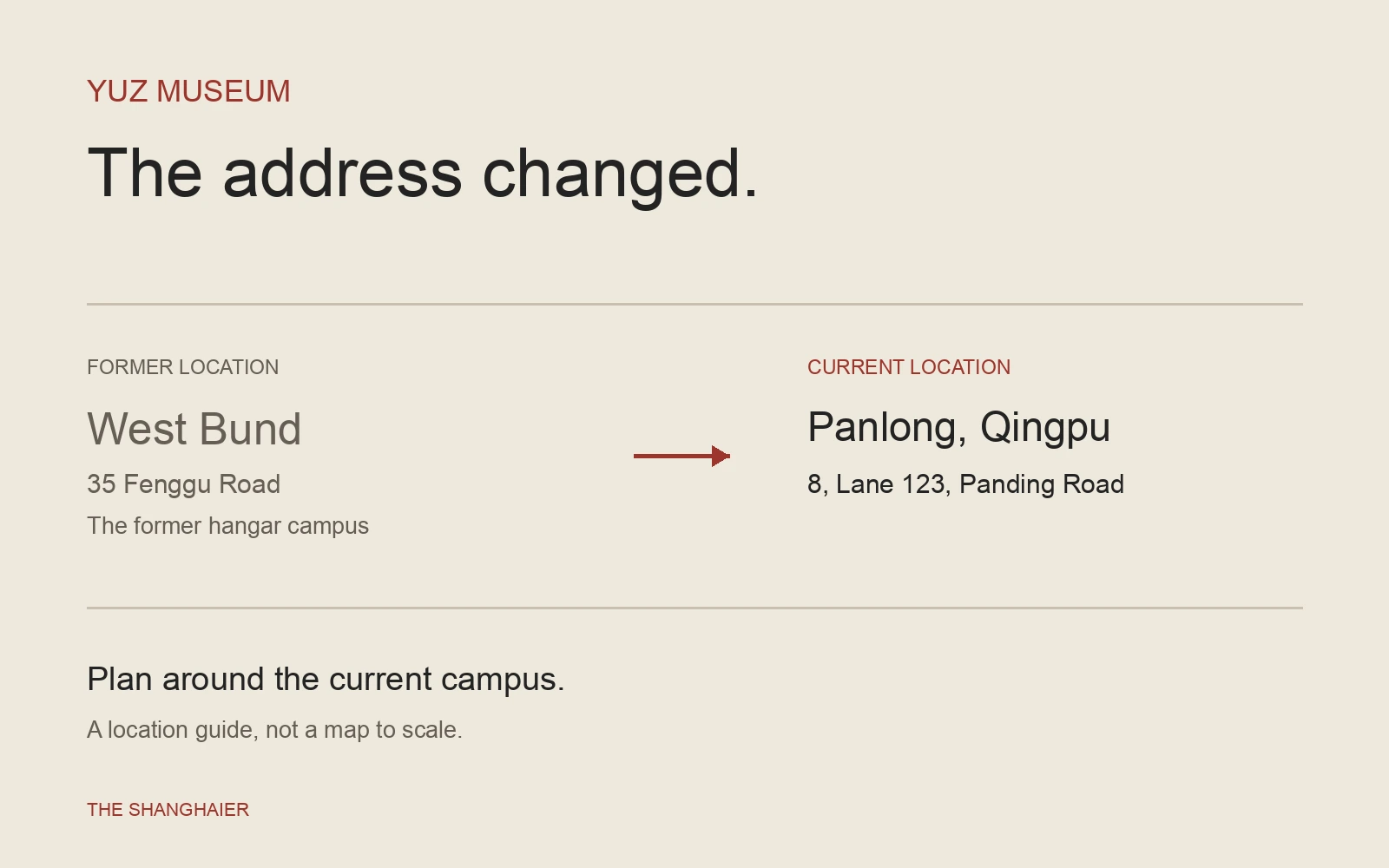
Begin with the location you will actually reach
Yuz Museum is at No. 8, Lane 123, Panding Road, Qingpu District, 上海市青浦区蟠鼎路123弄8号, in the Panlong development. This is a different journey from the former West Bund site. For an international visitor staying near the Bund or the former French Concession, I would give it an afternoon of its own. The reward is the combination of an exhibition, a lower-rise waterside setting and time to sit down, rather than the efficiency of moving between several central museums.
The city’s updated 2026 art-museum guide lists usual daytime opening as Tuesday–Sunday 11:00–19:00, with Monday closure except national holidays. Its summer 2026 night programme extended some days to 22:00, but that was a particular announcement linked to summer exhibitions. I would plan around the daytime hours and the specific exhibition ticket, not sell the summer extension as a permanent promise. The museum’s current programme is what makes the longer journey worthwhile.
The old hangar is history, not the present visit
Budi Tek, the Chinese-Indonesian collector and philanthropist, founded Yuz in 2014. Its original Shanghai home occupied a former Longhua Airport hangar on the West Bund. The institution’s move to Panlong in 2023 changed the relationship between collection, building and surroundings. I find it useful to keep that earlier life in the story, but not let it supply the photographs or mental picture for a visit to the new location. A very large industrial volume and a Jiangnan-inspired structure make different demands on art.
What interests me is how a museum survives a change of spatial identity. Does it remain associated with the scale of its former installations, or does a new site alter what a visitor notices? This is a question to bring to the current exhibition, rather than a claim that every programme follows one trajectory. Collections carry history; institutions still have to make choices in the present. The move is part of the subject, not an inconvenience to be concealed in the directions.
A Jiangnan roofline with a contemporary structure
Yuz’s opening brochure describes a building set among waterways, fields, ponds and bamboo, with gable walls and double-pitched roofs reworked from Jiangnan domestic architecture. It also identifies interlocking steel trusses supporting the interior and exterior. I would look for that tension: a roofline that recalls regional forms and a structural system serving a contemporary museum. The useful comparison is between a reference and what has been built from it, rather than a verdict about whether the place looks traditional enough.
A roof can carry memory without reproducing an old building. I would pay attention to where walls meet the roof, how an opening frames the surrounding landscape, and whether the interior feels continuous with the outside or deliberately apart from it. These are ordinary visual tests. They make the building more specific than the phrase a blend of old and new, which could describe almost anything in a city that has been continuously rebuilding itself.
The collection is wider than a photo-famous installation
The municipality identifies Chinese contemporary art of the 1980s and 1990s, together with large-scale installations, as important collection strengths. Yuz’s historical programme has included internationally recognised artists, but an archive of past shows is not a list of things waiting permanently in the galleries. I would choose the current exhibition on its own terms. If the name that brought you here is not showing, the question is whether the actual programme still interests you enough to travel.
For installation art, I prefer to ask what the work does to the room before deciding how to summarise it. Does it change your speed? Does a familiar material become difficult, fragile or oddly substantial? Are you looking at an object, moving through an arrangement, or watching an action unfold? Those distinctions give a visit structure even when you have not heard of the artist. A museum should not require a pre-existing list of art-world names to become usable.
Domestic objects can make an unfamiliar work legible
The 2023 opening collection exhibition used the idea of home and everyday experience to connect paintings, sculpture, installation, photography and video. Its examples are useful as a historical account of the new museum’s approach, rather than as an assurance of what is currently installed. I find that starting point persuasive. Domestic things offer a shared scale: a body, a room, an object held or used. An artist can unsettle that scale and make a larger social question tangible.
My opinion is that ordinary materials are most interesting when their familiarity does some real work. Turning a household object into art is not automatically an insight. Ask what the change reveals: labour that has become invisible, a habit repeated without attention, or the difference between a comforting appearance and an uncomfortable material. If the explanation requires an elaborate text to supply every consequence, that is worth noticing too. You can be curious and exacting at the same time.
Contemporary art can speak across Asian places
Yuz’s 2026 programme included the Thai artist Kawita Vatanajyankur’s Memory Machine, examining bodies, labour, technology and memory. That exhibition ended in August and is an example of the programme, not a current booking recommendation. I mention it because it offers an alternative to imagining Shanghai’s international art scene as a one-way conversation with Europe and the United States. Regional artists can bring related conditions into view without making those conditions identical.
I would ask how a work makes an abstract subject physical. Labour can appear as a repeated action; memory can be organised through an object, a recording or a gap. The question is not merely whether a technological artwork uses something new. It is what the technology changes about a human relationship. A screen or an algorithm can be a medium, a subject, or both. Separating those roles usually produces a more useful conversation than deciding whether digital art is inherently progressive or inherently shallow.
Panlong deserves a clear-eyed walk
The surrounding development is part of the afternoon. I would look at the relationship between the water, public routes, retained historical elements and contemporary shops. It is possible to enjoy a well-arranged place without calling every experience ancient. The interesting story is how heritage and commercial life are being brought together now. That includes decisions about what kind of visitor feels invited to linger, which routes become prominent and where culture sits within a retail setting.
My preference would be to take the museum first, while attention is fresh, and walk afterwards. The sequence gives you a specific subject to think about rather than making the exhibition one more stop between drinks and shopping. If food, a waterside pause or a design shop becomes the second chapter, that is a perfectly good afternoon. The museum does not have to remain solemn to be taken seriously, and the surrounding development does not have to be described romantically to be enjoyable.
Decide whether this is your museum day
I would recommend Yuz most readily to someone whose interest in a current exhibition is strong, or someone who wants a different urban setting from central Shanghai’s monumental waterfront and busy shopping streets. It is less compelling as an obligation added to a first visit with very limited time. If your central question is Chinese historical art, choose Shanghai Museum East. If it is a single compact contemporary-art detour near the Bund, consider Rockbund. A good recommendation includes the freedom to choose another museum.
Allow roughly three to four hours for the exhibition and a Panlong walk, excluding the journey from your hotel. Ticketed and free programmes can coexist, so use the exact exhibition information from Yuz’s official account rather than a historic blanket price. The museum’s phone contact is 021-64261901. I would rather make the longer trip deliberate than turn the current building into a footnote beneath a photograph of the old hangar.