Publication details
First published . Series dates place related notes together in the reading archive.
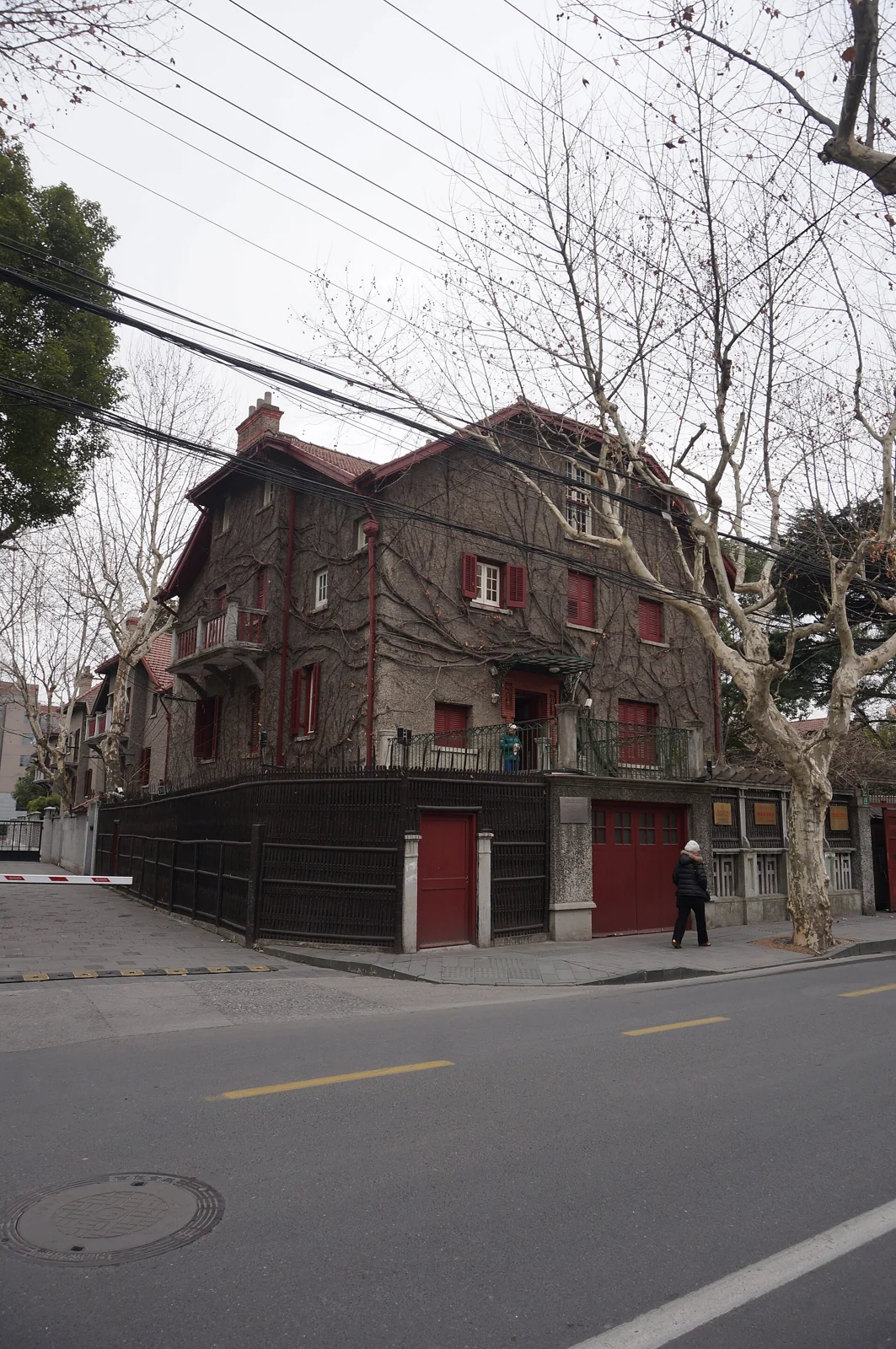

The name is the first piece of evidence
The full museum name is 中国共产党代表团驻沪办事处纪念馆(周公馆), at 上海市黄浦区思南路73号: 73 Sinan Road, Huangpu District. Calling it simply Zhou Enlai's former residence is convenient but incomplete. In 1946 the CPC delegation rented the house for its Shanghai office. The public identity as General Zhou's residence provided a different description of what was also an organizational address. I would begin with that ambiguity rather than treating the house as a conventional private biography.
A residence can receive visitors without looking like a formal headquarters. An office needs to communicate, organize and maintain relationships. When the two overlap, the plan acquires political significance. Which rooms can host a conversation? Where can people work? How does someone arriving from the street understand what the building is? The questions put attention on the building and the work it supported in 1946.
This is a restored museum with a recent new chapter
The museum reopened on 23 July 2024 after restoration. The municipal account describes restored historic settings, a permanent exhibition, temporary display space and an open garden. That matters if you remember older descriptions or photographs. A heritage property has a history after its famous period too: conservation, changing interpretation and decisions about visitor access. I would use the current museum presentation rather than assume an old guidebook describes exactly what is open today.
The reopening also changed the closeness of the encounter with some restored settings, according to the official account. That is an invitation to look carefully, not permission to handle objects. I like a house museum that allows the room to remain visually legible. The fewer barriers dominate your view, the easier it is to read a space as a place with practical uses. Still, museum circulation and conservation requirements take precedence over the route you might imagine through a private home.
The 1940 s belong to their own story
Keep this visit's period distinct from the 1921 First Congress site and from Sun Yat-sen's Xiangshan Road house. The political circumstances are different, even when a wider itinerary connects them. I would bring a short timeline rather than a long list of famous people: when was this office established, what work was it doing, and when did the delegation leave? That gives the building a historical task instead of letting its elegant exterior do all the explaining.
I find it helpful to think of an office as a network made temporarily visible. People arrive from elsewhere, letters leave, meetings depend on prior relationships, and decisions have consequences beyond the address. A house museum cannot show every connection at once. Your job as a visitor is to identify a few material traces and ask where they lead. It is a more satisfying way to spend an hour than attempting to absorb every panel as an isolated fact.
A coat makes a political figure bodily again
Among the objects introduced at the 2024 reopening was a coat associated with Zhou Enlai during the period of Kuomintang–Communist negotiations. A garment is useful evidence because it belongs to a body moving through weather, journeys and meetings. I would look at it with that practical fact in mind. Political work was done by people who had to travel, wait, rest and dress for a particular environment, however monumental their later public image became.
The garment should not have to prove an entire character judgement. Its value lies in its connection to use and circumstance. Read the label for the precise attribution, then observe the object on its own terms. What can its construction and condition show, and what remains outside the evidence? That small discipline makes a biographical collection more interesting. You can appreciate proximity to an individual without turning every possession into a moral emblem.
The relief receipt is a small document with a wide horizon
The municipal reopening account identifies a China Liberated Areas Relief Association receipt bearing Dong Biwu's English signature. I would give that item time. It points to administration, relief work and communication across languages. The presence of English is not just a decorative curiosity. It invites questions about audience, legitimacy and how organizations made their work understandable to people beyond an immediate political circle.
This is where a museum can outperform a general walking-tour summary. A receipt has a format, a purpose and a transaction behind it. Even if you cannot reconstruct the whole exchange from the case, it anchors discussion in something concrete. I would compare it with a much larger interpretive panel. How much history is compressed into a small administrative document, and what does the panel choose to draw out? That comparison keeps evidence and storytelling in view at the same time.
Soong Ching Ling appears through a gift, not just a family connection
Another object highlighted at reopening was a red silk quilt cover given by Soong Ching Ling to Lin Zhong, a worker associated with the Shanghai Relief Office. The specificity matters. A named giver, a named recipient and an ordinary domestic object show a relationship at a human scale. I would resist translating it immediately into a vague story about everyone knowing everyone in political Shanghai. Read the precise connection the museum records.
Objects used for care and hospitality belong to political history too. They can reveal how formal institutions depended on personal relationships, material support and daily living. That does not make every gift politically transparent. It gives you a question to hold alongside official titles and organizational names. Who helped work become possible? A quilt cover and a receipt answer different parts of that question, which is why I think they deserve attention alongside portraits and headline events.
The garden changes the house's relationship with the street
The garden in front of the house opened as part of the 2024 renewal. I would look at how it places distance between the building and the surrounding neighbourhood. A garden is not merely a pleasant pause before the serious indoor material. It shapes approach, visibility and the transition from public street to controlled interior. In a building whose name helped manage its public identity, that relationship is particularly worth noticing.
Sinan Road also offers a useful architectural comparison outside. Look at the size of the house, its plot and the neighbouring forms before turning the whole street into a generic old Shanghai scene. A political office occupying a garden residence tells a more specific story than an attractive facade alone. Use the street to understand the type of building; use the museum to understand the particular work attached to it. Each setting supplies something the other cannot.
An hour here can give a history walk a clear centre
I would allow 60–90 minutes and confirm the day's opening and entry arrangements through the CPC First National Congress Memorial, the operating institution. The address is close enough to Sun Yat-sen's house for a coherent central-city pairing, but do not assume both have the same access rules. Sun's latest verified notice is a partial opening announcement. A practical itinerary begins with what each institution currently admits visitors to, then builds the historical comparison around that.
For me, the strongest version of this visit follows one thread: how political work occupied ordinary rooms and used ordinary things. Choose the coat, the receipt and the gift, then relate them to movement, administration and care. You will leave with a more textured understanding than a list of statements about a famous leader. If you want a wider journey into Republican politics, this small office can be its most useful stop precisely because its scale encourages you to ask how work actually got done.