Publication details
First published . Series dates place related notes together in the reading archive.
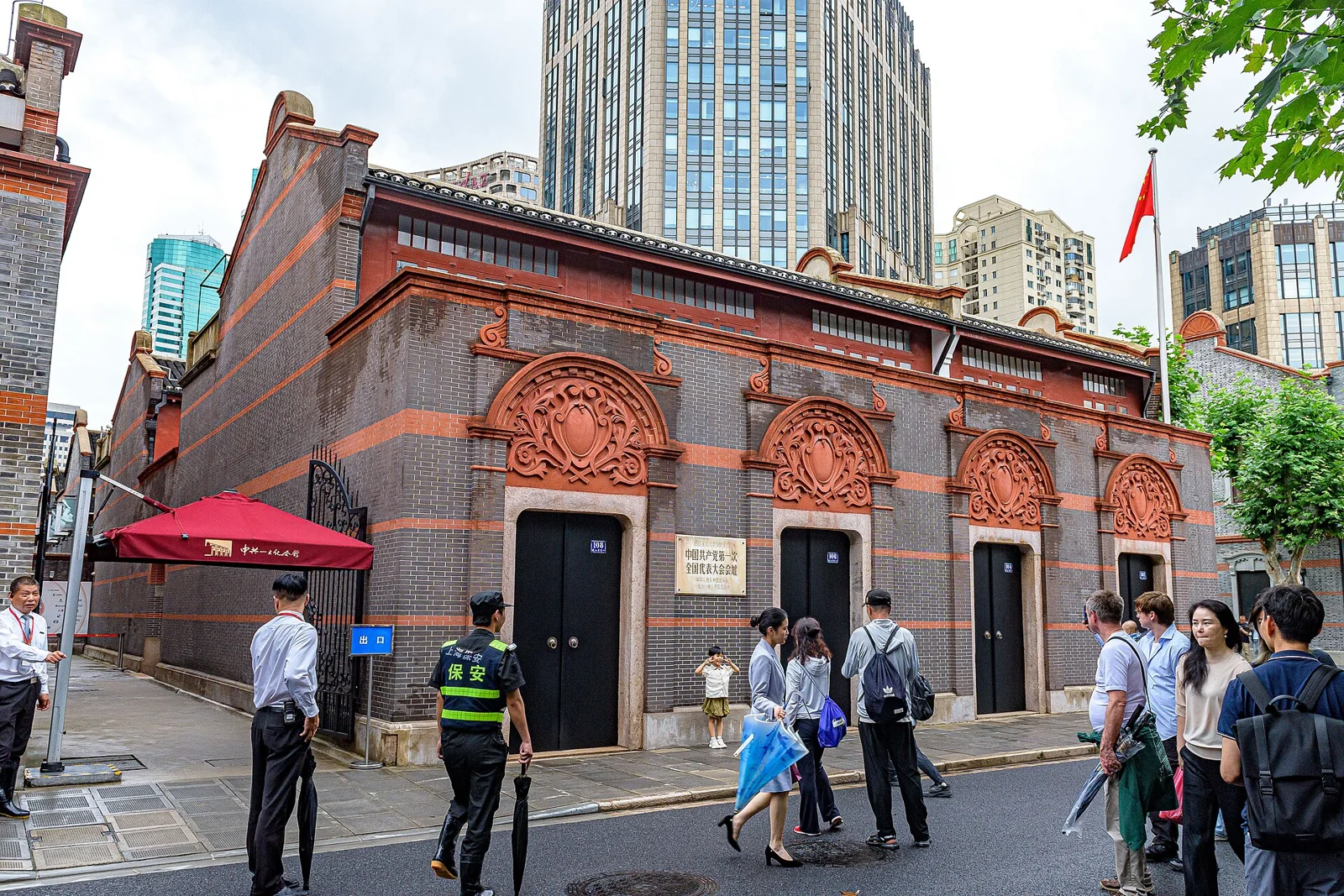

Two addresses belong in your plan
The memorial's visitor address is 374 South Huangpi Road, 上海市黄浦区黄陂南路374号. The historic meeting site is at 76 Xingye Road, 上海市黄浦区兴业路76号. They are connected in subject but are not interchangeable entrances. I would keep both addresses on the phone. The contemporary exhibition gives the wider narrative; the preserved site brings the scale back to a particular building and the meeting associated with it.
This distinction matters intellectually as well as practically. A museum can assemble material from many places and periods. A historic site makes a different claim: something happened here. Seeing both lets you compare an expansive account with a constrained physical setting. I think that is the most interesting structure for a visit. The smallness of an origin and the size of its later consequences should not be made to look the same.
Begin with the historical question you actually have
The First National Congress opened in Shanghai in July 1921 and marked the establishment of the Communist Party of China. That is the basic event. Before entering, decide what you want to understand about it. Are you interested in political ideas moving between languages, in how people organized, or in Shanghai as a setting for political activity? A precise question gives you something to follow through a large, purposeful exhibition.
I would avoid arriving with the ambition of solving the whole history of modern China in one museum. This institution has a commemorative role and a clear account of its subject. That is part of what you are visiting. You can learn from its evidence while examining the shape of its argument. A document's date, the interpretation on a panel and the meaning given to the event today are related layers; they are still worth distinguishing.
Give the printed pages the attention they deserve
The early complete Chinese translations of The Communist Manifesto are especially useful objects to look for. The municipal account identifies the 1920 Chen Wangdao translation in the memorial's display. It turns an abstract phrase such as the circulation of ideas into a material problem: words have to be translated, printed, distributed and read. A small booklet can therefore be historically consequential without looking visually grand in a case.
My preference is to inspect scale and format before reading the larger interpretation. How portable does the publication look? What can you learn from the cover, typography or way the text is presented? You may not read Chinese, but those physical features still tell you something. Then use the explanation to connect the object with its political life. Treating print as an active technology makes the gallery considerably more interesting than a sequence of names and dates.
Shanghai was a setting, not just an address
After a few displays, return to the question of why this story belongs in a city. Political organization requires communication, meeting places and relationships among people who may not share a household or a workplace. Shanghai's importance should not be reduced to a picturesque building. Think about the practical infrastructures of urban life and how they make contact possible. This is a useful lens for reading political history through streets rather than through portraits alone.
I would take that question outside too. The surrounding neighbourhood presents a strong contrast between a historic political site and contemporary commercial space. It would be easy to treat the contrast as a clever photograph and move on. I find it more productive to ask how memory is maintained inside a changing city. A site does not stop acquiring new relationships once it becomes protected. The way people approach it today is part of its present public life.
In the old site, look at domestic scale
The shikumen building deserves attention as a building, not merely as a symbolic backdrop. A doorway, passage and room establish the conditions of arrival and assembly. I would look at the relationship between street and interior and ask how a domestic type accommodated a meeting. You need not invent the atmosphere of that particular day to see the significance of an ordinary urban setting becoming a consequential historical place.
Be careful about the difference between surviving fabric, restored arrangement and interpretation. A historic room can be compelling without every visible surface being untouched since the event. Read the labels for what is original and what has been reconstructed. That habit makes the encounter stronger. It replaces a vague feeling of having stepped back in time with a more precise understanding of what the institution has preserved and how it has made the past visible.
The exhibition itself is something to read
The memorial presents party history through a contemporary institutional perspective. Notice how space, lighting and changes in scale guide your attention. Which objects encourage close reading, and where does the narrative become panoramic or ceremonial? Those design choices do historical work. They tell visitors what to remember and how the beginning is connected to the present. I would regard that as an additional subject of the visit rather than an obstacle to learning.
This does not require an oppositional stance. It requires keeping observation separate from conclusion. You might find one small document persuasive and one large summary too compressed. Follow that distinction. Ask what sort of evidence would answer the question you still have, then choose a second site accordingly. Zhougongguan, for example, shifts attention to the 1940 s and to political work conducted through an office, correspondence and relationships, offering a different scale of historical activity.
Build time around the places where you slow down
For the memorial and historic site together, I would allow roughly two to three hours, depending on queues and how closely you read. Normal museum hours are Tuesday to Sunday 9:00–17:00, with admission stopping at 16:30. The current municipal directory lists ordinary visits without a reservation, while some special exhibitions can have separate arrangements. Use the official opening-information page for your date; a group explanation booking is not the same thing as an individual admission requirement.
Free scheduled Chinese interpretation is advertised at several times during the day. If you do not understand Chinese, do not assume the crowd will automatically provide an English account. An advance outline in your preferred language can be more useful than standing behind a talk you cannot follow. I would bring the original identification document used for any booking or ticket requirement and ask staff about the historic site's current entry sequence on arrival.
Leave with a comparison, not a verdict on everything
I would finish by naming one thing whose scale surprised you: the booklet, the meeting room, or the size of the contemporary memorial. Then ask why that contrast matters. A good museum visit can leave an unresolved question. It need not end in a sweeping judgement about a country, a party or an entire century. The specificity is what makes the experience portable into the next place you visit.
For a broader political-history day, choose one additional stop with a different function. A residence brings household and public work into view; an office exposes organization; a city museum supplies the wider urban chronology. I would avoid stacking several commemorative institutions with identical expectations. Give each a question it can answer well. That produces a richer understanding of Shanghai than a checklist in which every facade is asked to stand for the same general idea of history.