Publication details
First published . Series dates place related notes together in the reading archive.

Start with the correct Soong sister
Soong Ching Ling was Sun Yat-sen's wife and later became Honorary President of the People's Republic of China. She is not Soong Meiling, who married Chiang Kai-shek. This sounds elementary until a loosely labelled family itinerary makes the sisters interchangeable. I would establish the distinction before visiting. Shared family origins can help explain a network, but they cannot substitute for the political commitments and public work of the individual whose home you are entering.
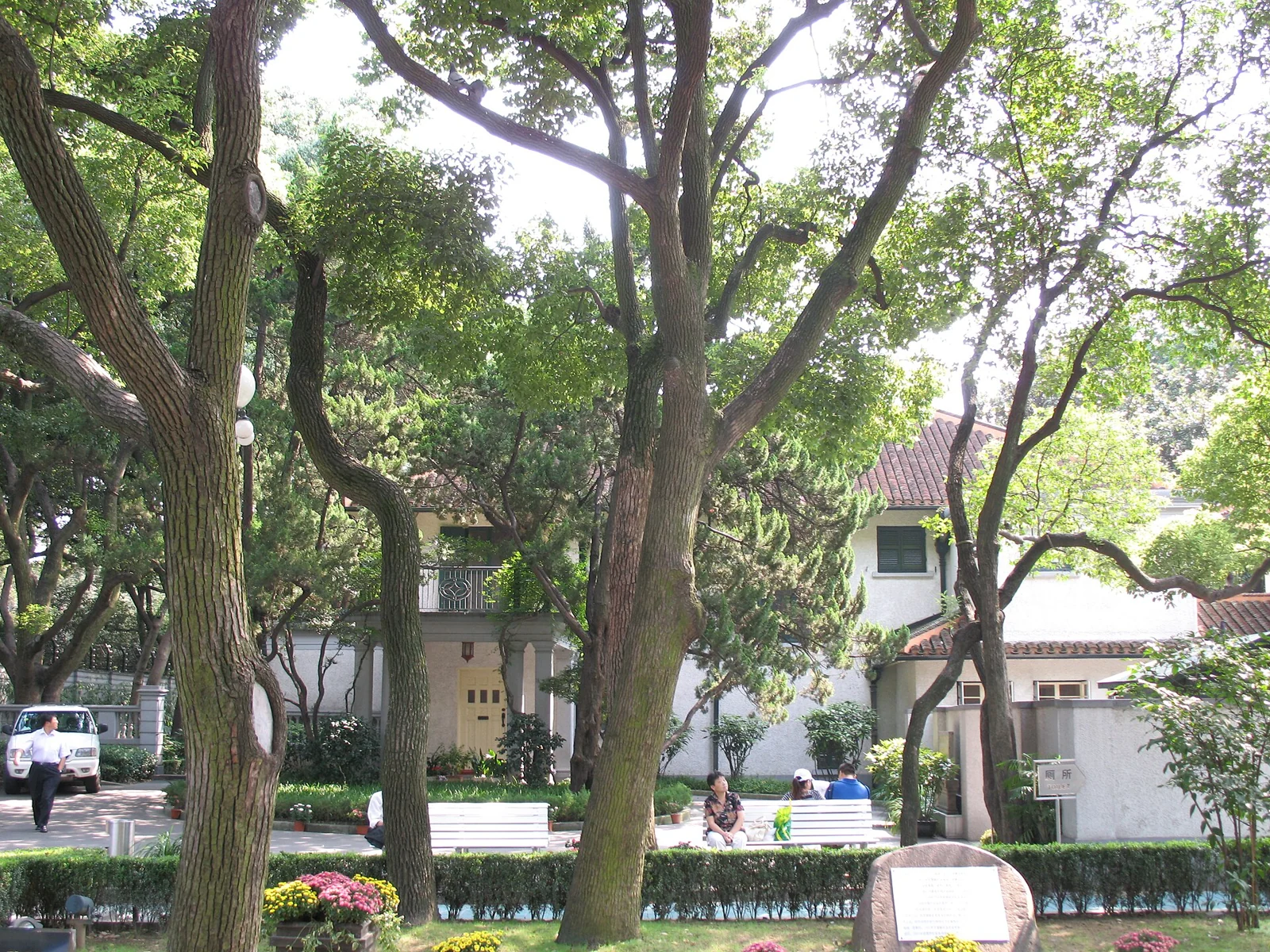
The venue is 上海宋庆龄故居纪念馆, at 上海市徐汇区淮海中路1843号: 1843 Middle Huaihai Road, Xuhui District. Keep this address separate from Sun Yat-sen's residence on Xiangshan Road and from Soong Ching Ling's former home in Beijing. Searching in English can bring up all three. For a Shanghai day, the Chinese venue name and full street number are the most useful practical information you can save.
Book through the museum, and read the small practical rules
The official visitor page lists Tuesday–Sunday 9:00–17:00, with last entry at 16:30, and an adult ticket of 20 yuan. It directs visitors to purchase in advance through the museum's WeChat mini-program. Monday closures can shift around national holidays and special commemorative days. I would use that official route and carry the identification associated with any concession or booking. The museum explicitly says it has not authorized third parties to sell its tickets or interpretation services.
There is a rule relevant to anyone arranging a guided visit: institutions or individuals organizing interpretation inside must obtain prior museum approval. A walk with me does not automatically grant permission to give a tour in every museum. I would settle that before building an itinerary around indoor commentary. You can still enjoy the house independently, use the museum's own resources, and discuss the wider history outside. Clear arrangements make the visit better for everyone sharing these small rooms.
A house is a sequence of permissions
I would look first at the journey from entrance to garden to main building. A home does not offer the same level of access everywhere. Reception spaces, work rooms and bedrooms have different relationships to a visitor. That structure is especially interesting when the occupant also has a public role. The house is doing two kinds of work, and the transitions between them can be more revealing than any single grand object.
This is why I prefer a slower circuit to a rapid hunt for famous possessions. Ask where conversation could happen, where work could be concentrated, and where the household could withdraw. These are questions about the plan, not claims that you know exactly what every room felt like. Looking carefully at the distinction between public and private gives a historic home a subject beyond the usual admiration for its size or its garden.
The furnished main building is worth reading room by room
The museum describes downstairs living and dining spaces together with east and west studies, and upstairs rooms including Soong's bedroom, study and Li Yan'e's room. I would use those functions as the beginning of a close look. A dining room organizes people around a table; a study organizes work around a surface and storage. The difference helps explain how domestic life can support activity that extends well beyond the household.
Follow one repeated element—chairs, shelves, doors or the relation between a window and a desk—rather than trying to memorize an inventory. What changes from a receiving space to a personal working space? A preserved arrangement can tell you something about use even before you know the biography behind every item. When a label identifies an original possession, give that claim its proper attention. When the presentation is a reconstruction or a replica, let it do that different job.
Do not erase the other people who made a household function
The identification of Li Yan'e's room is a useful reminder that a public figure's home was not occupied by a single symbolic person. Work, care and daily routines depended on other people. I would keep that in mind while moving through the furnished spaces. A house museum becomes much less interesting if everyone except the famous occupant disappears from the explanation of how the place operated.
Shared domestic life becomes more legible when the other occupants remain visible in the account. The spatial relationships are enough to begin with. Which rooms are near one another? Where does household support meet public work? Which people appear in captions, photographs or correspondence? Those questions keep the visit attentive to actual evidence. They also make the domestic setting more concrete than the generic phrase that a great person lived here.
The garden offers a different scale of attention
Give the garden its own few minutes, if the relevant areas are open. I would think about the relationship between planted space and the building rather than treating the grounds simply as a backdrop for a portrait. A garden can mediate between street and interior, offer distance from a busy road, and change how a house receives daylight and visitors. Those are architectural roles as well as pleasant visual effects.
For photography, choose a view that explains a relationship: a path approaching the house, a window facing the garden, or the transition between shaded planting and a wall. It is more informative than isolating a flower without context. Follow the museum's current photography and recording rules, especially inside. This is a small heritage site with other visitors and objects to protect; it rewards a measured approach much more than an elaborate photo session.
Bring her public life back into the domestic setting
After examining the house, I would return to the larger biographical question. What did it mean to maintain a personal home while carrying out public responsibilities? Which parts of the museum's narrative emphasize continuity, and which suggest change? The rooms cannot answer the entire political history, but they give the account a scale. Correspondence, meetings and reading happened somewhere, using ordinary furniture and the time of a finite day.
I find this a productive way to approach influential people. It allows an opinion about their choices without turning the visit into either uncritical admiration or a hunt for an easy contradiction. The museum has a commemorative perspective; you can recognize that and still learn from its material. Keep a distinction between what an object shows and the conclusion drawn around it. Then pursue the question that survives the visit in a second place or a good biography.
Two Soong-related houses make a stronger comparison than three sisters on a slogan
If you visit Sun Yat-sen's Xiangshan Road house too, keep the periods distinct. The earlier residence and this later home should not merge into one continuous furnished tableau. I would compare the settings through a question about work or access: how did each household receive people, and what kinds of public activity does the museum associate with it? That gives a family-history day a structure without reducing its subject to a family tree.
Allow roughly 60–90 minutes here and leave time between museums. I would not make Dongping Road 9 a promised third interior: the Chiang Kai-shek–Soong Meiling associated property is not open as a public house museum. A clearly labelled optional street-side stop is a different proposition. If you are most interested in Soong Ching Ling, stay with her. A coherent day following one person's work can be more rewarding than assembling every nearby address carrying a famous surname.