Publication details
First published . Series dates place related notes together in the reading archive.
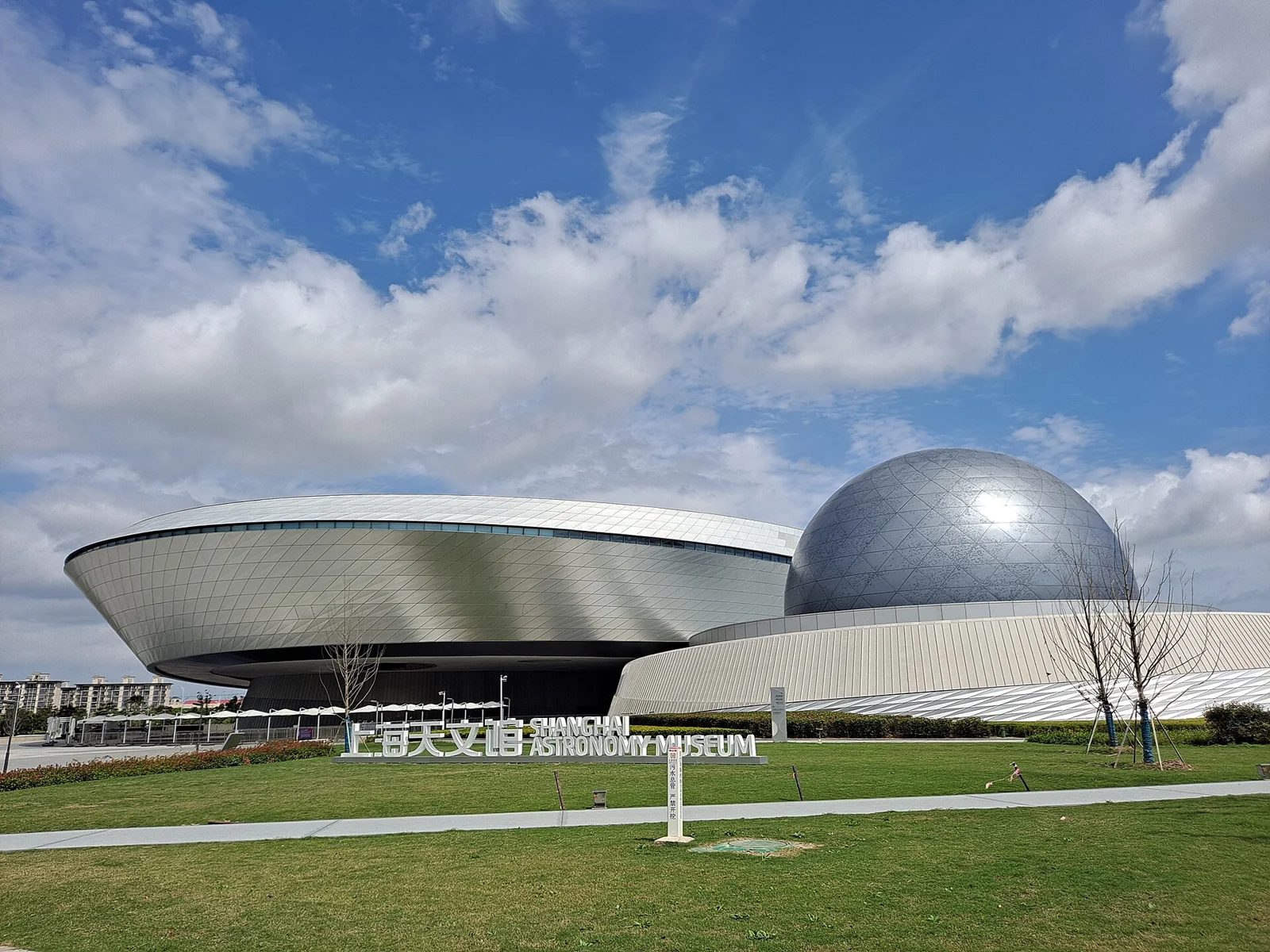

First decide whether Lingang belongs in your trip
The museum is at 380 Lingang Avenue, Pudong New Area: 上海市浦东新区临港大道380号. Pudong is enormous; the district name does not mean that this is a short extension of a Lujiazui afternoon. Metro Line 16 serves Dishui Lake, after which you complete the local approach. Use a live journey planner from your actual hotel instead of accepting a single citywide travel-time estimate.
I would count the outward and return journeys as part of the museum day. That changes the comparison with a central museum. If astronomy is a strong interest, the travel can be justified. If your interest is casual and your Shanghai stay is brief, the Natural History Museum offers a simpler cultural half day. There is no virtue in choosing the longest journey merely because the building is famous.
The architecture deserves attention before the screens
Ennead Architects designed the museum around three principal forms: the Oculus, the Sphere and the Inverted Dome. I like the underlying ambition because astronomy is unusually vulnerable to becoming an afternoon of looking at representations. Here, the building asks you to notice actual light, direction and sky as well as images and information. That is a useful shift in scale from an exhibit to your own position in the world.
Do not rush straight past the entrance because a photograph looks familiar. The Oculus admits a moving circle of sunlight; its exact alignment is tied to the sun’s position. The often-published complete-circle effect belongs to a particular solar alignment, not every random arrival. On an ordinary visit, I would simply watch where the light falls and let the weather be part of the experience.
A sphere with a job, rather than an arbitrary sculpture
The large Sphere houses the planetarium theater. Its form makes the relationship between architecture and astronomy legible, even before you enter a show. As you move through the museum, notice how the sphere seems to change its support and weight. I think that changing viewpoint is more interesting than searching for the single camera angle that appears in every travel post.
The Inverted Dome offers another relationship with the sky, while the spiral circulation makes movement through the building part of the story. I would avoid treating the design as proof that the science has become self-explanatory. A beautiful curve does not teach orbital mechanics by itself. It can, however, slow you down and create the attention that a more demanding explanation needs. That is a worthwhile architectural achievement.
Choose a route through Home, Cosmos and Odyssey
The principal exhibition areas are Home, Cosmos and Odyssey. Those titles offer a useful progression: begin with what feels close, widen the scale, then consider how people investigate what lies beyond direct experience. I would use that progression as a framework rather than a command to read every panel. Choose one question that survives the movement between galleries, such as how distance is known or how observation becomes an explanation.
The Chinese astronomy material is particularly relevant to a visitor who could see a generic space display elsewhere. It provides a reason to ask how the sky has been recorded, organized and interpreted in this cultural setting. I would make room for that perspective instead of spending the entire visit chasing the most spectacular simulation. Modern space exploration and older ways of observing the heavens belong in the same conversation.
Scale is another thread worth carrying. A model must choose what to preserve and what to distort: relative sizes, distances, movement or the ability of a visitor to see the thing at all. When you meet a planetary arrangement, check which relationship the display is explaining. An attractive arrangement need not be a literal map of distances. That is not a defect if the purpose is clear. It is a reason to read the explanation. I like the moment when a visitor stops asking only what an image represents and starts asking how the representation has been constructed.
Choose the experience you actually want before buying extras
A museum admission ticket and a particular theater or hands-on activity are separate planning questions. Check the official booking information for the date you want, including any separate reservation for the planetarium film or a specialist experience. Do not assume the physical presence of a telescope means a casual daytime ticket includes an observing session. Weather and program schedules matter as well.
I would make one extra the anchor only if it is central to your interest. A family determined to see a particular show should confirm that show before undertaking the journey. Someone interested mainly in the building may prefer a less interrupted route. For visitors using passports, check the document fields and obtain official assistance if needed. An unofficial admission promise is a poor foundation for an excursion this far from the centre.
Give the visit a realistic amount of attention
My recommendation is to reserve at least a substantial half day at the museum and allow the wider day for travel. Some people will finish sooner; serious astronomy or architecture enthusiasts may want longer. The useful measure is the complexity of your interest, not the number of galleries available. A child captivated by one area does not need to be marched away merely because an itinerary has assigned equal minutes to everything.
Build in a pause. Space exhibitions can involve darkness, screens, moving images and concentrated reading; they are not automatically restful because they are indoors. A break also gives a group time to discover whether everyone is enjoying the same thing. I would rather divide attention thoughtfully within the visit than insist that every person care equally about every display.
Dishui Lake is the logical companion; another major museum is optional
The nearby Dishui Lake setting gives the day a geographical centre. I would use the area for a change of pace before returning to town, subject to weather and energy. It is a more sensible immediate addition than racing back to central Shanghai for another timed attraction. The value of planning Lingang as a day is that you can stop treating every transition as lost time.
China Maritime Museum is another substantial museum in the area. Combining the two can make sense for a committed specialist with an early start and confirmed entry arrangements, but I would not recommend it as the default family plan. Ships and astronomy both deserve attention. If you need to remove something, remove a museum before removing lunch, rest or the margin needed to find an unfamiliar entrance.
My verdict: worthwhile for the right reason
I think this is an unusually coherent choice for someone who likes architecture as an experience rather than a backdrop. The relationship between light, curved movement and the real sky gives the visit an identity beyond the contents of a gallery. For a person interested in astronomy, that architectural framework can reinforce the subject. For a person who dislikes science museums, the building alone may not justify the whole journey.
The official municipal visitor information gives a standard 09:30–17:00 day, last entry at 16:00, with Monday the regular closure and separate holiday arrangements. Check the current calendar before travelling. If that day’s available tickets or journey create a rushed visit, I would choose a different date or a central alternative. A museum this specific is better approached with intention than with fear of missing out.