Publication details
First published . Series dates place related notes together in the reading archive.
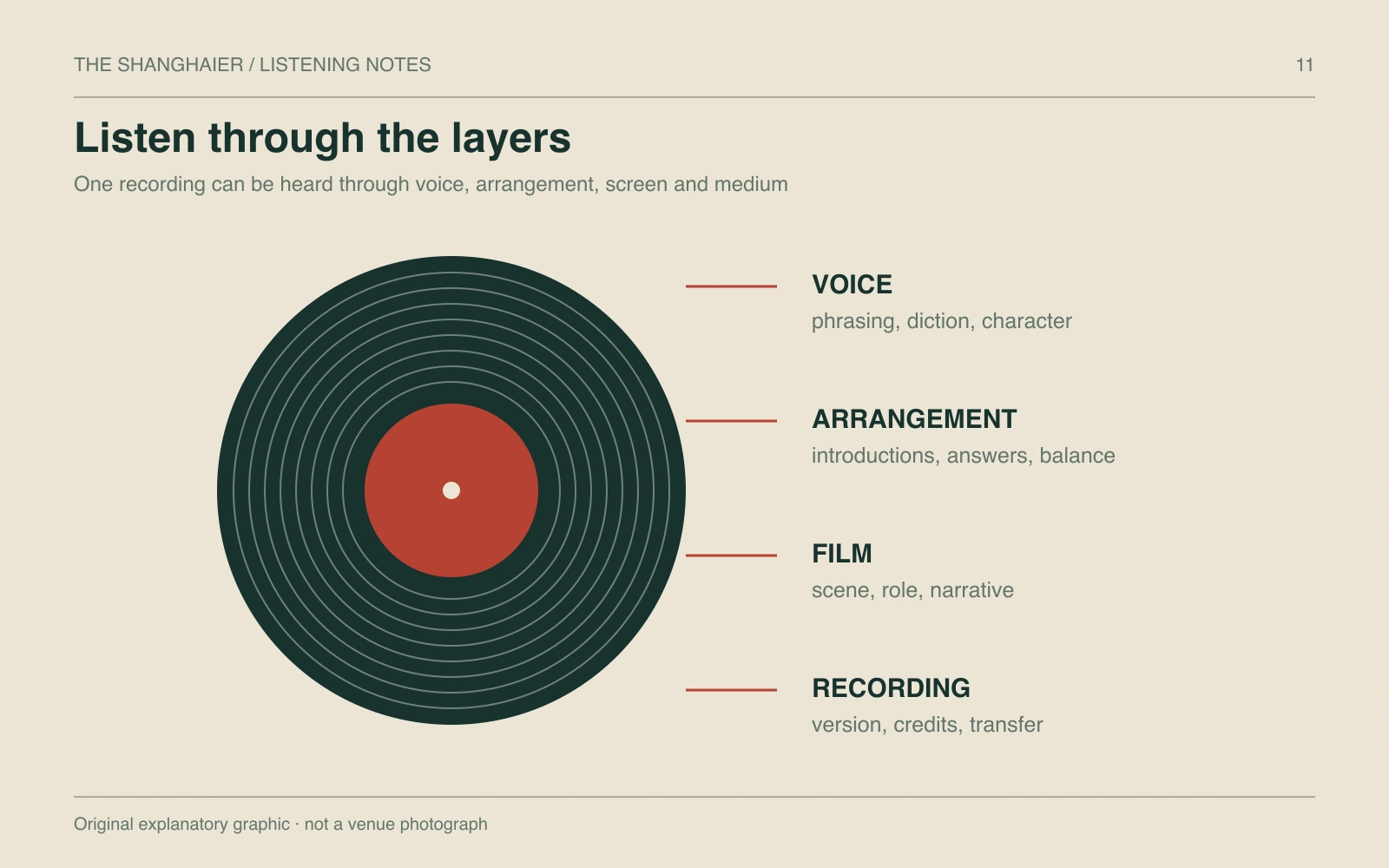
Start with a useful, limited definition
Shidaiqu, 时代曲, is a useful term for a hybrid Chinese popular-song tradition associated with Shanghai’s early twentieth-century recording, film and nightlife worlds. It is not a precise synonym for jazz, nor a label for everything Chinese that sounds old. Histories commonly place Li Jinhui near the beginning of its development and trace the meeting of several musical and entertainment traditions rather than a single uncontaminated source.
Use the term to open a set of questions, not close them. What language is being sung? Is the recording a film song, a studio issue, a later cover or a contemporary arrangement? Does a playlist identify the performer and date? The more efficiently a streaming title says “1930s Shanghai,” the more carefully I would check what individual recording it has actually supplied.
Let the voice be an instrument
You can hear a song closely even if you do not understand every word. Follow how the singer begins a phrase, carries it across a line and lets the final sound go. Is the melody presented evenly or stretched around certain words? Does the voice seem to address one listener, project to an imagined room or play a character? Those are questions about performance, not an obligation to diagnose a whole historical culture from one timbre.
Then find a reliable translation or account of the lyric’s situation. Meaning can change what you thought you heard. A poised vocal surface need not indicate an uncomplicatedly happy song. The gap between delivery and situation can be part of its force. Do not paste lyrics into an itinerary or assume a translated line gives permission to reproduce the recording. Listening, quotation and reuse are different activities.
Listen behind the singer
On a second pass, put the accompaniment in the foreground. Notice introductions, short instrumental answers, changes between sections and the material placed under the vocal line. Does the group double the melody or leave it room? Is the pulse equally clear throughout? These observations make a recording more specific than the word “vintage” can manage.
An arrangement is also a negotiation with the available recording format and performing group. A compact introduction may have to establish a mood quickly. A recurring instrumental idea may help identify the song after the voice pauses. You do not need to claim a direct American, European or Chinese origin for every gesture to hear how several vocabularies can coexist. Naming an influence should improve the listening, not replace it.
Film changes the kind of evidence
Zhou Xuan makes an inviting entry point because her work connects popular song and screen performance. Begin with a credited version of a film song rather than an anonymous lounge cover. Then distinguish the sound recording from the film scene: framing, character and narrative can make the same melody do work that a standalone audio playlist removes. A singer’s screen persona is not a transparent autobiography.
If you can watch a legally available scene, ask what the song is doing at that point in the story. Is somebody performing for other characters, expressing something indirectly or moving the story into another emotional register? The answer may complicate the easy idea that these songs simply celebrate nightlife. Cinema supplies situations, not just glamorous faces to print beside a record player.
Three listening doors, without a canon exam
For a first session, use the Shanghai Song research resource and a credited radio programme such as NTS’s shidaiqu selection to locate performers and titles. Treat the tracklist as a route into authorised recordings, not as a licence to copy the broadcast. Pick one singer-led song, one piece with a conspicuous instrumental introduction and a later version of a tune you have already heard.
That sequence gives you three different tasks: attend to a voice, attend to an arrangement, then compare an interpretation. It is more useful than playing forty tracks once. Save performer, title and version together. A song can be widely covered, and an English title may vary between catalogues. Keeping the original title when it is available will help you find another recording without mistaking it for the same performance.
A later cover can make the comparison sharper
A modern version is not inherently less valuable because it changes the older style. It gives you a way to hear decisions more clearly. Compare tempo, instrumental balance, treatment of the melody and the amount of space around the voice. Which qualities belong to the tune, which to the arrangement and which to the performer? Even an adaptation you dislike can clarify what you value in the earlier one.
Avoid measuring authenticity by surface noise. Crackle can come from the physical source, a transfer or an added effect. A cleaner restoration does not necessarily remove historical truth, and an artificially worn recording does not acquire provenance. Read the release information. The sound of age and the date of a performance are connected only when a reliable catalogue establishes the connection.
The city was more than its glamorous rooms
A playlist can make a period feel continuous and socially comfortable. History is less tidy. Commercial entertainment, film work and political conflict occupied the same city. At Pathé Villa, the story of recording March of the Volunteers puts a very different use of song and distribution beside the popular-music world. That connection is more revealing than assigning cheerful tunes to commerce and serious songs to an entirely separate Shanghai.
Do not flatten those differences into a claim that every recording represents the same audience or political position. A company can issue varied material; a performer can work in several contexts. Following credits and dates gives you a better method than guessing a work’s meaning from the atmosphere it now lends a hotel lobby. The recording industry was an infrastructure through which different purposes could travel.
Hear the recording as work
One reason I resist the phrase “soundtrack of old Shanghai” is that it turns musicians into anonymous suppliers of atmosphere. A credited song restores names, roles and decisions. Somebody wrote and arranged it; somebody performed it; somebody recorded and distributed it. The surviving version has also passed through later preservation and commercial choices before reaching your phone.
This does not require solemn listening. Pleasure is a perfectly good beginning. The point is to let pleasure become more exact: a phrase, a particular voice, a transition or an arrangement you want to hear again. If you buy a reissue, choose one with useful notes and clear provenance. If you stream, use an artist, label or licensed service rather than a download assembled without credits.
Carry one song into the city
After listening, choose one music-related visit rather than demanding that Shanghai reproduce a playlist for you. Pathé Villa offers a recording-history subject. A concert provides another way to encounter musical work now. A hotel jazz bar presents its own contemporary performance of memory. None is a portal into an intact earlier decade, and each becomes more interesting once the difference is allowed to remain.
My suggested exercise is simple: keep one song, one credited performer and one question. Perhaps you want to understand its film context or hear a different arrangement. That is enough to make the next encounter more personal than a themed playlist. Old popular music does not need to stay behind glass, but it deserves better than being used only to make the present look attractively old.