Publication details
First published . Series dates place related notes together in the reading archive.
Find the site before assembling the story
The visitor address is 811 Hengshan Road, Xuhui district: 百代小楼,徐汇区衡山路811号. It sits in Xujiahui Park. Save the Chinese name as well as the English Pathé Villa, since map translations vary. The park and the exhibition building are separate access questions. Reaching the house from public park paths does not establish that the interior is open when you arrive.
The city’s tourist-service directory also lists a Pathé Villa tourist centre at this address. That is a useful place to seek current visitor information, rather than relying on an old exhibition listing. I would make the exterior and park the dependable core of the visit, then check the interior opening and reservation arrangements before setting aside a fixed museum slot. Special commemorative exhibitions do not establish permanent hours.
A song before it was an anthem
The first record of March of the Volunteers was made in Shanghai in 1935, before the song became the national anthem of the People’s Republic of China. It began as the theme for the film Children of Troubled Times, with lyrics by Tian Han and music by Nie Er. Keeping that sequence clear matters. A work’s later national role should not erase the particular film and recording world in which it was made.
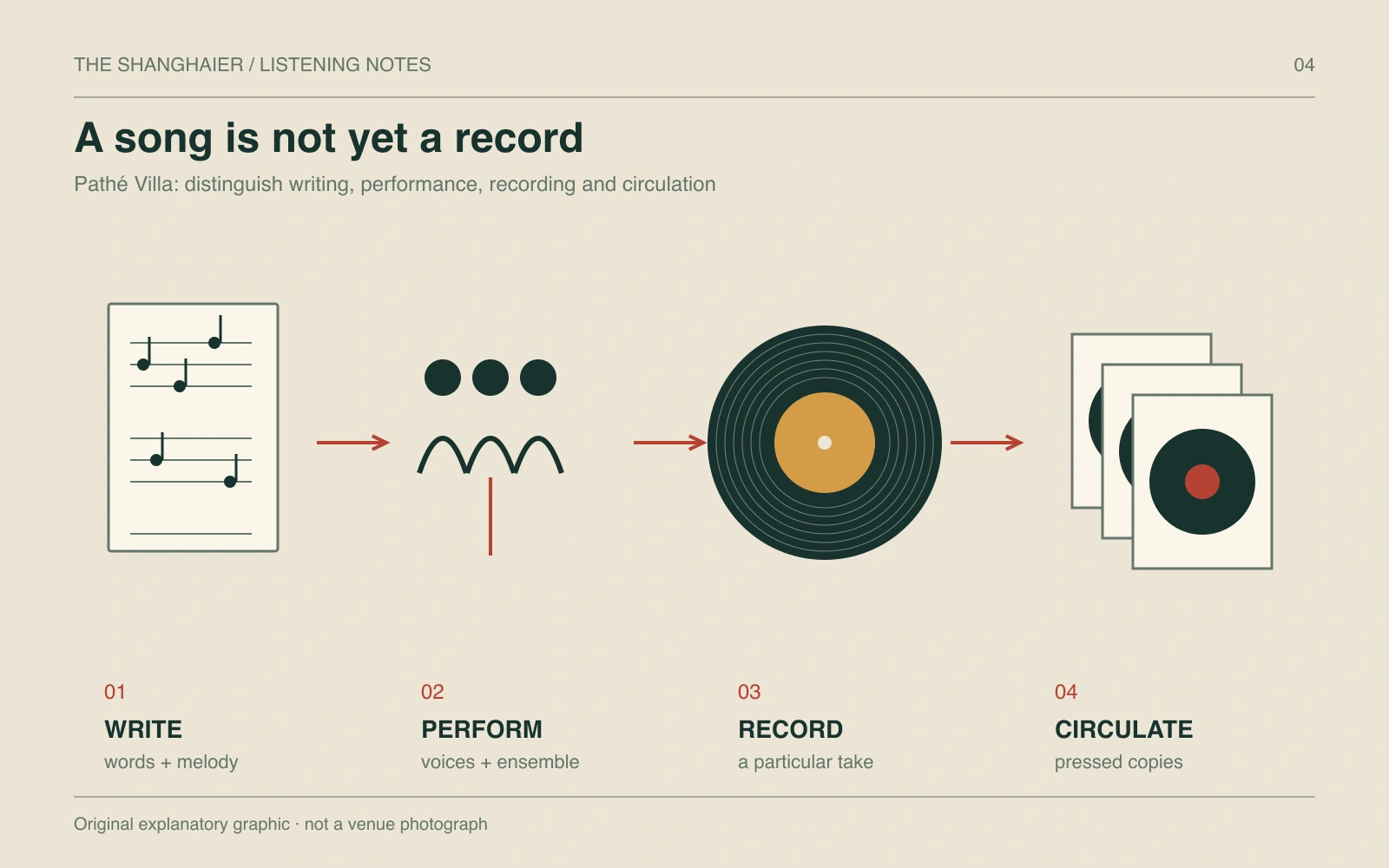
The Chinese Museum of Modern and Contemporary Press and Publication identifies Ren Guang’s role in the first recording and the involvement of the film company’s singing group. This was organised work by several people, not one composer alone in a picturesque room. The difference between writing, arranging, performing, recording and distributing is the intellectual centre of a visit here. Each stage changes what can reach an audience.
Read a record as an object
Look for a date, a company name, a catalogue number and the credited performers when an exhibition presents a record. These are not minor details below the important story. They tell you which version you are looking at and how it entered a commercial system. A later pressing, an original matrix and a modern playback copy can all represent the same song while being very different historical objects.
The publication museum identifies the early release number as 34848b. You do not need to memorise it, but the presence of a number makes a useful point: a recorded performance becomes something that can be ordered, pressed, stocked and identified. If a display uses a facsimile, read the label as carefully as the object. A replica can explain a process well without being evidence that the original was physically in that room.
Recording is a collaboration with technology
A microphone does not simply preserve a room unchanged. Placement, the balance between voices and instruments, the limitations of the recording medium and later restoration all affect what reaches the listener. You can carry that question through the exhibition without pretending to reconstruct every technical detail of a session. What was being captured, for which medium, and for which audience?
If a listening point offers an early recording, hear the whole excerpt before moving on. Compare the collective shape of the voices with the image of a single heroic composer often attached to a song. Then notice the playback conditions: a digital restoration through a modern speaker is a way of accessing an older performance, not time travel. That distinction makes the listening more interesting rather than diminishing its emotional force.
The building and the later exhibition
A commemorative exhibition has a point of view. Its selection of documents, images and reconstructed settings gives visitors a particular route through the past. Read the dates on captions and distinguish original material from interpretation. The house can connect you to the recording industry without every displayed room being preserved exactly as it stood during one celebrated session.
I would give an ordinary working detail as much time as a dramatic wall text: a credit, an object used in production, a sequence showing how a record was made. A song that becomes nationally familiar can feel inevitable in retrospect. Production details restore contingency. People had to arrange a session, perform, make a usable recording and distribute it before later audiences could give it other meanings.
Leave room for the park
After the exhibition, or if the house is closed, use the surrounding park as a pause rather than compensating with a long checklist. The building’s scale is easier to understand when you step back and see its setting. Keep to public paths and avoid leaning equipment against protected surfaces. A short exterior study can still connect a domestic-looking structure with a much larger industrial and cultural story.
Xujiahui contains several institutions, but they should not be treated as adjoining museum rooms. A cathedral, a library and a recording site have different histories, rules and opening arrangements. Choose one additional subject if time allows. Packing every named building into the afternoon often leaves very little time for the documents or sounds that made this stop worth planning in the first place.
What I would take away
The most useful souvenir here is a more precise way of talking about a familiar song. “Written in Shanghai,” “recorded in Shanghai,” “released by a company” and “later adopted as an anthem” describe different things. A building can connect them without making them simultaneous. That is why a small recording-history visit can repay more attention than its floor area initially suggests.
Before leaving, save one credited work or performer to look up through an authorised catalogue. Do not record exhibition audio or copy a display’s soundtrack for reuse. The point is to continue listening with a clearer sense of the people and processes involved. If music history is your main interest, pair this with a concert or a record-focused note, allowing old and current Shanghai to occupy the same day without collapsing into one nostalgic mood.