Publication details
First published . Series dates place related notes together in the reading archive.
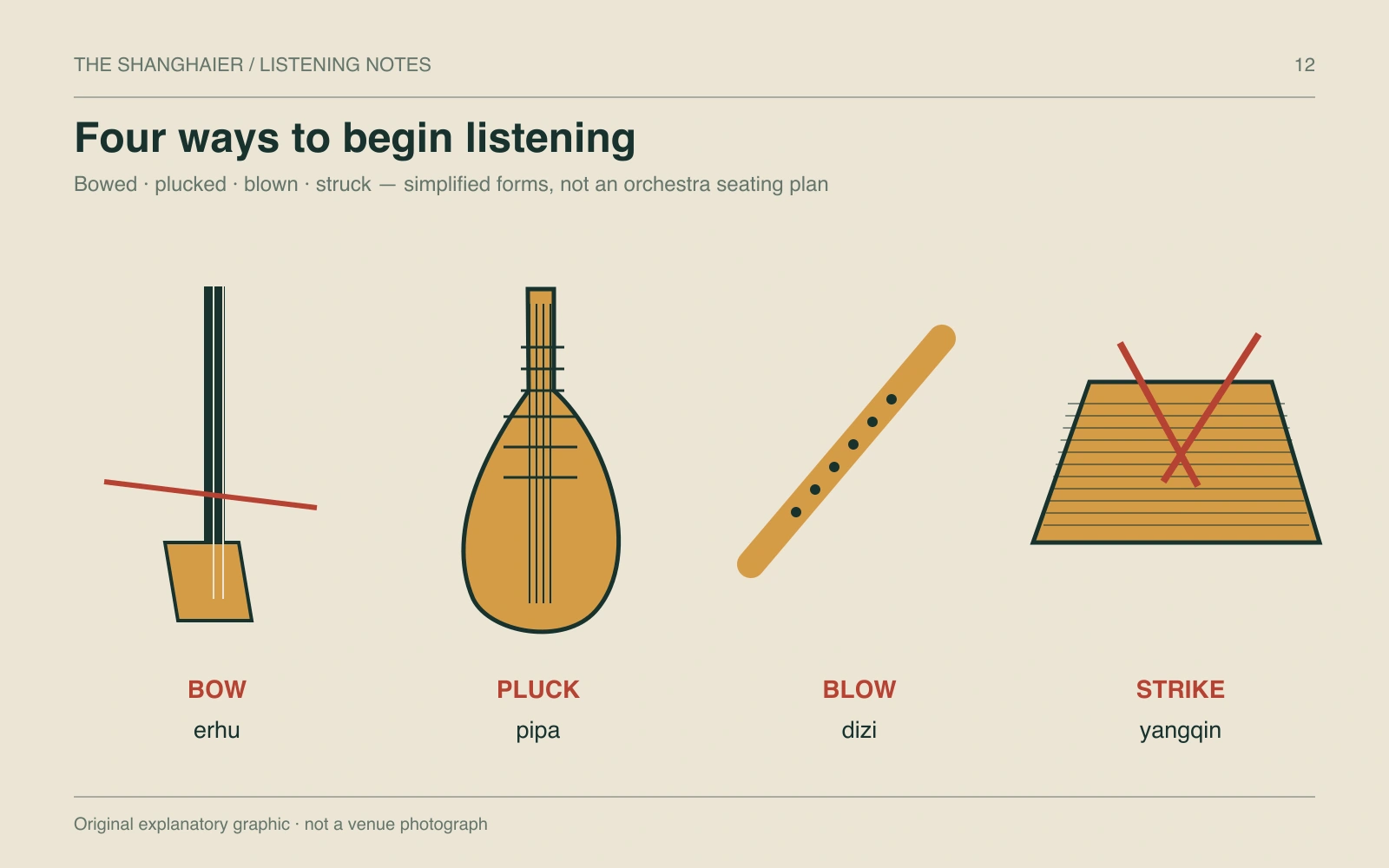
Begin with how a sound is made
The easiest orientation is physical. A bowed string can sustain a line through the motion of the bow. A plucked string starts with an attack and then changes as the sound decays. A wind phrase has a relationship with breath; percussion gives another set of attacks, colours and durations. These are listening handles rather than rigid descriptions of everything an instrument can do.
Do not make the orchestra into an exotic alternative to a supposedly neutral Western sound. Every ensemble asks listeners to learn its balances and conventions. If the instruments are unfamiliar, let that unfamiliarity sharpen your attention. Watch a gesture, hear its result and then listen again without looking. You can build a vocabulary through the performance instead of waiting until you feel qualified to attend.
Bowed strings: follow the line
Erhu, 二胡, is a useful first name to recognise. Its two-stringed, bowed sound can carry a prominent melody, but listening only for a solo misses the work of an ensemble’s bowed section. Notice how several players blend and how the line changes when another section answers. A sustained sound can be firm, delicate, interrupted or highly articulated; “expressive” is only the beginning of a description.
Avoid treating erhu as simply a violin in another shape. Comparison may help you find its role, but the instrument’s own construction and technique matter. In a concert, ask what the part is doing now: leading, supporting, doubling, contrasting or creating a texture. That question remains useful even when you cannot yet tell the related bowed instruments apart from your seat.
Plucked strings: the attack is only the start
Pipa, 琵琶, and zheng or guzheng, 筝/古筝, give different visual and aural clues. Watch the hands when the programme allows a clear view. A quick attack can be followed by a long resonance, and repeated activity can create a sense of continuity that differs from a bow’s sustain. Ruan, 阮, and yangqin, 扬琴, add other shapes of sound; the latter is played with small beaters.
Instead of counting instruments, choose one musical event to follow. Does a plucked figure establish a pulse that another player floats over? Does a passage use isolated sounds or a busy surface? Can you still hear individual attacks when the whole ensemble joins? These questions turn the instrument list into a way of understanding arrangement rather than a collection of decorative Chinese names.
Winds and the scale of a phrase
Dizi, 笛子, is a transverse bamboo flute. Xiao, 箫, is held vertically, while sheng, 笙, is a mouth-blown free-reed instrument with pipes. The forms are useful to recognise, but they should not dictate a story before the player starts. Not every flute passage represents mountains, and not every sustained texture is intended as an ancient spiritual atmosphere.
Listen for a phrase’s beginning and end, then for how it joins the surrounding group. Does a wind line emerge from the texture or arrive as a sharp contrast? Is it answered by plucked or bowed strings? The shift between sound families can be one of a composer’s strongest structural tools. A basic programme note can help you notice it without translating every sound into a landscape.
Percussion can organise the whole room
Percussion includes a wide range of instruments, so do not wait only for the loudest moment. A single punctuation can divide sections; a recurring pattern can hold the ensemble together; a change of colour can redirect attention without increasing volume. Watch how quickly a player may need to move between objects and techniques. The visible labour makes the apparently simple sound more legible.
Compare a passage with percussion to one without it. Does the pulse remain equally clear? Does the melodic phrasing become freer or only seem to? You need not solve the composition while hearing it. Noticing the difference gives you something concrete to discuss afterwards, which is more satisfying than describing the entire evening as beautiful or unfamiliar.
Traditional instruments, current composition
The word traditional identifies histories and practices; it does not establish that every work on the programme is old. Contemporary Chinese orchestral writing can use inherited forms, new techniques, adaptations and collaborations. Read the composer and arranger credits. An arrangement is a creative act, not a transparent delivery system that leaves an original work unchanged.
Shanghai Chinese Orchestra’s documented 2026 programming includes concert and staged formats. Past events are evidence of that range, not tickets you can still book. For your own date, find the ensemble’s current official announcement and match it to a venue’s listing. Some programmes may be strongly visual or narrated; others ask you to attend mainly to instrumental music. Choose the format you actually want.
Build one evening around a verified bill
Check the venue, date, duration and seat category before payment. Do not assume the orchestra performs every programme at one permanent public address. A title circulating online may belong to a completed residency. If there is spoken presentation, ask which language is used and whether surtitles or explanatory material are available. Language may matter much less to an instrumental programme, but the event description should tell you what role speech plays.
My choice for a first visit would be a programme whose instrumentation and overall shape are clear, with enough arrival time to read its notes. Choose two or three sounds to follow and leave the rest open. The aim is a good musical evening, not mastery of a taxonomy. If one player or piece catches your attention, that is a useful starting point for the next concert.