Publication details
First published . Series dates place related notes together in the reading archive.
Start from the street, not the ranking
A skyline photograph makes neighbouring towers look like objects arranged on a shelf. At street level, roads, forecourts, signs and entrances complicate that view. Begin with the outline and then bring your attention downward. How does the broad base meet the ground, where can a pedestrian approach and how much of the building is actually legible from nearby? A skyscraper is a great deal more than its highest occupied view.
I would compare two exterior positions rather than spend the whole visit directly under the tower. From farther away, rotation and taper become easier to read; closer in, the relationship between enclosure and entry takes over. Use public pavements and current crossings. A clear view from a service driveway is not an invitation to stand there. You can learn a useful amount about contemporary architecture without buying an observation ticket, provided you give the ground as much attention as the summit.
A twist can be a design tool
Gensler's account presents the tower's rotating form as part of a strategy addressing wind and environmental performance. The architect's technical paper describes a 120-degree rotation as a project design parameter. Those are project-specific design statements, not a general rule that every twisted tower performs better or a result that can be established by looking up at the facade. Shape is tested within a much larger engineering and environmental problem.
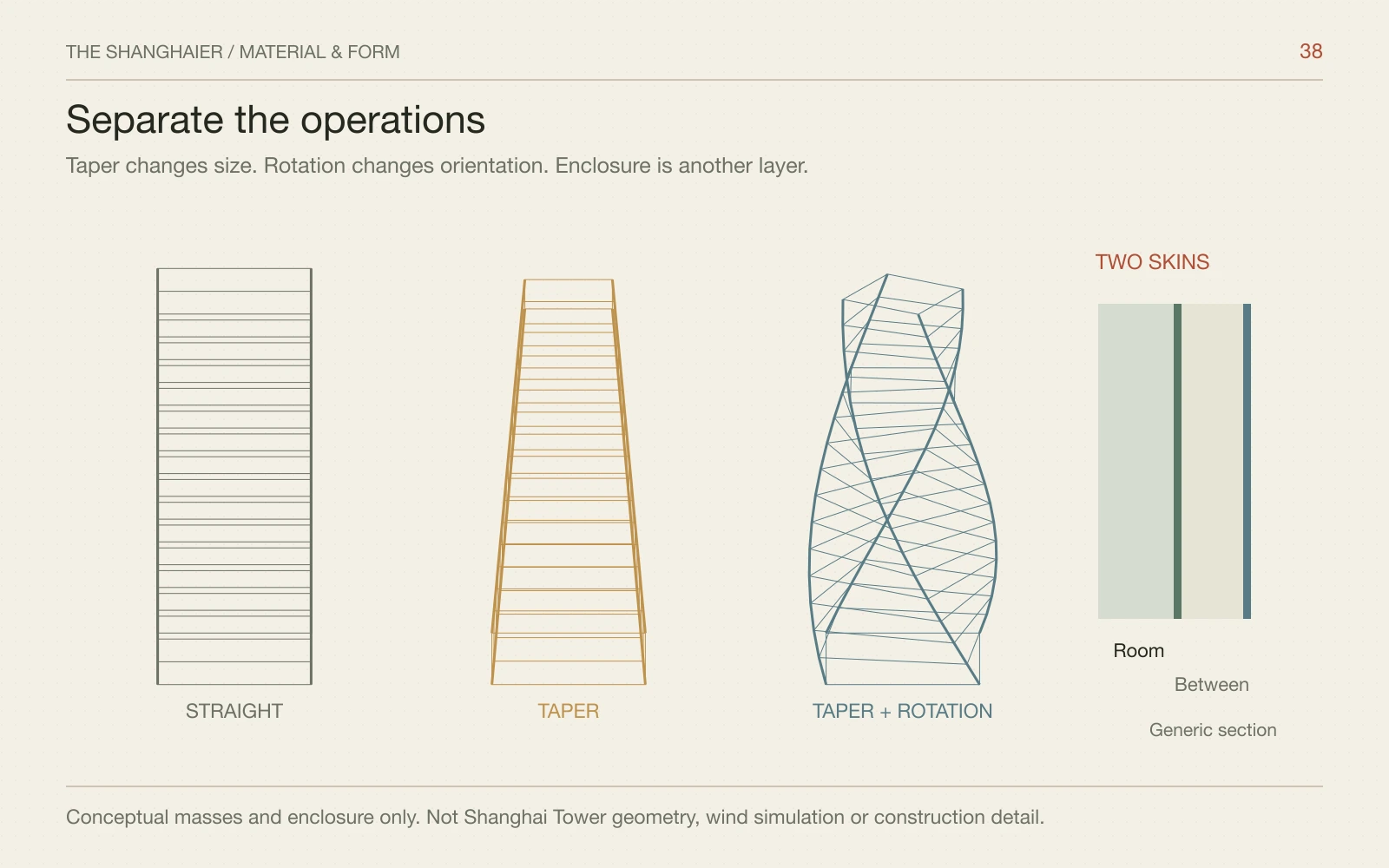
Our three conceptual masses separate straight, tapered and rotating forms so the differences can be seen. They are not computational wind models, and their arrows do not measure force. The practical looking question is simpler: does the silhouette change continuously as it rises, and how does that change compare with the building's taper? Keeping those operations separate gives you a better vocabulary than saying the tower looks futuristic. It also stops the diagram from pretending to prove a performance claim it cannot test.
Taper and rotation are not the same operation
Taper changes the size of the mass as it rises. Rotation changes the orientation of successive sections. A building can use either or both. From one viewpoint the two effects can blend, especially through a reflective outer surface; compare the width near the base with the visible movement of the outline higher up. You may not be able to reconstruct the plan shape from the street, and there is no need to pretend otherwise.
This distinction travels well to the surrounding skyline. Ask which part of a tower's character comes from its overall volume and which from a surface pattern. A grid can make a simple form feel active, while a smooth skin can make a complicated volume appear continuous. The exercise is not to award points for novelty. It is to connect an effect with a visible choice and then ask what other demands—structure, use, servicing or enclosure—might be involved. The answer needs evidence, but the question begins with looking.
Two skins create an intermediate space
A double-skin facade has an inner and outer enclosure with a zone between them. In Shanghai Tower, Gensler links that strategy with atrium spaces and environmental intentions. Our generic section separates occupied interior, inner layer, intermediate zone and outer layer. It is not a construction detail, fire strategy or measured plan of the built tower. Real facade systems contain joints, ventilation arrangements and operational controls that a simple diagram cannot show.
The important point is that a reflective exterior does not necessarily sit immediately outside every room. There can be another spatial relationship behind it. Look for where the outer volume appears to pull away from the occupied form, but avoid turning a glimpse into a claim about public access. An atrium shown in an architect's presentation is not automatically an unrestricted visitor garden. Its design purpose, current use and admission arrangements are separate pieces of information.
Design claims need an owner and a date
Architectural descriptions often move too easily from intended benefit to measured result. A wind-informed shape or a facade designed to reduce environmental loads is a design strategy. To state a particular operating energy saving, you would need an appropriate measured assessment, a baseline and an account of the period studied. Those are different kinds of evidence. This note explains the strategy and attributes it to the designer; it does not turn that description into an independently audited performance report.
That distinction makes the architecture more interesting rather than less. It lets you ask how a proposal is tested, how construction changes it and how use affects the eventual result. A building can be worth studying without every publicity sentence being accepted as a universal fact. I would be equally cautious about a casual dismissal based only on the amount of glass. The performance of a large occupied building cannot be read completely from either a handsome photograph or an unflattering one.
One address does not mean one visitor entrance
The operator's office page gives 501 Middle Yincheng Road, Pudong New Area—上海市浦东新区银城中路501号. It is explicitly an office address. The same site distinguishes the observation experience, hotel, offices, cultural destinations and other functions. Do not use an office contact address as a promise that a tourist can enter there and ride to any floor. A vertically mixed building distributes people through different systems for practical reasons.
For exterior looking, choose a current public-street approach and allow thirty to forty-five minutes if you want two viewpoints. For a paid observation visit, use the operator's dedicated observation information and the entrance directions attached to your actual ticket. Check security, last admission and any weather-related restrictions before paying. This note does not certify a particular sightseeing gate or promise access to sky gardens. If you are heading for a specific bookstore, museum or hotel venue, verify that destination's entry procedure separately.
The ground is where the tower becomes a place
Look at what happens in the last few metres before an entrance. Is the route obvious from the street, does signage distinguish functions, and where does a visitor stop to work out what to do next? The contrast between an easily recognised silhouette and a complicated arrival is a useful architectural subject. A building can be instantly identifiable at a distance while requiring very careful decisions about circulation at its base.
Compare scale as well. Which element is sized for the whole skyline, which for a group entering together, and which for one person finding a door? Large buildings need several scales to coexist. A facade photograph tends to suppress this negotiation; a street visit brings it back. There is no need to enter an office lobby or photograph security procedures to make the comparison. The public edge already tells you a good deal about how a major mixed-use building addresses people who are not its everyday occupants.
A skyline method you can reuse
For the next tower, repeat four questions: what does the mass do, how is it enclosed, how is it used and where does a person enter? If you cannot answer one, leave it open rather than letting a style label fill the gap. Contemporary performance-led design is an approach to organising several demands, not a single official Shanghai style with a checklist of features. Different buildings can give very different answers to the same questions.
I would finish with a broad view that keeps the tower in its streets and a closer image showing one relationship at the base, where photography is permitted. The pair gives you more than a height claim. If you want a guided architecture walk, tell me whether the interest is engineering ideas, street experience or the changing skyline. We can choose a few buildings to compare properly and keep any paid interior visit as a deliberate decision, rather than assuming the highest ticket is always the most informative one.