Publication details
First published . Series dates place related notes together in the reading archive.
Begin with the whole wall
Find a place on the public pavement where you can see several openings together. Read the wall before isolating its most photogenic arch. How many bays can you hold in one view? What marks their edges: a projection, a change of brickwork, the spacing of windows or a vertical feature? The repetition gives a church elevation its pace. A single pointed opening is much easier to recognise than the way a whole wall has been organised, but the latter tells you more.
Then compare the height of an opening with the solid material around it. A tall recess can make a wall seem thin even when there is substantial masonry behind the effect. A projecting edge can cast enough shadow to give a modest facade depth. These are observations you can make without an interior visit. Keep the road and crossing clear while looking; a building's best photograph does not give a visitor ownership of the pavement or the right to step into traffic.
Revival names a later conversation with the past
Gothic Revival refers to a later reuse and reinterpretation of Gothic architectural vocabulary. It does not mean that a Shanghai building was transported from medieval Europe or that every detail reproduces an older structural system. In a city shaped by construction, trade and institutions moving across borders, a style name is the start of a question about design choices. It is not a substitute for the building's date, programme or local history.
At Holy Trinity, keep the institutional history attached to the red-brick church on Jiujiang Road. The official tourism authority's heritage account identifies Gothic features and records the bell tower's addition in 1893. An added tower is already a reminder that the visible building need not belong to one uninterrupted campaign. Look at its relationship to the main volume rather than treating the entire silhouette as a single dated object. If a source gives a date for one component, do not silently use it for every wall.
The pointed arch is a useful comparison
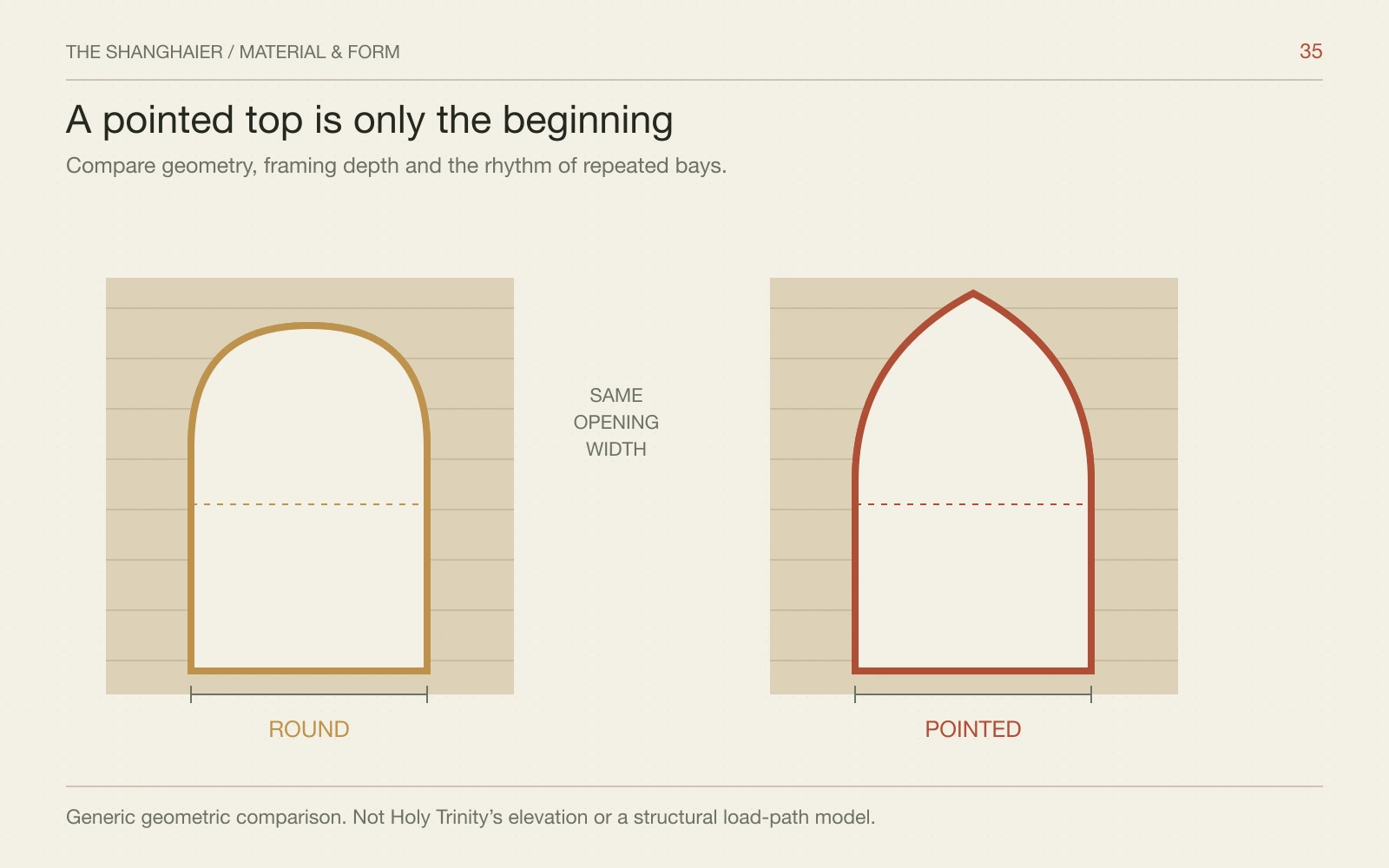
Our drawing places a round and a pointed arch within two deliberately simplified bays. It shows geometry and the space left above an opening, not a structural analysis. The shape can direct the eye upward; its visual force also depends on how narrow the opening is, how its frame is layered and what sits above it. A pointed top on a broad, low opening can read differently from a tall, slender one.
At the actual church, choose an arch and follow its frame. Does it sit flush, step inward or appear within a larger recess? Compare the shadows on the two sides. Those changes are part of the architectural experience even if you cannot name every molding. Do not infer a hidden vault or a load-bearing system solely from the shape of a window. The appearance of a Gothic element and its structural job are separate questions, and a pavement visit rarely resolves the second completely.
Brick has a scale of its own
Red brick makes the church legible at two distances. From across the street it contributes a broad field of colour; close up, the individual units, joints and edges divide that field. Look where the brick turns around an opening or meets a contrasting surface. Small repeated pieces have to negotiate a larger curved or pointed shape. That relationship can be more informative than a photograph edited until every mortar joint becomes a dramatic line.
Weathering and repair also affect what you see. A difference in colour might reflect replacement, cleaning, exposure or another cause; without a conservation record, avoid assigning a confident date to it. I would note the change and keep it as a question. Architectural looking improves when it allows uncertainty. A neat story about old and new brick may be satisfying to tell, but an unsupported story can obscure the real work of maintaining a building that continues to have an institutional and religious life.
A tower is part of a skyline and an approach
A bell tower changes how a church is found and how its main body is understood. Look at where the vertical element meets the lower volumes. Does your eye move through a series of steps or jump immediately to the top? Then shift the comparison to the surrounding streets: the tower may have a different visual role among today's buildings than it had when added. Height is relational, not just a number attached to one monument.
This is where I would resist reducing the whole visit to a tower portrait. The longer elevation tells you about repeated occupation of space; the tower tells you about emphasis and visibility. Both matter. Our graphic is intentionally generic and should not be read as a measured elevation of Holy Trinity. For the actual building, use your own view and any trustworthy historical image with a clear date. A diagram can organise attention, but it cannot establish which parts of a particular church are original.
An exterior visit is the dependable plan
The institutional contact address is 219 Jiujiang Road, Huangpu District—上海市黄浦区九江路219号. That is the church institution's published address, not a separately verified tourist gate. The municipal landscape authority also identifies the neighbouring green space between Jiujiang Road, Hankou Road and Middle Jiangxi Road. It supplies useful geographical context for understanding the church's immediate setting; it does not grant access through the church grounds.
Plan twenty to thirty minutes of exterior looking from public streets. That is my suggested allowance, not a formal opening session. I have not confirmed a general sightseeing timetable or a visitor entrance for the interior. A worship service, an institutional visit reported online and an ordinary tourist opening are three different arrangements. If the door is closed, the plan still works. Do not seek a rooftop or enter an office building for a view simply because someone has posted a photograph taken from there.
If an interior visit becomes available
Use the church's current instructions for the particular date and purpose. Ask whether sightseeing and photography are permitted, whether there is a designated entrance and what areas remain reserved for worship or staff. A service is not a timed architectural performance for visitors. If you attend, let its purpose determine your behaviour and avoid moving around to collect interior photographs. Architectural curiosity is compatible with giving other people the room they came to use.
Inside, the useful continuation would be the relationship between the exterior bay and the space it contains. Can you connect an opening you saw outside with a repeated unit inside? What can actually be observed about the roof and supports, and what remains hidden? Describe the material visible to you instead of assuming an English medieval construction system. If a technical account is unavailable, a careful description of light, rhythm and scale is stronger than an elaborate structural claim made from resemblance.
Carry one comparison into the next street
The payoff is a looking method you can use elsewhere in Shanghai. At the next building, begin again with overall rhythm, then the depth of an opening and the material scale. A round arch does not automatically make a building Romanesque, and a pointed one does not settle its entire style. Several periods and programmes can share a vocabulary while arranging it differently. The specific building should remain more complicated than the label you attach to it.
I would keep one photograph of a whole bay, if you can take it without obstruction, alongside any close-up. The larger view lets you remember what the detail was doing. For a guided architecture walk, say whether you are most interested in materials, religious buildings or the changing streets around them. We can then choose a route whose questions connect, instead of visiting a sequence of famous facades and repeating a different style name at each one.