Publication details
First published . Series dates place related notes together in the reading archive.
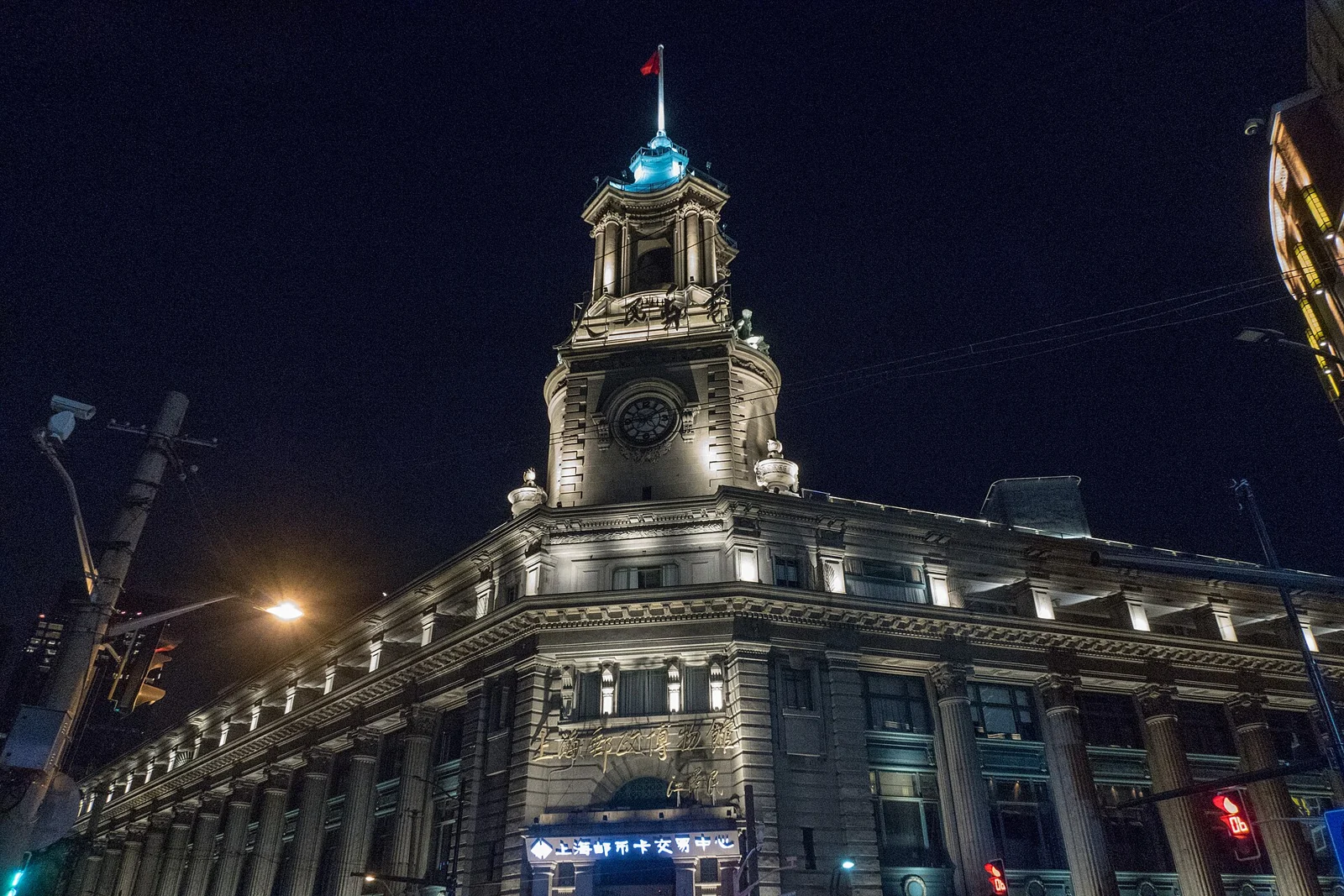

The entrance callout I would actually save on my phone
The museum is on the second floor at 395 Tiantong Road, Hongkou District: 上海市虹口区天潼路395号2楼. The official instructions specify 258 North Suzhou Road, 北苏州路258号, for Wednesday, Thursday and Saturday visits. On Sunday, use 395 Tiantong Road, 天潼路395号. Those are not competing addresses to average out; they are different entrance instructions for different visiting days.
The published regular museum days are Wednesday, Thursday, Saturday and Sunday, 09:00–17:00, with entry ending at 16:00. Admission is free and normally does not require a reservation. Public-holiday arrangements are announced separately. I would check those details before walking over, especially if you are adding the museum to a Monday or Friday river itinerary because the building itself looks accessible.
Why a post office belongs in the story of Shanghai
The General Post Office Building dates to 1924. The Postal Museum first opened in 2006 and reopened on 1 December 2024 after a refurbishment that began that April. I would keep those dates distinct: the age of the building is not the age of the current exhibition, and an old photograph of an interior does not necessarily show the renewed museum.
The subject suits this part of the city. If you are interested in international commerce, think about what had to move besides the goods themselves. Instructions, contracts, news and personal letters all rely on systems of delivery and recognition. I like a museum that lets an apparently mundane service become a way of understanding urban scale. It makes the grand architecture around the water feel less like a disconnected collection of handsome fronts.
Follow one message through a network
My preferred way into postal history is to imagine a single item beginning with a sender and ending with the intended recipient. What has to be legible on it? How is the destination identified? Where is it sorted, handed over and transported? Who is responsible at each stage? A stamp or a document becomes more interesting when you connect it to those practical questions.
That approach also makes the exhibition accessible if you do not read every historical label comfortably. Look for objects and displays that explain a step in a process. You can then use the text to refine what you have understood visually. I would rather leave able to describe a few relationships between objects than remember a succession of dates without a clear picture of the work that connected them.
The address itself is a useful object of attention. A delivery system must convert a place that feels obvious to a local person into information that someone elsewhere can interpret. House numbers, street names and the ordering of a destination therefore belong to the story, not only to the envelope. Visitors experience a small version of this when an English place name and a Chinese mapping result do not immediately match. That is why I include the Chinese address in these notes. It is practical help, but it also makes the infrastructure of naming a little more visible.
The institutional account is part of what you are looking at
The renewed displays cover the origins and development of postal services, postal workers and revolutionary history, networks and services, stamp collections and contemporary business. That breadth tells you that this is both a museum of communication and an institution presenting its own history. I would approach it with interest in both, rather than expect a neutral encyclopaedia of every event involving a letter.
Notice which kinds of achievement receive space: service, organization, technology, labour or commerce. Then ask what kind of city each emphasis makes visible. This is a useful habit in many museums. You can learn from an institutional account while recognizing that the account has a point of view. The question is not whether to accept or dismiss it in one gesture, but what particular evidence and interpretation each display offers.
Stamps reward a slower scale of looking
A stamp is a tiny object that has to communicate efficiently. I would look at one as a design problem: a restricted surface, a recognizable value, a destination system and an image meant to carry meaning. Enlarging that thought is more interesting than trying to see the greatest possible number of examples. What would remain understandable if the object were viewed quickly, from a distance or by someone unfamiliar with the picture?
For a visitor interested in graphic design, this is a useful counterpart to the scale of the building. One works through a monumental façade, the other through minute information. Both organize public recognition. That comparison is my reason to slow down in a section other visitors may hurry through. You do not need to be a collector to appreciate how much a small printed object is being asked to do.
Look at the building without assuming every part is a public attraction
The General Post Office still has postal-service functions. That gives the address an everyday life beyond a heritage listing, but it also means access is not the same as wandering through an empty historic mansion. Follow the museum route and signs. An open postal counter is not proof that the exhibition upstairs is open, and a familiar photograph of the building is not a map of permitted access.
I would be particularly cautious about promising the rooftop. Old descriptions and travel photographs can make a roof garden sound like a guaranteed part of the visit, but I do not have a current official guarantee of that access. The building and museum are enough reason to come. Plan around what is confirmed, and treat any additional public area offered on the day as an extra rather than a failed expectation.
A sensible route begins at Tiantong Road
The official guide points to Tiantong Road station on Metro Lines 10 and 12, Exit 3, followed by a walk of about 400 metres. Once outside, use the entrance required for that day rather than following only the nearest museum pin. Save both the museum name, 上海邮政博物馆, and the appropriate Chinese street address. A second address in your notes is useful here, not redundant clutter.
I would allow roughly an hour to ninety minutes for a selective visit, longer if postal history or architecture is a strong interest. This is a recommendation for an unhurried stop, not a rule imposed by the museum. It fits well before lunch or a river walk because it leaves space for the rest of the city. Free admission does not make it necessary to treat the visit as a hurried look through the door.
Use Suzhou Creek as the continuation of the subject
Afterwards, I would return to the water and think about movement: the movement of people, information and things, and the buildings created to coordinate it. A walk towards the riverfront is a natural pairing because the museum has already supplied a specific question. You are no longer just collecting façades; you are asking what work their owners and occupants needed the city to perform.
I would not add another distant museum by default. This stop is strongest within a compact day around Suzhou Creek and the northern side of the central waterfront. If you enjoy the contrast between visible architecture and hidden systems, keep following that contrast on foot. A good small museum can sharpen an entire walk precisely because it has not used up all your attention before you step outside.