Publication details
First published . Series dates place related notes together in the reading archive.
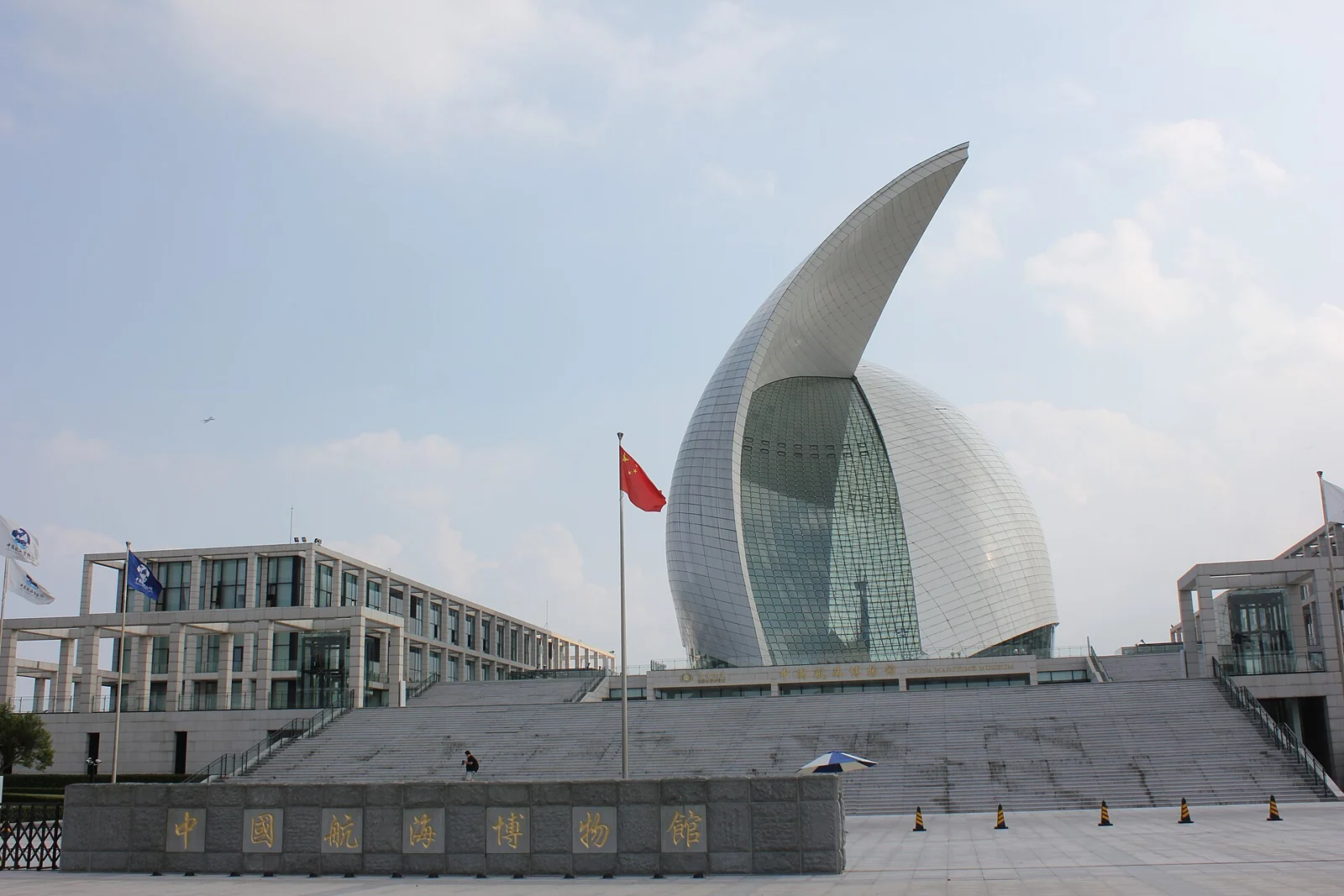

A port city makes more sense when you stop looking only at its façades
The Bund gives you an immediate architectural image of Shanghai’s international connections. A maritime museum takes the subject into less photogenic but more fundamental territory: hulls, channels, berths, equipment and work. I like that change in emphasis. An elegant office building can tell you who accumulated money; a ship and a port can help explain how people and goods moved in the first place.
That does not mean every visitor needs a specialist museum. I would choose this one if a cargo ship, a chart or the construction of a wooden vessel already prompts questions. If you mainly want a short introduction to Shanghai’s urban history, a central historical museum is easier. The attraction here is the depth of a particular subject, not a claim that all Shanghai history can be fitted inside one building.
Begin with a hull and ask what the shape is doing
The reconstructed Ming-era Fujian-style ship provides a strong focal point. I would begin by recognizing it as a reconstruction that makes a historical type legible, rather than treating it as an intact vessel pulled from a wreck. That distinction helps you look at the choices in its design without confusing a teaching object with an archaeological survival.
Look at the relationship between width, height, internal space and the way a vessel meets the water. You do not need to calculate displacement to recognize that a ship’s shape has consequences. What could be carried? Where could people move? What has to withstand force? A large reconstruction allows you to ask those questions at a scale that a small model cannot. I would spend time on one convincing question before moving to a wall of ship types.
A model is useful when you compare it with another
A row of models can become visual wallpaper if you approach it as an inventory. I would choose two vessels with visibly different purposes and compare them. Where is their volume concentrated? How is cargo separated from machinery or accommodation? What does the arrangement suggest about loading, propulsion or the conditions in which they operate? The museum’s broad coverage of ships gives you room to make that comparison.
This is also a good way to visit with children without turning the day into a quiz. Ask which difference they notice first, then look for an explanation together. Avoid rewarding only the identification of a name. Being able to describe why two hulls are shaped differently is a more substantial achievement than knowing which model is the largest or which ship would win an imaginary race.
Navigation is a problem before it is a gadget
The museum separates navigation history from the ship itself, and I would preserve that distinction in the visit. A seaworthy hull does not tell a crew where it is. Think about direction, position, depth and the interpretation of conditions as separate pieces of information. An instrument becomes much more interesting once you understand what uncertainty it is meant to reduce.
I would not hurry directly from historical navigation to a modern simulator. Put the two in conversation. What information is visible, what must be inferred, and what happens when the information is incomplete? The important comparison is not simply old versus new. It is the changing relationship between human judgment, a reliable measurement and a machine that presents an answer. That question remains useful even when the technology is unfamiliar.
A chart is worth treating as a selection, too. Its purpose is to support a particular kind of decision, so the information important to a navigator may not resemble the information that dominates a tourist map. Look at the relationship between symbols, numbers and the area being represented. Before trying to decode every mark, ask which decision the reader needs to make. I find that question far more productive than admiring an old chart only as a decorative surface. Technical beauty often comes from the discipline of making complicated information usable under constraints, rather than from decoration added afterwards.
Give the port and the sailor equal attention
The institution’s six principal subject areas cover navigation history, ships, navigation and ports, sailors, maritime safety and military navigation. I would use that range to escape the assumption that maritime history is only the history of famous vessels. A port is a coordinated system. Cargo needs to reach a berth, be handled, be recorded and continue somewhere else; a sailor works within an organization rather than an adventure story.
The safety material belongs in that account too. A good technical museum makes routine competence visible, even when spectacular accidents attract more attention. I would ask what has to go right every ordinary day for the system to function. That is often the missing perspective in tourist descriptions of Shanghai: the infrastructure appears monumental, but its usefulness depends on repeated, skilled and frequently uncelebrated work.
The ticket is for this museum, not a separate submarine attraction
The official ticket service is explicit that admission at 197 Shengang Avenue does not include Shanghai Submarine Exhibition Hall. I would put that distinction near the top of any family plan. A child promised a particular submarine is unlikely to appreciate the administrative difference after arriving at the wrong destination. Book the attraction you mean, not the name that sounds approximately right.
Use the museum’s own ticket portal or its official WeChat account, 中国航海博物馆. Historical pages remain searchable and can carry superseded prices or schedules inside the body while displaying newer information in the footer. I would read the live ticket date and current notice as the operational authority. For an overseas document, confirm the correct registration route before departure rather than assuming an identity field is interchangeable.
Give the address enough geographical context
The address is 197 Shengang Avenue, Pudong New Area: 上海市浦东新区申港大道197号. The museum is in Lingang, near Dishui Lake. Metro Line 16 reaches the lake area, but you still need the final local journey. I would check that leg on a current map and keep the Chinese address saved. Do not confuse a Pudong location with being near the downtown riverfront.
I would set aside roughly three hours for selected galleries, then add the actual travel time from your accommodation. That is my suggested allocation, not a promise about a fixed visit duration. Regular closure is Monday in the museum’s visitor material, with exceptions announced for holidays. Check the current entry calendar for opening and last-entry times; I would not base a long trip on an old search-result snippet.
What I would pair with it—and what I would leave for another day
A break around Dishui Lake is the natural accompaniment. It gives the day a coherent local setting and a chance to stop absorbing information. Shanghai Astronomy Museum is another possible Lingang destination, but I would select it as the second museum only for people who actively want an intensive day. Two substantial collections do not become easy merely because they share a metro terminus.
My preference is Maritime as the day’s main subject, an unhurried meal, and a little time outside if the weather allows. When you return to the central riverfront, look at the city through the practical questions the museum raised. That is the satisfying connection: a museum visit should change what you notice afterwards, not simply add another admission ticket to the record of your trip.