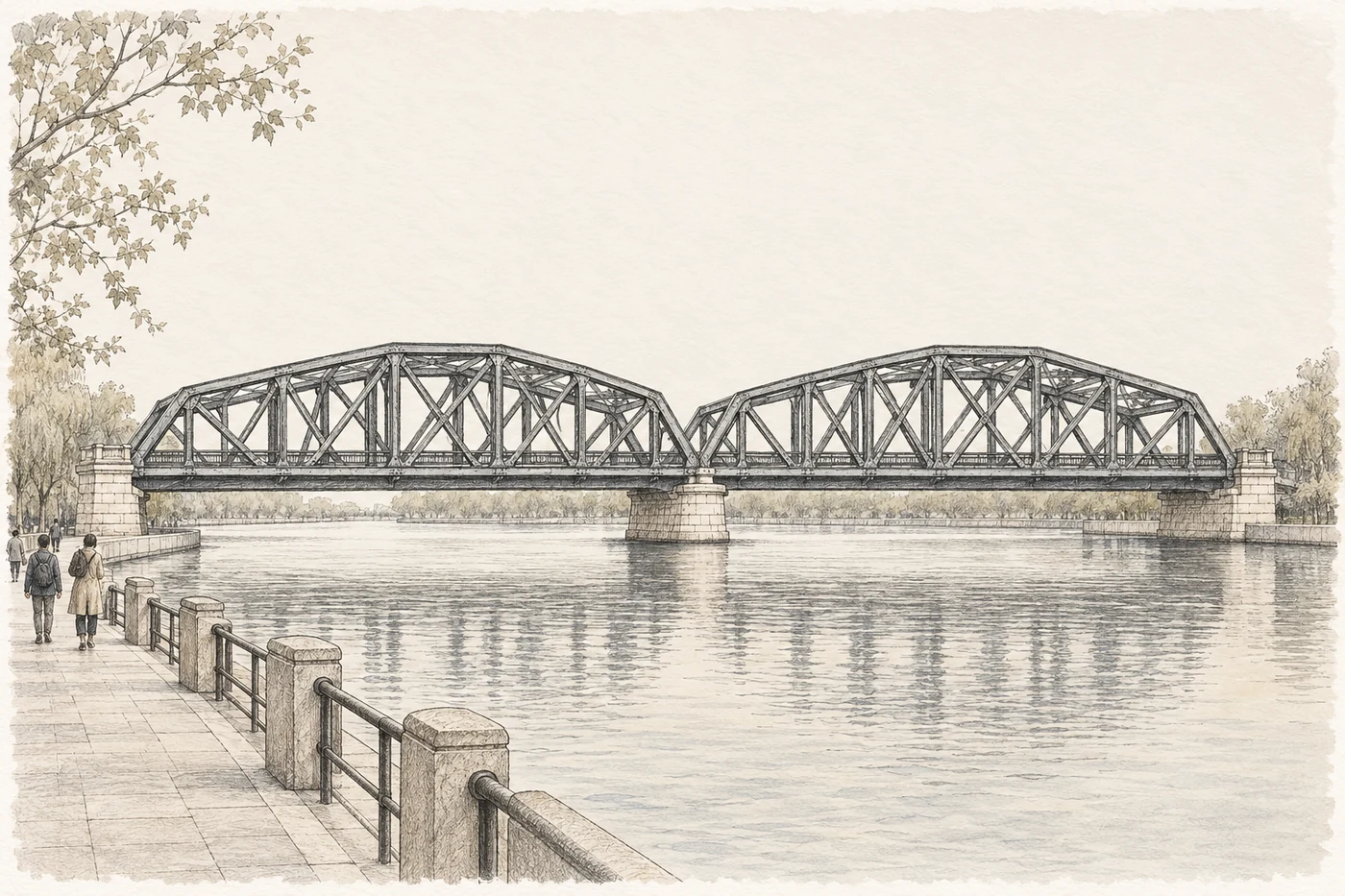
Choose a short stretch
Suzhou Creek is too long to treat every named destination as part of one casual stroll. Begin with a compact section and one question. Near its meeting with the Huangpu, for example, bridges and the relationship with the Bund can provide the organizing idea.
Shanghai's municipal architecture guide presents the creek through individual landmarks and their histories. Use it to prepare a few places, then allow time between them. A good comparison often needs two buildings and a pause, rather than ten addresses.
Let a bridge change the view
Before crossing, look along your current bank. After crossing, look back. Notice which entrances, facades or edges become legible from the opposite side. A building that seemed like background may become the main event when the viewpoint changes.
Keep observation separate from an assumption about original use. A waterside position can suggest questions about movement and trade, but it does not identify the history of every structure. Read the plaque or consult a building-specific source before supplying a confident story.
Ask what a new use keeps
Older buildings now used for culture, retail or hospitality invite a useful pair of questions: what remains visible, and what has the new program changed? Compare thresholds, signage and the relationship between inside and outside. A preserved exterior and an unchanged interior are different claims.
The broader Suhewan area has also hosted contemporary fashion events, including LABELHOOD's October 2025 festival. That dated example is a reminder that heritage districts can support present-day creative activity. It is not evidence that the event is running when you arrive.
Leave room for the ordinary edge
Not every interesting observation needs a named monument. A change in pavement width, a place to sit or the way a path meets a road can tell you how a waterfront is being used. Notice how the setting works for someone passing through as well as someone stopping to look.
Check the current route for construction, crossings, weather and venue access before a longer walk. Indoor stops have their own opening and ticket arrangements. The history walk explores a central stretch around the Bund and Suzhou Creek. Ask about a longer itinerary if you want to follow the water farther.