Publication details
First published . Series dates place related notes together in the reading archive.
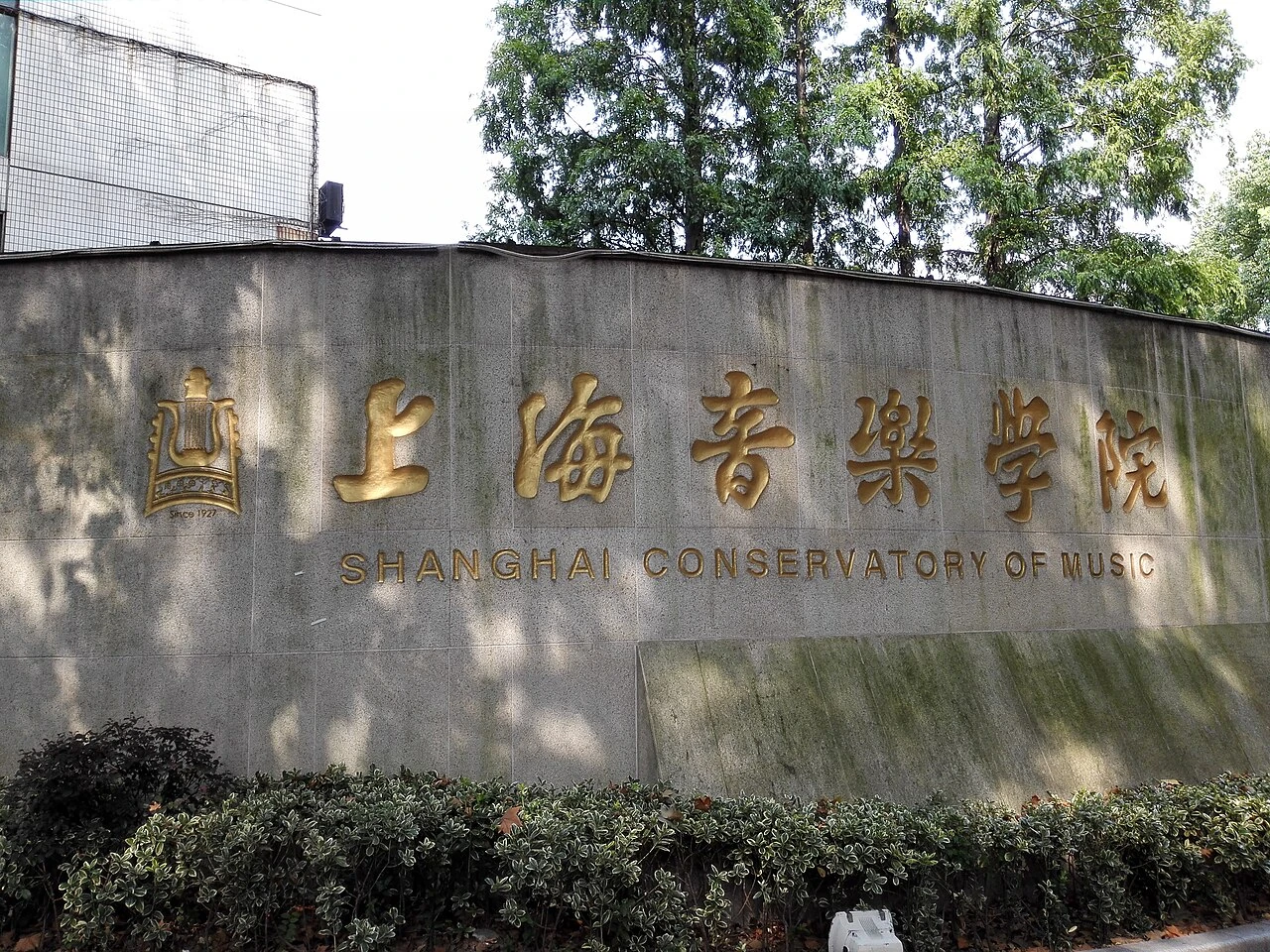

Begin with a working institution
Shanghai Conservatory of Music gives its address as 20 Fenyang Road, Xuhui district: 上海音乐学院,徐汇区汾阳路20号. Its institutional history starts with the National Conservatory founded in 1927. That is enough orientation to begin; a visitor does not need a roll call of famous alumni before looking at the street. The more interesting question is what it means for specialist musical training to occupy an ordinary piece of the city rather than an isolated visitor attraction.
Approach from the public pavement and notice the entrance, the scale of the buildings and how institutional frontage meets surrounding shops and housing. A gate may be memorable, but it is also doing a job. Do not follow a student through it on the assumption that a historic campus is an open garden. Public performances and particular exhibitions have their own entry arrangements. Admission to one does not give general campus access.
Let the streets be the walk
Fenyang Road is the starting subject, not a promise of an uninterrupted soundtrack. You might hear music; you might hear traffic and deliveries. Both belong to a functioning neighbourhood. Resist the temptation to treat a faint instrument behind a wall as a private performance for visitors. Carry the idea of musical work with you without searching for somebody’s practice window.
For an easy outing, choose a short street segment and return by a parallel public route rather than setting a distant landmark as a compulsory finish. Check the actual junctions on your map before starting. Tree cover, pavement space and crossings matter more to the afternoon than the shape of a line on a promotional map. Allow time to stop without blocking entrances, cycle lanes or the flow through a narrow stretch.
The concert is a separate booking
Shanghai Symphony Hall is at 1380 Middle Fuxing Road: 上海交响乐团音乐厅,复兴中路1380号. It gives this part of the city a practical evening destination. The Conservatory and the Symphony are related to the same broad musical neighbourhood, but they are different institutions. An event with a Conservatory connection could be held somewhere else, and a concert at Symphony Hall is not a campus visit.
Read the venue field on the ticket rather than navigating to the organiser’s general contact address. Then check the particular hall, performance date and start time. A short walk works well before a booked concert because it gives the evening some physical context. It works badly when an ambitious shopping itinerary leaves ten minutes to locate the entrance and find a seat. Let the performance set the boundary.
What to look for before listening
A music district can be read through quite ordinary details: an instrument case, a score in a shop window, a programme notice, the difference between a teaching building and a public auditorium. None requires photographing a stranger. One useful exercise is to look for the point where a private working environment becomes a public cultural event. A poster tells you something about that transaction; an impressive facade alone does not.
Read programme titles carefully. A recital suggests a different scale of evening from a full orchestral concert. A competition round has another rhythm again, with several performers and rules about audience movement. You do not have to prefer one format. Knowing what sort of event you have chosen makes it easier to enjoy it on its own terms instead of expecting every ticket to deliver a grand ceremonial night.
A pause with a function
My preference would be a seated break that leaves the next step simple. Choose somewhere by the time you have, whether you want food, and how easily you can reach the actual venue afterwards. A photographable cup is a weak reason to cross the neighbourhood twice. Keep dinner and listening in proportion: arriving hungry is distracting, but so is checking the time throughout a meal because the curtain is approaching.
Use the pause to read the programme, not to memorise a composer biography. Find the players, the instruments and the order of the pieces. Pick one thing to listen for: a returning theme, the conversation between soloist and ensemble, or the change in scale between two works. That gives an unfamiliar programme a handle without turning the evening into homework.
Keep photography on the public side
Historic buildings make this area tempting to photograph, but institutional and residential boundaries still apply. A door left open is not an invitation. Avoid photographing identity checks, students at close range, teaching rooms or work through windows. If there is a public exhibition, ask about photography inside it; the answer may differ from the rules in a performance space.
The same distinction improves the pictures. A street view explaining how a building sits among its neighbours is often more useful than a tight crop pretending the surrounding city does not exist. Take the entrance as one part of a sequence, then give the pavement and junction equal attention. The subject here is music embedded in a neighbourhood, which is difficult to show if every trace of the neighbourhood is removed.
An afternoon that can stay small
Without a ticket, this remains a modest exterior walk. That is a legitimate outing. Do not fill the missing concert with promises of impromptu campus access or an imaginary visitor centre. With a ticket, leave a generous arrival margin and keep the Chinese venue name available offline. If rain or heat makes the street section unpleasant, shorten it; the musical evening does not depend on completing a route.
If you would like help shaping the walk, tell me whether the interest is architecture, recorded music, contemporary composition or hearing one performance. Those are different afternoons. I would rather connect two things properly than send you past ten musical addresses whose doors you cannot enter. The district becomes useful when its working life and your own time are both taken seriously.