Publication details
First published . Series dates place related notes together in the reading archive.
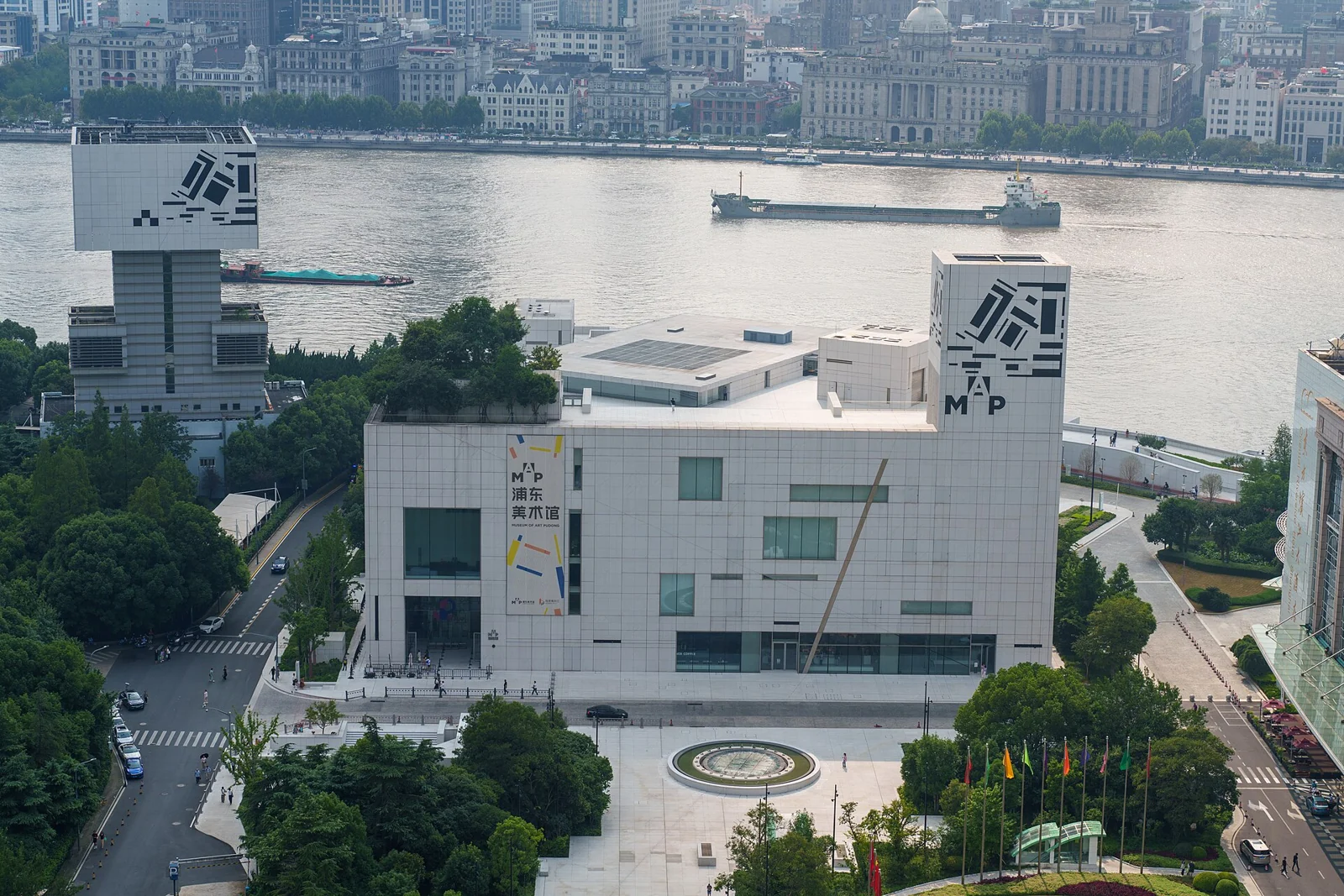

The address and the entrance are not quite the same instruction
The museum’s address is 2777 Binjiang Avenue, Pudong New Area, 上海市浦东新区滨江大道2777号. Its Chinese visitor guide directs entry from Fucheng Road near the Mingzhuta Road intersection, 由富城路近明珠塔路口进. I would save both pieces. A riverfront address tells a driver where the museum is; the entrance note tells you where to approach on foot. It is particularly useful in Lujiazui, where large plots and changes in pedestrian levels can make a place look closer than the available route.
The current visitor page lists daily 10:00–21:00 opening, last admission 20:00. Ordinary daily reservations have been removed: visitors can enter with a ticket, although peak crowds can trigger timed entry controls. The Chinese page is clearer and more current on this point than the English visitor page, which still refers to making an appointment after purchase. I would follow the current Chinese admission notice and the instructions on the exact ticket you buy, rather than repeat an obsolete blanket reservation requirement.
A museum designed for this river edge
Museum of Art Pudong opened in July 2021 and was designed by Ateliers Jean Nouvel. The architect describes a domain extending beyond the enclosed galleries: pale stone, trees, public ground and a deliberate relationship to the Huangpu. I find that a more useful starting point than the building’s place on a list of international architect projects. A museum’s boundary is not necessarily where its climate-controlled rooms end. Its approaches can begin shaping the visit before a ticket is checked.
I would look at the horizontal surfaces as well as the facade. What appears continuous from a distance may reveal a pattern, joint or change of level nearby. The comparison is especially interesting against Lujiazui’s tower landscape. A low museum can claim attention by controlling the ground and the edges of a view rather than by trying to become the highest object. My preference is to see it with a little city around it, where that choice becomes legible.
The Large Glass changes the usual skyline encounter
Nouvel’s project places large glass surfaces towards the Bund, turning the opposite bank into an architectural subject. I would give this part of the building time, but I would not make it the sole reason to buy an exhibition ticket. The attraction is the relation between the room, the glass, reflected light and the city beyond. Stand still long enough to notice which part of the image belongs outside and which part is being produced by the space you occupy.
That is different from looking through a perfectly invisible window. Reflections can place the visitor inside the view and make the room appear to continue. My interest is in that mild uncertainty, especially after looking at art concerned with perception or composition. The city becomes another image with edges and conditions. You can enjoy the Bund’s buildings and still notice that the museum is arranging your encounter with them. A view is not neutral simply because the scenery is real.
International exhibitions need a specific reason
The museum’s stated purpose includes international exhibitions, Chinese artists, education and cultural exchange. For a traveller, that raises a reasonable question: why use a Shanghai afternoon to see art from somewhere else? My answer would depend on the exhibition. A coherent selection, unusual loans or a subject that matters to you can justify it. The country of origin of the works is less important than whether the encounter adds something you could not get from an arbitrary hour in another museum.
I would not recommend a show merely because its title contains a famous name. Look at the actual selection and the proposition. Is it a retrospective, a focused period, a dialogue with other artists, or a display of a collection assembled for a different purpose? Those formats create different experiences. A smaller, tightly argued show may be better for a first-time visitor than a broad survey that assumes considerable prior knowledge. The most recognisable advertisement is not automatically the most useful choice.
Morandi offers a good test of attention
In October 2026, the museum lists Giorgio Morandi. Solo through October 28, 2026. That end date is close, so I would treat it as a specific current opportunity rather than a permanent attraction. Morandi’s still-life subject matter offers a useful way to describe the kind of looking I value: small differences in position, interval, contour and colour can carry a painting. You do not have to start with a dramatic subject for a picture to ask a substantial amount of attention.
I would compare the space between two forms before deciding which object is the main one. A group of bottles or vessels can become a conversation about distance rather than a catalogue of possessions. That method remains useful beyond this exhibition. In a large international museum programme, the quieter work can make a stronger demand than the spectacle. The judgement should come from what the picture does, not from its ability to hold its own on a social-media screen.
Hall X and the question of scale
The museum’s current programme also lists Carolina Caycedo’s Salute of the Whales in Hall X through February 21, 2027. A large installation invites a different relationship from a small still life. I would begin by asking how the work positions the body: where it can be seen together, where it breaks into parts, and how the vertical distance changes the experience. A monumental room can make a small intervention look weak, or it can make that smallness the point. Scale is a relationship, not simply a measurement.
I would resist using immersive as an automatic compliment. A room can surround you without giving you much to think about. The more interesting test is whether the surrounding changes the meaning of a material, an image or a movement. Spend enough time to identify one such change. If you cannot find it, that is also a legitimate response. Contemporary exhibition design should not make a visitor feel that enthusiasm is compulsory because the room was expensive to construct.
Use the evening hours deliberately
The 21:00 closing time makes MAP a useful option when a day has already been organised around outdoor sights or work. I would arrive with a proper viewing interval, not at 19:55 expecting the last-admission deadline to function as a suggested arrival time. Two hours can still be selective in a museum with several exhibitions. Choose an anchor, then see what energy remains. Evening light at the river is a bonus rather than a reason to spend the whole visit waiting for darkness.
There is also a trade-off in stacking attractions around the museum. TheOriental Pearl Tower, nearby commercial centres and the riverside can turn a supposedly compact plan into a long succession of queues and lifts. I would choose one major indoor experience. MAP followed by a riverside pause can make more sense than MAP plus an observation deck plus every mall in Lujiazui. Different kinds of looking need room between them if you want any one of them to remain distinct.
Tickets and the afternoon I would choose
The museum’s official ticketing page links foreign visitors to its Trip.com ticket route, alongside the official WeChat mini-programme. I would start from that museum page, choose the date and the product, and check what exhibitions it includes. A day ticket, concession or special exhibition option should not be assumed interchangeable. The venue has no car park; the visitor guide directs drivers to nearby paid parking facilities. For most central visitors, the metro plus a short final walk is simpler than making parking the first cultural experience of the day.
Allow around two to three hours for one serious exhibition and a selective look at the building, longer for multiple shows. Afterwards, I would stay on the Pudong riverfront rather than immediately cross back just to photograph the same museum from the Bund. The two banks offer different relationships to the city. Here you look towards the historical waterfront from a contemporary cultural building. Let that position be the subject for a while. A Shanghai visit becomes richer when the familiar view is allowed to produce a new question.