Publication details
First published . Series dates place related notes together in the reading archive.
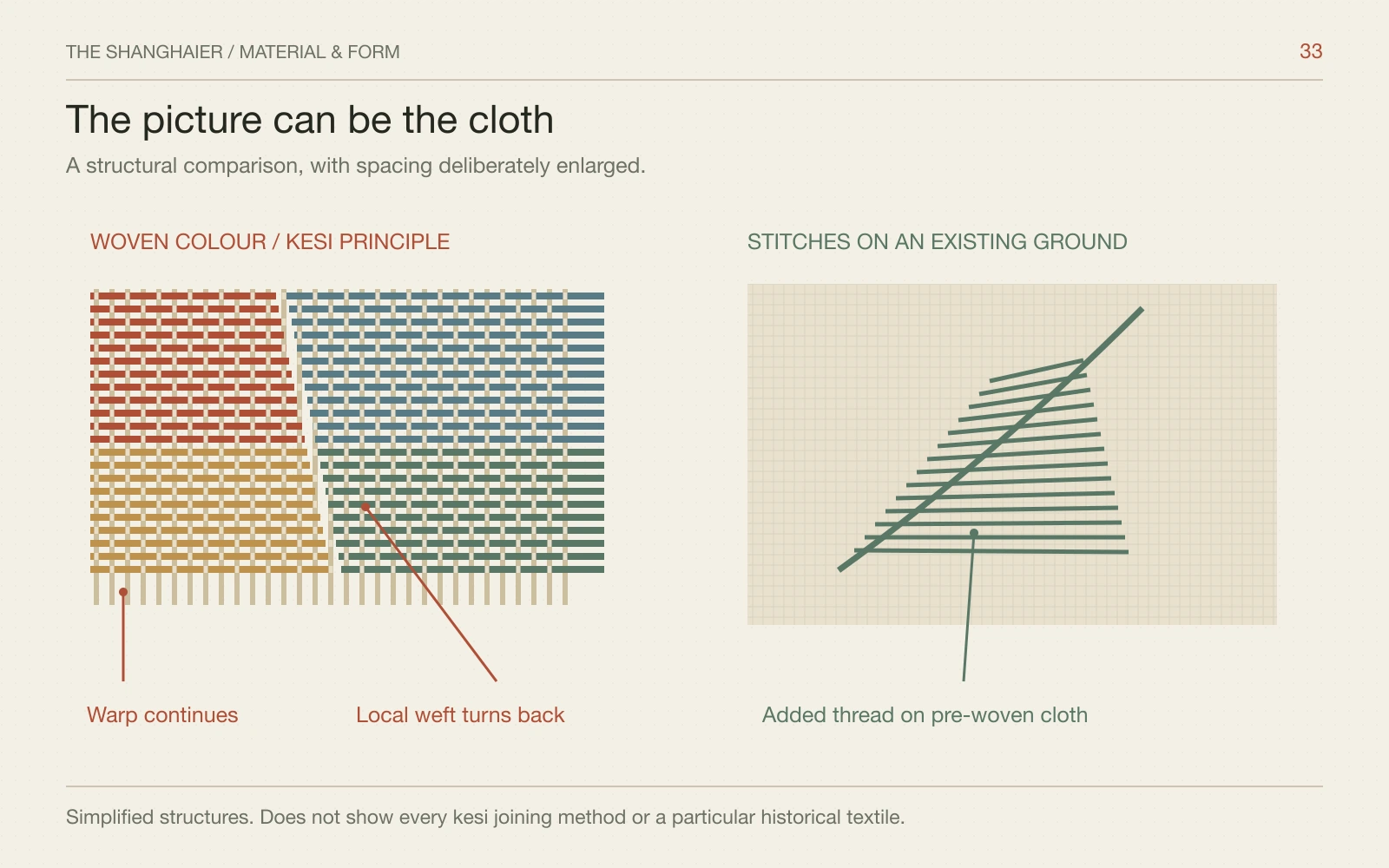
The picture can be the cloth
With embroidery, stitches are added to a ground that already exists. In kesi, coloured wefts are woven with the warp to form the textile image itself. That is the basic distinction to hold onto before learning a long vocabulary. Two objects can both show a flower in silk and still have been constructed in different ways. Similar subjects, colours or apparent fineness do not make their structures interchangeable.
Try looking first at the label's technique field rather than the scene. If it says silk tapestry or kesi, carry the idea of local areas of woven colour into the image. If it says embroidered silk, look for the relationship between the added stitching and the support. Neither is a prestige ranking. A beautifully made embroidered object does not become less impressive because another maker wove a picture; what changes is the problem the maker had to solve and the evidence you should seek.
Warp continues; coloured weft turns back
Warp is the set of threads running along the length of the working textile. Weft passes across it. The Palace Museum's technical explanation of kesi describes continuous warp with separate coloured weft passages: each colour works through its own part of the image rather than travelling across the entire width. Small shuttles make those local passages possible. The familiar Chinese shorthand is 通经断纬, continuous warp and discontinuous weft.
Our drawing enlarges three coloured regions so the principle is visible. It is not a weaving draft or a diagram of every joining method. Real boundaries can be handled in different ways, and an apparently continuous patch may conceal considerable technical work. Use the schematic to ask how a shape was made to turn, narrow or meet another colour. Do not expect to identify the whole structure by finding one convenient hole in a finished object; mounting, scale and the particular technique can all limit what you see.
An edge is a sequence of decisions
Follow a diagonal in the woven image. A changing boundary has to be made from successive thread passages, rather than drawn with one uninterrupted sweep of a brush. Look at how the edge advances, whether the transition is abrupt or gradual and how the shape relates to neighbouring colours. The object can be persuasive at a normal viewing distance even when a magnified detail reveals a highly structured sequence. Enlargement teaches you about means; it should not become a demand that every line imitate a photograph.
The China National Silk Museum's explanation discusses ways of handling colour transitions, reminding us that the basic continuous-warp principle is only the beginning of the craft. Rather than memorising technique names without examples, find a passage with a gentle transition and another with a clear boundary. Which suits the subject? A sharply separated silhouette and a shifting patch of plumage ask different things of the weaver. The interesting question is how the textile answers them, not how many colours the label can count.
Do not make the two sides a visitor test
You may encounter descriptions stressing kesi's relationship between front and back. That is useful technical context, but it does not mean a museum visitor should expect to turn over a mounted textile or a buyer should insist on handling a fragile work. A display offers only the evidence its arrangement permits. If the reverse is unavailable, record that limit rather than inventing a result. A technician or conservator may have information the case cannot show.
The same caution applies to the term handmade. A detailed image, uneven edge or expensive price cannot independently prove a production method. Ask for documentation when that claim affects a purchase. For looking, let the visible structure and the object label work together. There is plenty to notice without appointing yourself an authenticator. I would rather understand one boundary properly than claim to have solved an object's manufacture from a phone close-up taken through glass under mixed lighting.
Suzhou is a regional visit, not a neighbourhood
Suzhou belongs naturally in a Jiangnan craft conversation, but it is a separate city in Jiangsu, not a Shanghai shopping district. If you are travelling from Shanghai, plan a proper regional outing and confirm your transport independently. The silk museum is at 2001 Renmin Road, Gusu District—江苏省苏州市姑苏区人民路2001号. Keep the Chinese address available so the destination does not get confused with a commercial silk showroom using a museum-like name.
A sensible first visit can focus on the relationship between raw material, weaving and finished object. You do not need to exhaust every textile category to learn something useful. My suggestion is to allow ninety minutes, then decide whether another Suzhou stop still appeals. That is a reading pace, not an advertised official tour. Avoid making a train connection depend on a demonstration starting precisely when you arrive; the presence of a craft programme in a museum's remit does not promise daily performances at every loom.
What the museum currently promises
The Suzhou Silk Museum's own site lists its principal opening as Tuesday–Sunday 09:00–17:00, with entry stopping at 16:00 and Monday closure except national holidays. It lists a different schedule for its Future Museum, so check the particular building you want before treating Monday as an ordinary full visit. This operator information was checked online on 24 October 2026. Temporary closures and programme changes can still affect individual rooms.
The current display of a particular historical kesi object was not established by that general opening notice. If a named textile is the reason for your journey, ask the museum whether it is actually on view and for how long. Ask separately about weaving demonstrations and photography. A collection database establishes ownership; an exhibition announcement establishes a display for a given period. Confusing the two is an easy way to produce an attractive itinerary whose most important encounter turns out to be in storage.
Three questions make a label more useful
Technique, material and maker or date are enough to begin. Technique tells you whether the picture is woven, embroidered, printed or made through another process. Material prevents silk-like appearance from standing in for a fibre identification. Maker and date place the work in a specific production context, with uncertainty acknowledged where necessary. A label that offers only a poetic title and the word heritage is giving you atmosphere rather than much usable object information.
If you are buying contemporary work, ask how the image was developed and whether the piece is made by the named seller, by another maker or by a workshop. There is nothing inherently wrong with a workshop, provided it is described clearly. Ask for dimensions, care guidance and a written description of the technique. Do not let a general saying about the value of kesi become a price guarantee. An individual textile still needs an individual account of its making, condition and intended use.
What I would take away from the case
Choose one small shape and explain its construction in a sentence you could say to a friend: this colour turns back here, while these lengthwise threads continue. If you can do that without calling it embroidery, the diagram has served its purpose. Then return to the overall picture. Technical knowledge should let the image become richer, not reduce every object to a specimen of crossing lines.
A contemporary textile can reward this attention without a palace story attached to it. The same goes for a modest educational sample with a clear description. I would prefer either to an object sold through vague imperial associations and no maker information. If you want a Shanghai textile-shopping visit, mention whether you are interested in fibre, tailoring or pictorial craft. For a Suzhou museum extension we should check the current exhibition and travel plan first; the craft connection is strong, but it is still a different day's geography.