Publication details
First published . Series dates place related notes together in the reading archive.
An image made to circulate
Before asking whether a print is original, ask what kind of object it was made to be. New Year pictures belong to a history of images entering domestic and seasonal life. A sheet intended for a wall or door makes a different demand from a small image bound in a book. Its scale, strong outlines and readable groupings have to be judged against that use. What seems blunt in an isolated screen crop may be clear and effective in a room.
Taohuawu, 桃花坞, identifies a Suzhou printmaking tradition. It is a useful geographical and historical name, but not a complete description of every sheet carrying it. Read the work's own title, date, format and technique. I would start with one figure's outline and the space around it: can you read the gesture immediately, and what helps it remain legible amid pattern? That gives you an opinion about the image before the sales vocabulary begins.
A block reverses the way you think about a line
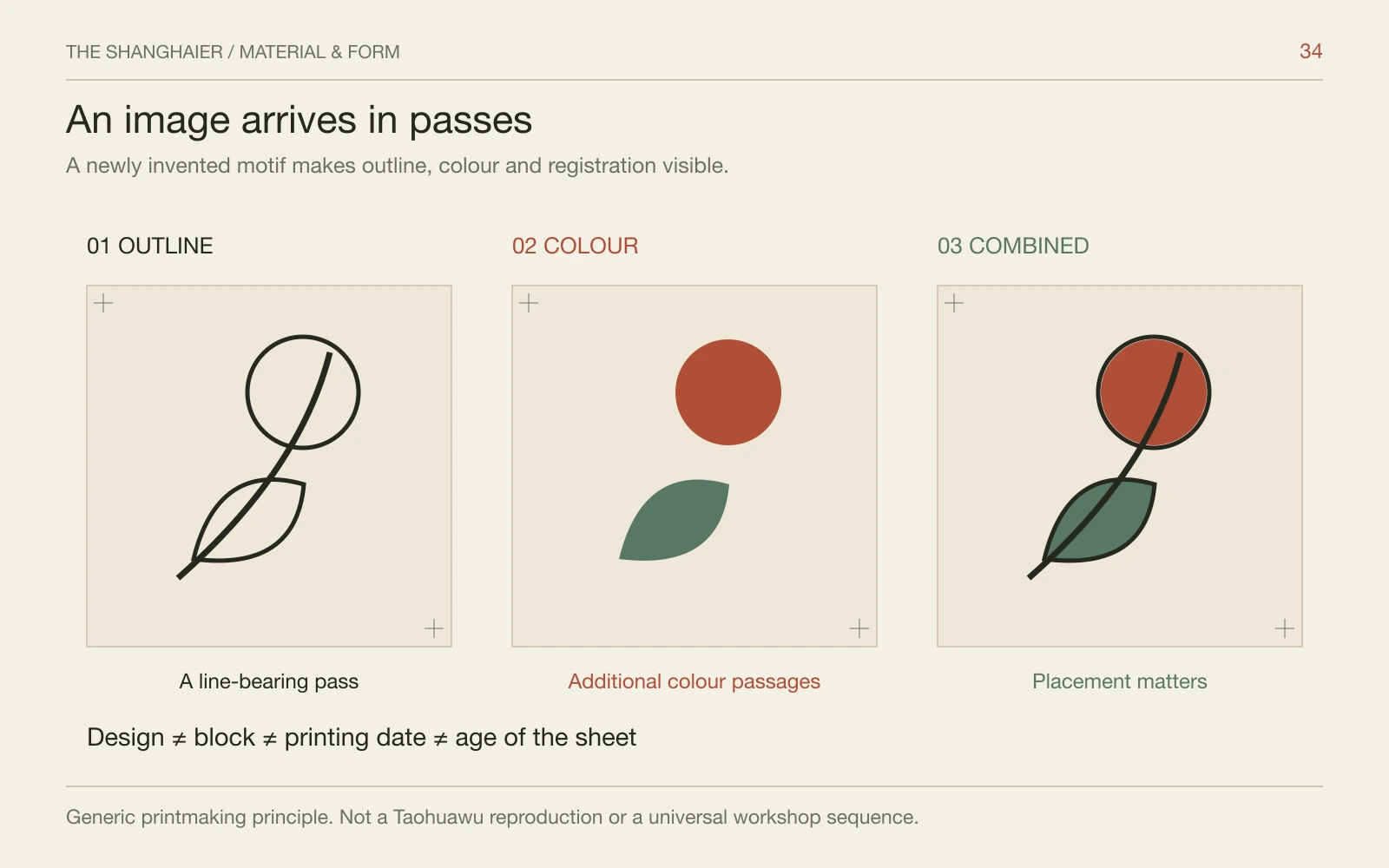
A relief-printing block leaves raised areas to carry ink while recessed areas generally do not print. The sheet records contact with that prepared surface. In our explanatory drawing, a simple raised line becomes a printed line; the drawing is a newly invented motif, not a traced historical block. Thinking through that relationship changes how you look at a delicate stroke. It had to survive as part of a usable printing surface, not merely be imagined as a mark.
A finished print alone does not always tell you every part of its production. There may be different blocks, hand colouring, later additions or a modern reproduction process. Read the caption before deciding that each visible colour corresponds to a separate old block. For a workshop edition, ask how this particular sheet was made. A clear account of carving, printing and any additional colouring is more valuable than the unspecific assurance that it follows an ancient tradition.
Colour needs a relationship between impressions
When different colour impressions are combined, their placement relative to one another matters. Registration is the ordinary term for keeping those passes aligned. Our diagram shows an outline and two invented colour passages moving into one image, with reference marks outside it. It explains the principle, not a universal Taohuawu workshop method. The exact order and registration system must come from evidence about the chosen print or from a maker demonstrating their own process.
At close range, compare a colour edge with the outline it meets. Does a slight offset weaken the image, give it a particular rhythm, or matter very little at its intended viewing distance? Do not automatically turn every discrepancy into charming proof of handwork. A mechanical reproduction can reproduce an old misregistration perfectly. Equally, a carefully printed hand-made sheet need not display an obvious error to be authentic. The production history has to accompany the visual observation rather than being conjured from it.
A multiple can still be an original print
The word original becomes slippery when it is made to mean unique. A work conceived for printing can exist in more than one legitimate impression. That does not make every sheet identical in condition or date, and it does not establish that a modern impression came from a historical block. Separate the design, the block, the act of printing and the particular sheet you are holding. Those may belong to different moments.
This gives you better questions in a shop. Is this a contemporary design, a new impression from a workshop's block, a recut version of an older design, or a digital reproduction? Who carved and who printed it? Is an edition recorded, and what does the numbering mean? A modest, clearly labelled reproduction can be an excellent way to live with an image. Its value does not require a fiction that the paper itself has passed through centuries of household use.
Read the picture before the list of symbols
It is tempting to decode every fish, fruit or child immediately. Symbolic meanings can be illuminating, but they should belong to the particular work's documented context. A dictionary of auspicious motifs cannot by itself establish what one maker, customer or household intended. Start with composition: repeated shapes, changes of scale, the direction of a face and the relation between text and image. These remain visible even when the inscription is not yet translated.
Then ask for the title and an explanation of the words on the sheet. A good translation can change what you think the scene is doing. Keep that translation with a photograph of the whole object, including its borders where possible. Cropping away an inscription to make a cleaner image may remove the most useful clue. I find an explained, slightly unruly picture more interesting than a perfectly styled detail whose subject and purpose have disappeared from the caption.
Where a Suzhou visit can responsibly begin
The Suzhou Arts and Crafts Museum is listed by the municipal culture authority at 88 Xibei Street, Gusu District—江苏省苏州市姑苏区西北街88号. Older official collection information includes Taohuawu prints among its holdings. That establishes a relevant institution, not a promise that a particular print is currently hanging. Ask about the exhibition programme and any temporary closure before treating it as the centre of a dedicated printmaking trip.
Puyuan, 朴园, needs a firmer boundary. The garden authority's history records a heritage-centre and Taohuawu print-museum use, but I have not established a current public visitor gate and timetable. I would not send you to an old garden address with the promise of a functioning print museum. The responsible alternative is to confirm a current institutional display or a named workshop appointment first. A research lead belongs in the planning notebook until its present-day entrance has been resolved.
Buying a sheet without buying a story
Ask the seller to put the production description on the receipt or accompanying information. A useful record includes title, maker or workshop, printing date where known, medium and the relationship to any older design. If the block is described as historical, ask what evidence supports that account and whether the sheet itself is recent. Do not infer paper age from a warm colour, rough edge or staged photograph of carving tools.
For a low-cost souvenir, the questions can remain friendly and proportionate. You may simply want a well-printed image with an accurate label. For an expensive historical object, seek appropriate specialist advice about authenticity, condition and provenance rather than relying on a travel guide. Ask how to transport it flat or safely rolled, and follow professional conservation guidance for valuable paper. The aim is not to make buying intimidating. It is to make the words used in the sale match what is being sold.
The useful souvenir is a better distinction
Before leaving a display, compare two kinds of repetition. Repetition within the image may organise a crowd, an architectural setting or a border. Repetition through printing allows the image itself to circulate. Neither is simply a failure to make something unique. This is why Taohuawu can be a productive companion to Shanghai's contemporary design shops: it gives you another way to think about editions, affordable objects and the relationship between a design and its many owners.
I would choose one image I could describe with some precision over several acquired through a vague promise of luck. It might be a recent sheet, a reproduction or a museum postcard; the label should say which. If you want to add a printmaking visit to a regional outing, tell me whether you want to look at collections, watch a confirmed demonstration or buy contemporary work. Those are three reasonable interests, but a historical institution listing cannot guarantee all three behind the same door.