Publication details
First published . Series dates place related notes together in the reading archive.
Begin at the distance the picture asks for
An embroidered picture can be a very different object at three paces and at the edge of a display case. Start far enough away to see its composition. Does a branch pull the eye diagonally, does a bird balance an empty corner, or does a patch of untouched silk hold the scene together? Before thinking about the maker's patience, decide what the image is doing. Hours of work are important to understanding labour, but they do not explain why one arrangement feels more convincing than another.
Then move closer without touching the case. Select a small junction rather than the most densely worked area: a leaf meeting a stem, a feather against the ground, a distant hill dissolving into space. A good edge may be firm, interrupted or almost absent. The point is not to discover a hidden code that proves quality. It is to notice that making an image involves decisions about what to leave unresolved as well as what to describe.
What the name Gu actually tells you
Gu embroidery, 顾绣, takes its name from the Gu household associated with Luxiang Garden in Ming-period Shanghai. Han Ximeng is a central named maker in its history. The national intangible-heritage account describes her use of Song and Yuan painting models; her work belongs in a discussion of pictorial invention, not only in a list of regional souvenirs. Calling it painting with a needle is a useful beginning, provided the phrase does not make the thread disappear from the explanation.
The household name also needs care. It does not mean that every object subsequently described as Gu embroidery was made by the same woman or inside the same garden. The historical literature traces a tradition extending beyond that elite household. When a label gives a maker, date or attribution, keep those details attached to the object. A prestigious school name should open questions about authorship and transmission rather than replace the answers with an anonymous image of endlessly patient women.
Thread direction is part of the colour
The easiest experiment is to compare two stitched areas of similar colour that run in different directions. If the display lighting allows, change your viewing angle gently. Silk can appear lighter or darker as its relation to the light changes. The difference may help articulate a feather, separate overlapping leaves or suggest the turn of a form. A photograph taken from one position can flatten that relationship; a brightly shining image is not automatically a more accomplished embroidery.
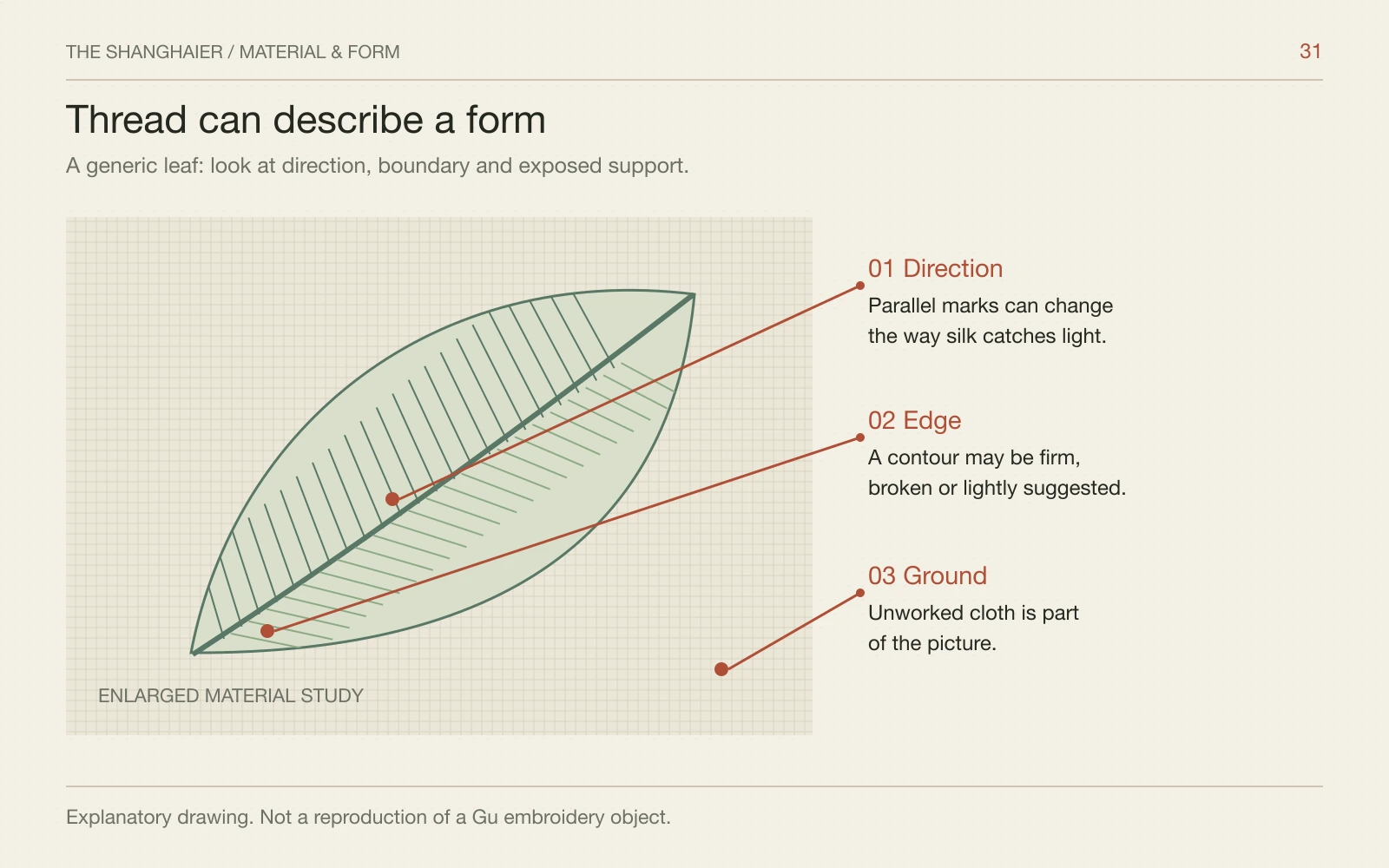
Our explanatory drawing separates a curved contour from several groups of directional strokes. It is a looking aid, not a reconstruction of Han Ximeng's technique or a diagram of one museum object. At the case, check whether the stitching actually follows the pictured contour, crosses it or complicates it. Describing what you can see is more useful than identifying a stitch name from a small photograph. A conservator's or maker's technical identification requires closer evidence than a casual visitor can obtain.
Empty silk is doing work too
The support is not packaging. A pale expanse around a subject can establish depth, provide an interval between forms or allow a lightly stitched passage to remain delicate. This matters when looking at pictures online: a white or cream area may be part of the original cloth, not an unwanted photographic backdrop. Cropping it away can change the composition and make a restrained object appear much more crowded. I would choose a complete view before an irresistible close-up.
Ask where the cloth is visible and how the image moves into it. Is there a sharp boundary, a scattering of fine marks, or a gradual thinning of stitches? Then compare this with a painted picture nearby if one is available. Ink can change through dilution and brush pressure; thread has other possibilities, including its direction, thickness and relationship to the support. Neither medium needs to defeat the other. The comparison becomes interesting precisely where their means of making a similar visual effect differ.
Read the historical praise with some distance
The Ming and Qing texts discussed by the national heritage institution are evidence of how Gu embroidery was admired, valued and circulated. They are not a neutral time sheet for every maker. When a writer praises refinement or exceptional labour, notice who is speaking, which object is being discussed and whose name survives. Han Ximeng should remain a person in the story, rather than being swallowed by a general claim that Chinese women had miraculous fingers.
For a visitor, this changes the label questions. Who made this particular work? Is the attribution secure, traditional or uncertain? Does the date refer to the embroidered object, the painted model, or a later mounting? An embroidered version of an older painting is not automatically the same age as that painting. These distinctions do not reduce the pleasure of the image. They stop a persuasive historical association from doing more work than the evidence permits, and make room for contemporary makers to be discussed on their own terms.
A useful comparison with another embroidery
If a gallery has embroidery labelled Suzhou, compare objects before ranking schools. Choose a comparable motif if possible, but keep differences of date, purpose and size in view. A garment panel and a small framed picture are designed for different kinds of looking. What reads as dense close up may have been meant to register across a room or on a moving body. Regional labels alone cannot explain that change of scale.
Make the comparison concrete: count neither stitches nor prizes. Look at one outline, one transition between colours and one relationship between worked and unworked ground. Which decisions suit the object? Which passage keeps your attention after the initial effect has passed? It is perfectly reasonable to prefer the quieter example. It is also reasonable to admire a bold, easily read image. The useful opinion is one you can connect to a visible choice, rather than to a claim that one city produces inherently superior hands.
Songjiang gives context, not a guaranteed display
Songjiang Museum is a possible cultural companion at 233 East Zhongshan Road, Songjiang District—上海市松江区中山东路233号. The municipal visitor information establishes the museum and its address; it does not establish that a particular Han Ximeng object, or even a Gu embroidery gallery, is permanently on view. I would confirm the current exhibition list before making the journey specifically for textiles. An object in a collection catalogue may be resting in storage or away on loan.
Treat Songjiang as its own outing, with time for the museum and the surrounding town, rather than as a quick detour between central Shanghai appointments. Ask the museum which textile works are currently displayed, whether any case is temporarily closed and what photography is allowed. An office or heritage-protection contact address is not necessarily a workshop reception. There is no promised live demonstration in this note. An encounter with a maker needs an appointment; a heritage address alone does not establish visitor access.
If you want to bring something home
Start with the work, then ask for its description in writing. Is it contemporary or sold as antique? Who made it, what materials are recorded, and is the image stitched, woven or mechanically reproduced? If a seller claims an old attribution, provenance and condition deserve more than a confident story. No naked-eye test in a travel article can authenticate handwork or age. A modest contemporary piece with a clear maker can be a more satisfying purchase than an impressive but unverifiable historical claim.
Ask about mounting, light exposure and transport before paying. Avoid requesting that an unmounted textile be handled repeatedly for a photograph, and take conservation advice for a valuable object from a qualified professional. Buying is optional. The best result may be learning to see why a nearly empty patch of cloth matters. If you want a Shanghai shopping afternoon centred on textiles and construction, tell me that in advance; it gives us a useful question to carry into a shop instead of an instruction to find something expensive.