Publication details
First published . Series dates place related notes together in the reading archive.
A brush pot is a curved piece of material first
Before following the figures or landscape, find the rim and base. A bamboo brush pot begins with a physical constraint: a curved wall with a limited thickness. The maker cannot remove material indefinitely. That simple fact makes the outside edge a productive starting point. Compare the original surface with a recessed area, then look for the transition between them. A distant rock or a foreground branch may be separated by a very small change in depth.
It helps to imagine the object without its subject. Where is the uninterrupted cylinder, where has its outline been altered, and how does it stand? This is not a test of whether you know the story represented in the carving. It is a way of seeing the carved scene as part of a vessel rather than as a flat illustration pasted onto one. A root carving starts from another shape again; do not assume every bamboo object begins as an identical straight tube.
Relief and openwork make different promises
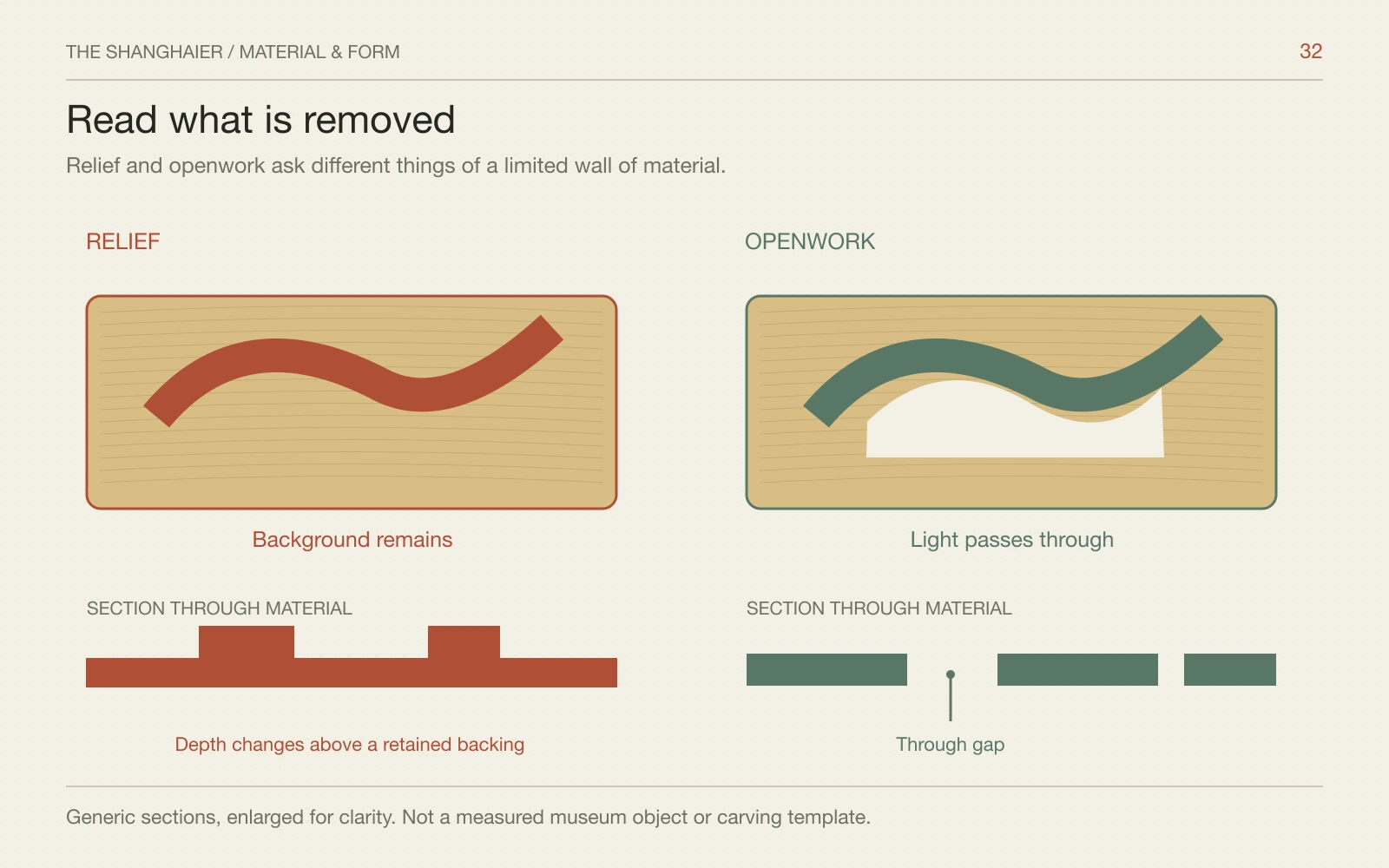
In relief, a subject projects from or is cut into a remaining background. Openwork removes material right through selected areas so that light and the space behind the object participate in the view. The official account of the Jiading school identifies high relief and openwork among its characteristic techniques. Our section drawing makes that distinction deliberately large. It is a generic explanation, not a measured section through a museum brush pot.
At a case, use the distinction as a question. Is the dark patch an actual opening, a deep recess, a shadow or part of the material's colour? You may not be able to decide from one angle. That uncertainty is useful: it slows down the habit of reading every dark region as background. Change your position within the permitted viewing area and see what moves. Never test a gap with a finger or assume a fine bridge of material is robust because the overall object looks solid.
Jiading is a school, not a single signature
The municipal tourism account places Zhu He, his son and grandson at the emergence of the Jiading school in the middle and later Ming period. This gives the tradition a useful historical anchor. It does not authorize attributing an unsigned object to a famous ancestor. Later makers, modern interpretations and museum-selected contemporary work belong to the story too. A living carving practice should not be made to end when the most celebrated family tree ends.
I would read the object label after the first close look and then return to the carving. Does a date change your expectations? Does a named maker make you notice a choice you had overlooked? Keep school, maker and attribution separate in your notes. A piece described as in the Jiading tradition need not be an antique, and contemporary work is not a lesser category by definition. The judgement still has to return to how the maker handles the particular material and image.
Follow one branch through the scene
A practical looking exercise is to choose one continuous element: a branch, a path or the edge of a rock. Follow it through the relief. Where does it pass in front of another form, disappear behind it, or become part of the untouched surface? The success of the illusion depends on those junctions. A very crowded scene can be technically ambitious while still making its spaces difficult to read. Complexity is something to examine, not an automatic verdict of excellence.
Next, find the quietest area. It may give the figures room, expose the material or provide a visual pause between episodes. Compare the amount removed with the amount retained. I tend to be more persuaded by a small depth change that makes a landscape intelligible than by a large display of undercutting that competes with every other passage. That is an editorial preference, not a universal rule. The important thing is being able to point to the passage that supports your response.
Curvature changes the picture as you move
A cylindrical object cannot give you its whole composition from one stationary position. Parts turn away, disappear around the side or become compressed near the silhouette. A photograph straight onto the central scene can therefore misrepresent the design. If a display allows movement, compare a frontal view with an oblique one. Ask whether the scene unfolds around the pot or is concentrated on a principal face, and how the rim participates in that arrangement.
Do not walk around a case as though completing a checklist of angles. Choose two positions and compare what changes. A delicate raised line may become visible because it catches the light; an apparently solid mass may reveal a hollow behind it. This is the difference between recording the subject and looking at a carved object. Keep reflections in mind as well. A dark photograph through glass may show your coat more clearly than the recess you meant to study, so give the direct view priority.
The museum address is clear; hours need care
The Jiading Bamboo Carving Museum is in Jiading Villa at 321 Nanda Street, Jiading District—上海市嘉定区南大街321号. The official tourism page describes historical and selected modern works, with additional displays appearing from time to time. It lists 08:00–16:30, while a Shanghai culture-bureau programme gives a different schedule: Tuesday–Sunday 08:30–17:00, last admission 16:30, Monday closed except holidays. These are published references, not a reason to assume the earlier opening.
For planning, arrive after 09:00 on a non-Monday and confirm the current museum notice before travelling. Allow an hour for a focused look; add time if there is a temporary exhibition you actually want to see. That is my suggested pace, not an official tour duration. Check photography rules at reception and ask whether any gallery is closed. Do not build the afternoon around a carving demonstration unless the museum has advertised one for your date. A collection display and a working studio visit are different experiences.
New work deserves precise questions too
If you find a contemporary carving for sale, ask who made it, which part of the bamboo was used and what the description of its technique means. A small, clearly attributed piece may tell you more than a large anonymous one. Ask whether a maker's certificate accompanies the sale and what it actually certifies. A certificate repeating a school name is not the same as independent authentication of a historical attribution or a valuation.
Look for a description that can survive being written on the receipt. Age, repair and condition matter if the seller is presenting the object as old. A surface crack is not automatically evidence of antiquity, and a highly polished surface does not prove recent manufacture. Leave those determinations to appropriate expertise. For an ordinary contemporary purchase, clarity about material, maker and care can be enough. There is no need to turn a souvenir decision into an unsupported investment argument just because the object belongs to a respected tradition.
Let the material set the pace of the outing
Jiading is worth approaching as a town rather than as a single shopping opportunity. Keep the museum as the anchor and leave time outside it instead of trying to fill every minute with another attraction. After looking at carved branches, ordinary bamboo and timber surfaces become more interesting. Compare how a small object controls attention with how a doorway or vessel does it. The question travels well beyond the museum, which is one reason I like beginning with a material.
Before leaving the display, return to the first pot you chose. Can you now explain one relationship between the curve, the relief and the subject? If the answer is yes, the visit has produced something more useful than a list of master names. Photograph the full label if permitted, then keep it with any detail image so the maker and date do not get detached later. For a guided craft-focused day, tell me whether you want object study, contemporary buying or a confirmed workshop appointment; each calls for a different plan.