Publication details
First published . Series dates place related notes together in the reading archive.
Begin with the artist’s own catalogue
The artist catalogue uses the name GOOOOOSE and identifies Shanghai, China. Keep the spelling when searching; it helps distinguish the musical project from unrelated results. Release pages supply the first reliable structure: titles, dates, collaborators, formats and credits. Start there rather than assembling a biography out of retailer descriptions that may have been copied or shortened across several sites.
A 2025 Nuits Sonores festival programme identifies Gooooose as Han Han and describes an audiovisual practice associated with Shanghai. That offers a documented performance context, not a guarantee of a forthcoming local show. The difference matters for a visitor: a musician can be strongly connected to a city without performing there every week, and a festival biography can remain online long after its particular event has ended.
A project is not a fixed genre box
Electronic, experimental and audiovisual are useful broad orientations. None tells you exactly what a release will do. A project can change over time, take different forms in collaboration and use a different approach onstage from the one preserved on an album. Give the particular work in front of you enough room to establish its own conditions.
I would read the credits before reading a long chain of comparisons to other artists. Comparisons can help, but they can also tell you what to expect so insistently that you stop noticing what differs. A title, a date and an artist’s authorised recording are a better first set of facts. Add outside interpretation afterwards, when there is something specific for it to illuminate or challenge.
First pass: find something repeatable
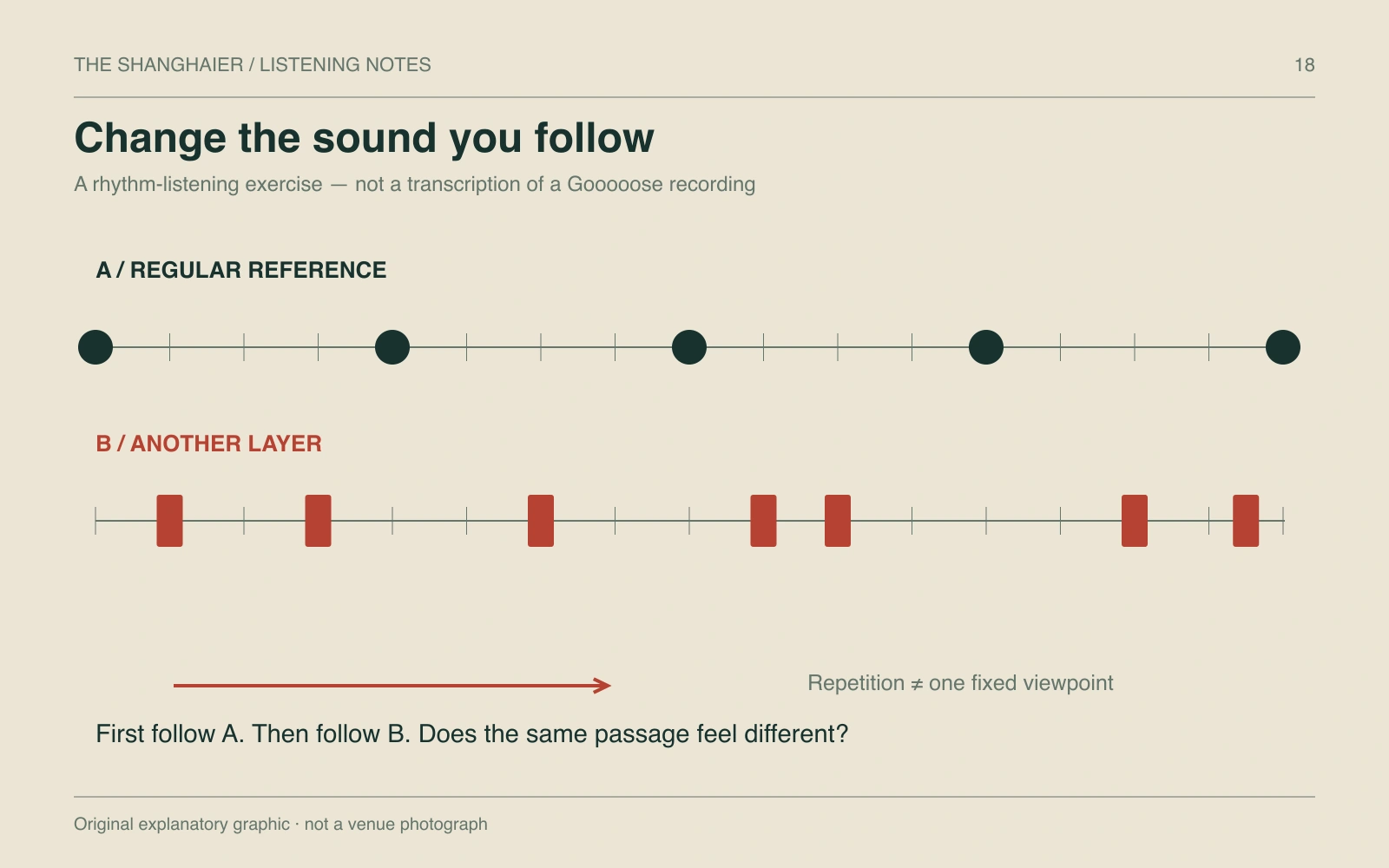
Choose a piece from an official release page and listen without jumping between tabs. Look for one recurring event: a pulse, an attack, a short figure or a sound that returns. You do not have to decide its time signature. The task is simply to notice what lets your ear predict the next moment and whether the prediction remains useful.
If you lose that reference, do not immediately treat it as a mistake in listening. Ask what has changed around it. A regular event can seem displaced when another layer becomes more prominent, and a repeated texture can make time feel different without behaving like a conventional drum beat. This is an invitation to listen again, not a claim that every Gooooose track follows one identical rhythmic method.
Second pass: move your attention sideways
On another pass, follow something other than your first anchor. Listen for a contrasting register, a quieter event or a sustained layer. Does it reinforce the sense of movement or give you another way of organising time? The same recording can seem more stable or less stable depending on the element your ear treats as central.
This exercise is why a full piece is more useful than a short “sounds like” clip. Relationships can become audible through repetition. You are also allowed to decide that a piece does not hold your attention. The exercise is not designed to make every unfamiliar work agreeable. It gives a preference some substance: you can say what drew you in, what resisted you and whether another listen changed the balance.
Rusted Silicon: attend to the release shape
Rusted Silicon appears in SVBKVLT’s official catalogue as a Gooooose release. Read its sequence and credits before shuffling. Where remixes are included, keep them distinct from the original pieces. An album can present a set of related ideas, then let other artists approach the material from different positions; hearing the whole sequence makes that structure available to you.
For a visitor approaching the artist for the first time, I would choose one original and return to it after hearing another track. Does it now feel like the centre of the release, an exception or one possible direction? That question asks more of the album than a verdict after its opening seconds. It also avoids pretending that the first piece you encountered is a complete summary of the artist.
JAC: credits make the collaboration legible
JAC is credited to Gooooose and DJ Scotch Egg. The label’s notes describe a Shanghai studio session, and the tracklist distinguishes original work from remixes by other contributors. This supplies a concrete way to talk about collaboration without inventing a meeting, a studio visit or an account of who touched which control. The published credits are enough to establish the work as a shared project.
Choose the title piece and its listed remix as a comparison. Keep the artist names beside the versions so the second does not become an anonymous variation. Notice what gives you a sense of continuity between them and what changes the experience. You need not determine precisely which sound belongs to which maker; unless a source establishes that, it is a question rather than a biographical fact.
Software is not an explanation of every sound
An artist’s involvement with software or visual work can be relevant to a practice, but it does not justify guessing the process behind each recorded result. A complex rhythm is not proof that it was generated by an algorithm, and an unusual timbre does not reveal the hardware used. Separate what the artist documents from what the listener infers.
That separation makes criticism clearer. You can describe the effect of a sound on your attention without supplying a fictional technical origin. If process interests you, follow a credited interview, talk or artist presentation and keep its date. A method discussed for one project need not be the permanent recipe for every release. The music should not become an illustration of a convenient technology story.
A live listing needs its own evidence
If you find a Gooooose event, check whether the billing says live, DJ or audiovisual, and read the presenter’s description. These are related formats with different possibilities. A studio release is not a promise of the set’s material, and a visual practice does not establish that every performance includes projections. Confirm what the actual event offers before making that feature the reason to buy.
Then do the ordinary booking work: correct city, date, room, identity requirements and arrival time. A festival biography or past review is not a calendar. If no current Shanghai show fits your dates, listen through the catalogue instead of forcing an imagined performance into the itinerary. Music remains a useful way into the city even when you cannot encounter its maker in person.
Follow one connection beyond the profile
The most productive outcome is not being able to recite an artist biography. It is having one piece you want to revisit and one connection you want to follow: a collaborator, a remix, another release or a future performance. Save the proper credits so the path remains legible after your trip. A listening history built that way is personal without requiring an invented insider story.
My preference is to make room for the point at which a beat becomes less obvious and attention has to reorganise. That is a proposal for how to listen, not a demand that everyone enjoy the same sound. Try the exercise, decide what you hear and let the catalogue complicate the answer. Shanghai’s musical present is more interesting when an artist can remain specific and difficult to summarise.