Publication details
First published . Series dates place related notes together in the reading archive.
Use the current Hengshan8 address
The current ShowStart venue inventory lists Shanghai JZ Club at Water Tower Plaza, 8 Hengshan Road, Xuhui district: 上海JZ CLUB,徐汇区衡山路8号水塔广场. October 2026 events are listed against that venue. This is the address to match to a current ticket, rather than assuming an older JZ contact page or a years-old guide still describes the destination you are booking.
A club can keep its name while changing location, and a music organisation can present events away from its own room. Save the venue field from your selected event in Chinese. If it gives another hall, follow that booking rather than this general address. A map pin named JZ is only useful once it agrees with the event date and venue details in front of you.
Read below the headline name
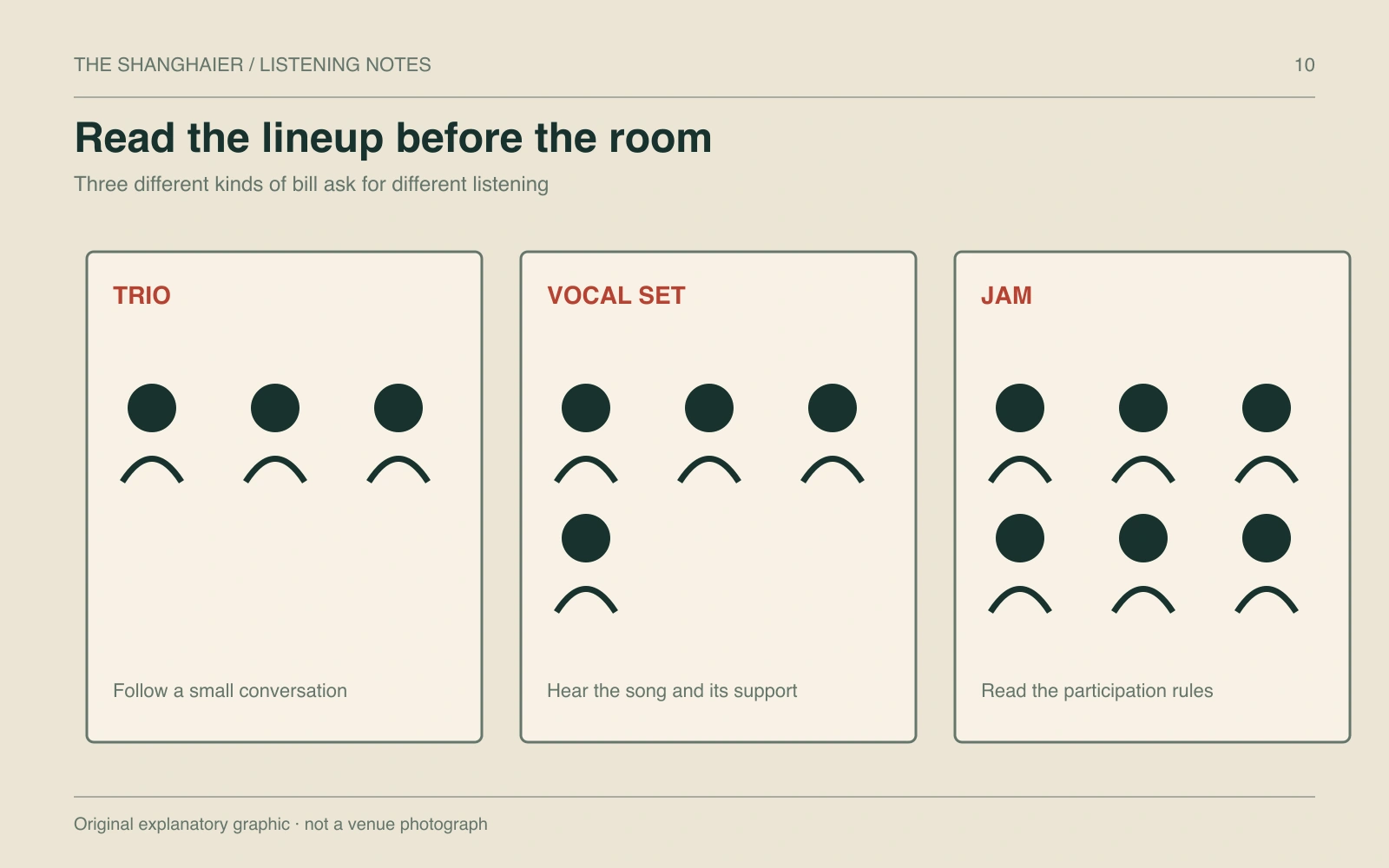
Start by identifying the musicians and instruments. A named leader can work with different groups, so last year’s recording may not describe tonight’s lineup. “Trio,” “quartet” and “big band” give a rough sense of scale, but they are starting points rather than sound categories. Read whether the programme is originals, a tribute, a repertoire project, a vocal set or a collaboration.
Then listen to an authorised recording from the artist or label. One full track tells you more than a promotional adjective. Ask yourself whether you want a foreground listening experience, a vocal programme you can follow through songs, or a more open improvisational evening. You can choose unfamiliar names. The short listening step simply makes the choice intentional instead of delegating it to whichever poster looks most prestigious.
Separate an early set from a late one
The current venue inventory demonstrates that more than one differently priced event can appear on a date. Do not assume a ticket for the earlier show includes every later performance. A late programme may have another admission arrangement, and “jam” does not mean that all visitors can arrive whenever they like or walk onto the stage. Read each event’s terms separately.
This is especially important if you are planning dinner around the music. A ticket time might describe the performance start rather than the door opening. Allow time to find Water Tower Plaza and the actual entrance. If you hope to stay for more than one programme, ask whether you need separate reservations or tickets. It is easier to resolve this before payment than while a second audience is arriving.
What the Chinese ticket fields tell you
Look for 演出时间 for performance time and 演出地点 for the venue. 单人票 is a single-person ticket; a label that includes 酒水 may involve a drink arrangement, but the exact inclusion still needs reading. 预售 and 现场 distinguish advance and door sales when both are offered. Do not infer a free drink, guaranteed seat or dinner from a price alone.
A very low listed price can refer to a particular category or programme, not the club’s general cost for an entire night. Likewise, a sold-out advance allocation is not proof that door tickets will exist. If seating matters, ask what kind is being reserved and whether a party can sit together. Jazz is easier to enjoy when the practical arrangement has been established before the first tune.
Hear the supporting conversation
A useful first-listen exercise is to follow one player who is not currently soloing. The bass and drums, for example, can shape the direction of a passage without occupying the melodic foreground. A pianist may answer a phrase briefly and then leave space. You do not need technical vocabulary to notice a response, a pause or a change in density across the group.
This is why I would give a set a fair span of attention instead of treating each tune as a separate opportunity to talk. The relationship between players develops over time. A familiar standard can be a testing ground for that relationship, while an unfamiliar original can become legible through repetition. Neither is automatically safer or more adventurous; the performance makes the difference.
Make the evening physically comfortable
If you have hearing, mobility or seating needs, ask the venue about the actual event configuration. A room’s general description cannot answer every question about a particular night. Standing, shared tables, sightlines and sound levels matter. Carry hearing protection if loud amplified music is uncomfortable for you; being able to stay with a performance is more valuable than pretending volume has no effect.
Choose dinner with the arrival margin in mind. Hengshan Road gives you a neighbourhood context, but a long route beforehand can turn music into the final item of an exhausting itinerary. I would aim for one well-chosen performance and an uncomplicated meal. Keep your return destination saved in Chinese and check transport for the time you expect to leave, particularly if the attraction is a late programme.
Let the bill change your idea of the club
A venue can be a stable address for quite unstable musical possibilities. Return to the programme if the first date available does not interest you. There is no obligation to book a particular club simply because a guide mentions it. Sometimes the better choice is a different evening; sometimes it is a different room entirely. Following musicians across events can reveal connections that following venue rankings never shows.
If you want help finding a night, tell me what you enjoy hearing and what kind of evening you can comfortably manage. “Jazz” is a beginning, not a full brief. A couple who want an early seated set and a listener looking for a late improvisational programme need different recommendations. The aim is a good match between the actual music and the people coming through the door.