Publication details
First published . Series dates place related notes together in the reading archive.
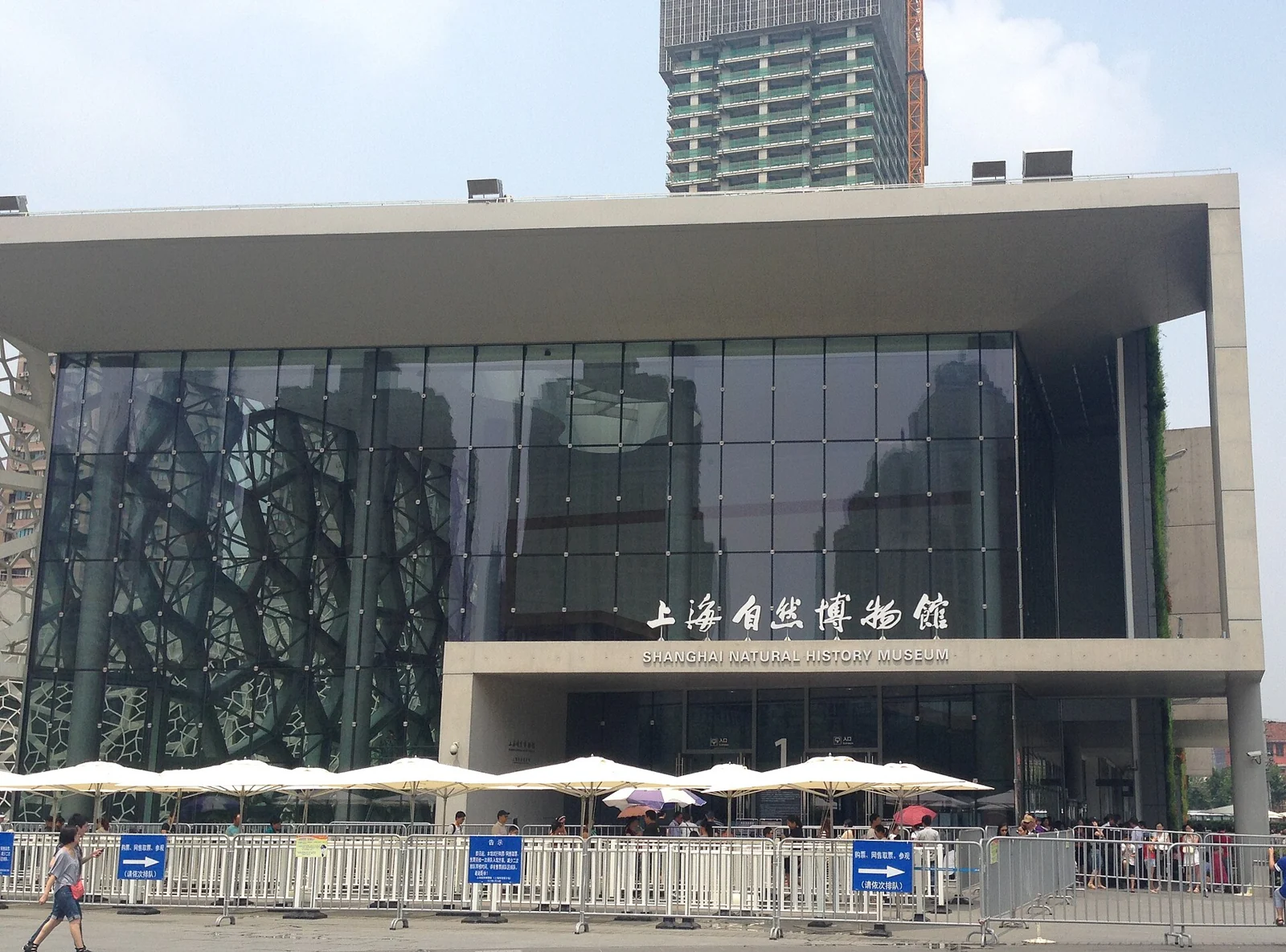

Start by correcting the Tuesday problem
The current official visitor page lists opening from 09:00 to 17:00, with entry ending at 16:00, and Tuesday as the regular closing day, except for public-holiday arrangements. That is an easy detail to miss because Monday closures are so common in Shanghai. I would check the museum’s own calendar before making the rest of the day depend on a visit.
Its address is 510 West Beijing Road, Jing’an District, inside Jing’an Sculpture Park: 上海市静安区北京西路510号(静安雕塑公园内). Metro Line 13 has a Shanghai Natural History Museum station. The museum says it has no public visitor car park, so I would normally use the metro rather than manufacture a parking problem in a central neighbourhood. Save the Chinese name, 上海自然博物馆, with the address.
The useful question is adaptation, not the animal count
The permanent exhibition uses evolution as an organizing idea. I would translate that large theme into something manageable: how does a body move, find food, protect itself or reproduce in a particular environment? Pick one of those questions and carry it between a few displays. It gives a child permission to look closely, and it gives adults a reason to linger beyond the spectacular skeleton photograph.
Look for structure rather than an imagined contest between animals. Compare the way a limb supports weight, the relationship between teeth and food, or the surface of a body and its surroundings. You do not need to know every scientific name to make a worthwhile observation. The museum should enlarge your curiosity; it does not require you to arrive having memorized a zoology textbook.
A useful further distinction is between an observation and an inference. You can observe the shape of a tooth in front of you; deciding what an animal ate may involve comparisons and other evidence. Read the label to see how those steps have been connected. This is especially interesting with extinct animals, where the living body is unavailable for inspection. Rather than demand absolute certainty from a display, ask what supports the explanation. That makes a fossil more than a remnant from a remote past: it becomes an example of how somebody works from a surviving trace towards an account of a lost world.
Use the impressive scale, then return to the small thing
Large specimens are excellent at interrupting ordinary attention. I would let them do that job. Stand far enough back to understand proportions, then choose one detail and move your attention inward. A joint, the shape of a foot or the arrangement of a jaw can tell you more than a hurried photograph of the entire display. Size is the invitation, not the whole explanation.
After a dramatic grouping, I would deliberately choose something less imposing. The change in pace makes the big displays easier to remember and prevents every room from becoming another visual climax. This is especially useful with children: ask for one detail they can describe without pointing at the case. If the answer is simply that an animal was huge, there is another layer of the visit still available.
A wolf in two settings makes a better conversation than a checklist
The museum’s own learning material identifies wolf displays in both the River of Life area and an Arctic ecological grouping. That offers a useful way to think about museum interpretation. A species is not only a shape with a name; the setting and the question around it change what you are being invited to notice. One arrangement may encourage comparison, another a relationship with a particular environment.
I like this as a small exercise for adults as much as children. Ask why the specimens have been grouped together, what the background contributes, and what remains absent from the scene. A display necessarily selects a moment. Recognizing that selection does not spoil the pleasure of looking; it makes you a more active visitor. The cases are a starting point for thinking, not a substitute for it.
The building is another exhibit
Perkins&Will’s museum, completed in 2015, takes its spiralling form from the geometry of a nautilus shell. Its central cellular wall, planted surfaces and stone façade work with different natural references. I would pause where the building opens around its sunken courtyard and notice how daylight changes the sense of scale after the denser exhibition spaces. The architecture is doing more than providing an attractive shell for a collection.
There is a useful comparison to make between the ordered repetition of the wall and the irregularity of the objects inside. A museum has to simplify nature enough to make a building and an explanation; nature itself is less tidy. I think the design works best when you experience the change between enclosed study and light-filled circulation, rather than treating the courtyard as one more obligatory photo location.
Book the visit before adding every extra
Use the official online ticket instructions and the institution’s named mini-program. Standard adult admission is listed at 30 yuan on the current service page; temporary exhibitions, films and certain activities can have separate arrangements. A general ticket should not be read as an entitlement to every program in the building. Check the date and the particular activity you want, not just the museum’s overall availability.
For a first visit, I would keep extras modest. A film or exploration activity can be worthwhile if it matches the group, but fixed appointments can pull you out of an absorbing gallery. If you are using an overseas passport and the form is unclear, ask the official visitor service before the day. Do not substitute an identity number that does not belong to the visitor merely to get through a booking screen.
A half day should contain an exit
I would allow roughly three hours for a selective visit, more if you enjoy reading or have a confirmed activity. That is a planning recommendation, not the museum’s required route. Give yourself permission to omit a section. The official floor guide spans several levels, so a plan based on seeing just one more room can quietly become a much longer outing than everyone expected.
Agree on a stopping point before fatigue makes the decision unpleasant. For families, I would finish with a question somebody still wants answered rather than a test of what they remember. For adults, I would leave a short period to revisit the most interesting object. Returning to one display after seeing the rest often produces a more coherent impression than another rapid circuit through unfamiliar cases.
The park is a better immediate pairing than a distant second museum
Jing’an Sculpture Park is directly part of the setting, so I would use it as the transition back into the city. After concentrated indoor looking, space to move and notice contemporary sculpture is welcome. It also keeps the day geographically honest. You can decide over a break whether the group wants more culture, a meal or simply a quieter walk.
For a short Shanghai stay, this central location is an important advantage over the Astronomy Museum in Lingang. I would not call one better in the abstract: astronomy rewards a particular enthusiasm and a longer commitment, while natural history is easier to combine with a varied urban day. If the choice is being made for children, ask what they want to understand, then make the travel and attention budget fit that interest.