Publication details
First published . Series dates place related notes together in the reading archive.
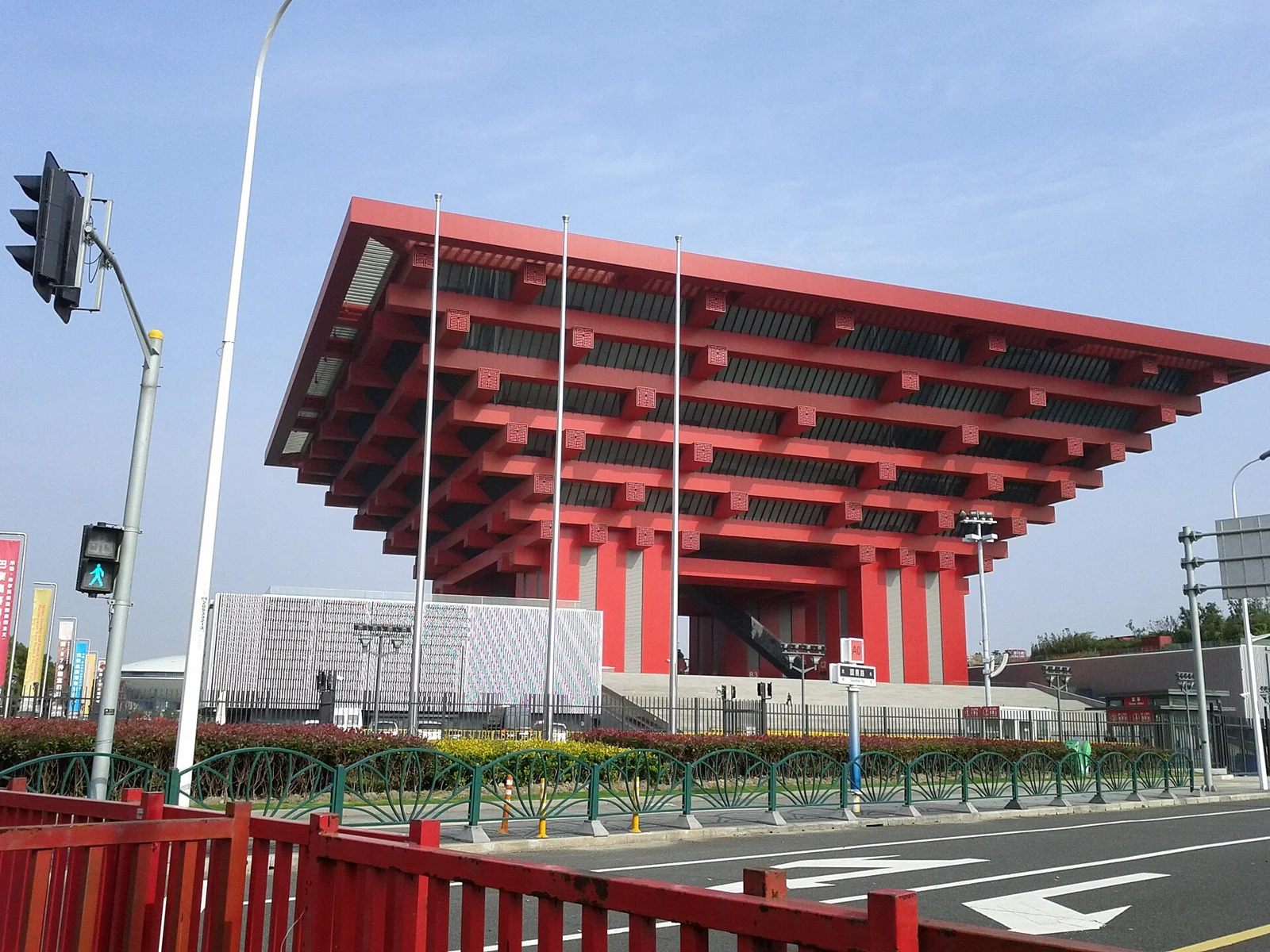

A name that carries several institutions’ histories
China Art Museum is the familiar English name associated with the red former Expo pavilion. Shanghai Art Museum is the institution’s current lead name in Chinese, with 中华艺术宫 retained in parentheses. This is not the Shanghai Museum of ancient art, and it is not the Power Station of Art across the Huangpu. Keeping those names separate is the first useful act of planning. Each institution gives you a different account of what art and a museum are for.
The museum’s seventieth-anniversary history in 2026 traces its foundation to 1956 and its moves through several Shanghai sites before this one. I find the continuity more interesting than a simple new-museum story. A public institution can inherit collections, donor relationships and ways of telling history while changing its architecture dramatically. The building announces a destination. The collection asks what has accumulated behind that announcement, and whose work has been trusted to represent a city over time.
The entrance changed in September 2026
Use the west gate at 153 Shangnan Road, Pudong, 上海市浦东新区上南路153号(西门). The city’s culture and tourism authority announced this visitor entrance from September 15, 2026. Older guides and older museum pages may still send you to 205 Shangnan Road. I would save the Chinese west-gate address before leaving. From Metro Line 8’s China Art Museum station, Exit 3, the official directions are approximately 100 metres south along Shangnan Road. That short approach is considerably more useful than a general map pin over the whole pavilion.
Normal opening is Tuesday–Sunday 10:00–18:00, with last admission at 17:00; Monday is closed except national holidays. The museum’s visitor-services page offers free permanent-exhibition tickets at the entrance, with separate ticket arrangements for special exhibitions. A group of thirty or more has its own advance reservation process. For an ordinary individual visit, I would not confuse a paid exhibition advertisement with a requirement to buy entry to every part of the building.
Let the pavilion make its statement, then question it
The former 2010 Expo China Pavilion is emphatically architectural. Its broad red structure presents culture through monumentality before you have reached a painting. I would spend a few minutes looking at how the apparent weight gathers above the approach, and at how human figures make that scale legible. A visitor standing underneath tells you more about the design than a clean image with all the people removed. The place is meant to receive a public, not just to hold an abstract shape in the skyline.
My interest is in the difference between that outward certainty and the variety a collection can contain. A large national image can imply one coherent cultural story. Paintings, drawings and an artist’s changing decisions are usually less tidy. I would keep both experiences in the visit. The pavilion’s symbolism is worth noticing; it does not need to dictate your response to every work inside. A museum becomes more useful when you can think about its presentation and the individual objects at the same time.
Start with Shanghai represented, rather than Shanghai branded
The permanent exhibition Shanghai in Art opened on the 49-metre level in July 2026. The museum identifies more than a hundred works across Chinese painting, oil painting, printmaking, watercolour and sculpture, with artists including Ren Bonian, Wu Changshuo, Liu Haisu, Xu Beihong, Lin Fengmian, Chen Yifei and Wu Guanzhong. I would use that range as an invitation to compare ways of representing a place. A city is not one visual subject just because its name appears in the exhibition title.
Ask what each work chooses as its evidence of Shanghai. Is it a person, a type of work, a particular building, a crowd or an atmosphere? Does the picture need you to recognise a location, or does its argument work without that knowledge? I prefer this to treating every painting as an illustrated historical fact. Images can record, idealise, commemorate and persuade. The interesting question is often how they do those things, especially when two artists look at a similar city and make fundamentally different pictures.
Read public history through the composition
If you are interested in the history of the Chinese government, this museum offers one route through public images rather than a chronological political-history display. I would look at how work, construction and collective action are framed. Who occupies the centre? Is an individual legible as a person or mainly as a representative figure? What makes an event appear orderly, heroic or inevitable? Those are visual questions, and they are more precise than labelling an entire room with a single political verdict.
It is also important to let dates matter. A work’s subject, the period it depicts and the year it was made are not necessarily identical. A later commemorative painting is evidence of how an earlier event was remembered, not an unmediated window onto that event. I would check the label before drawing a historical conclusion. This distinction leaves room for a clear opinion without collapsing a complicated history into either endorsement or dismissal. The picture deserves to be looked at; the claim deserves to be examined.
A donation is part of the object’s later life
The museum’s anniversary account notes major gifts by artists and their families, including Wu Guanzhong’s 2008 donation of 66 works and a large body of He Youzhi’s original lianhuanhua drawings. These are collection histories; they are not a guarantee that every donated piece is on display. I find them valuable because the decision to give work to a public institution is itself a choice about audience and memory. The object’s life does not end when the artist finishes it.
If drawings or sequential images are available during your visit, I would give them the same seriousness as a large oil painting. A small sheet can show the economy of a gesture or the work of making a narrative legible. Lianhuanhua, often described in English as linked-picture stories, invites attention to sequence: how much needs to be shown in one frame, and what the reader carries from the previous one. Monumental architecture should not make you overlook an art form whose power depends on modest scale.
The multimedia scroll is a separate kind of looking
The museum also lists its multimedia version of Along the River During the Qingming Festival as a standing attraction. I would approach it as a contemporary presentation derived from a historical image, rather than describe it as the original painting. That distinction changes what you can reasonably learn from it. Movement, projection and enlargement can make a crowded urban scene easy to enter. They also make decisions on behalf of the visitor about duration, emphasis and where an eye should travel.
For a family, that can be a useful part of the day, especially if everyone is curious about street life and the density of a historical city. My preference would be to compare the moving presentation with the experience of looking at a still work elsewhere in the museum. What does animation clarify, and what does it make harder to choose for yourself? It is possible to enjoy the spectacle and still ask that question. Current ticket conditions for this feature should be read as its own product, not assumed from general free entry.
Give the museum one subject to organise around
I would allow two to three hours, choose Shanghai in Art as an anchor, and add one other exhibition or medium that changes the rhythm. The 49-metre-level designation is a floor-height reference used by the museum, not an instruction to climb a public observation tower. Staff at the service desks can explain the current route. The building is large enough that arriving with no preference can become a lot of movement with relatively little looking.
For an Expo-focused afternoon, pair the museum with the surrounding Pudong public spaces and discuss what remains of 2010’s vision of a city on display. For an art-focused afternoon, stop after the museum and keep the conversation over a meal. I would not add several more galleries simply because there are many in Shanghai. This one is most rewarding when you let a specific question organise the visit: how a city pictures itself, how a public collection forms, or how political history enters an image without becoming the whole of it.