A small, documented translation problem
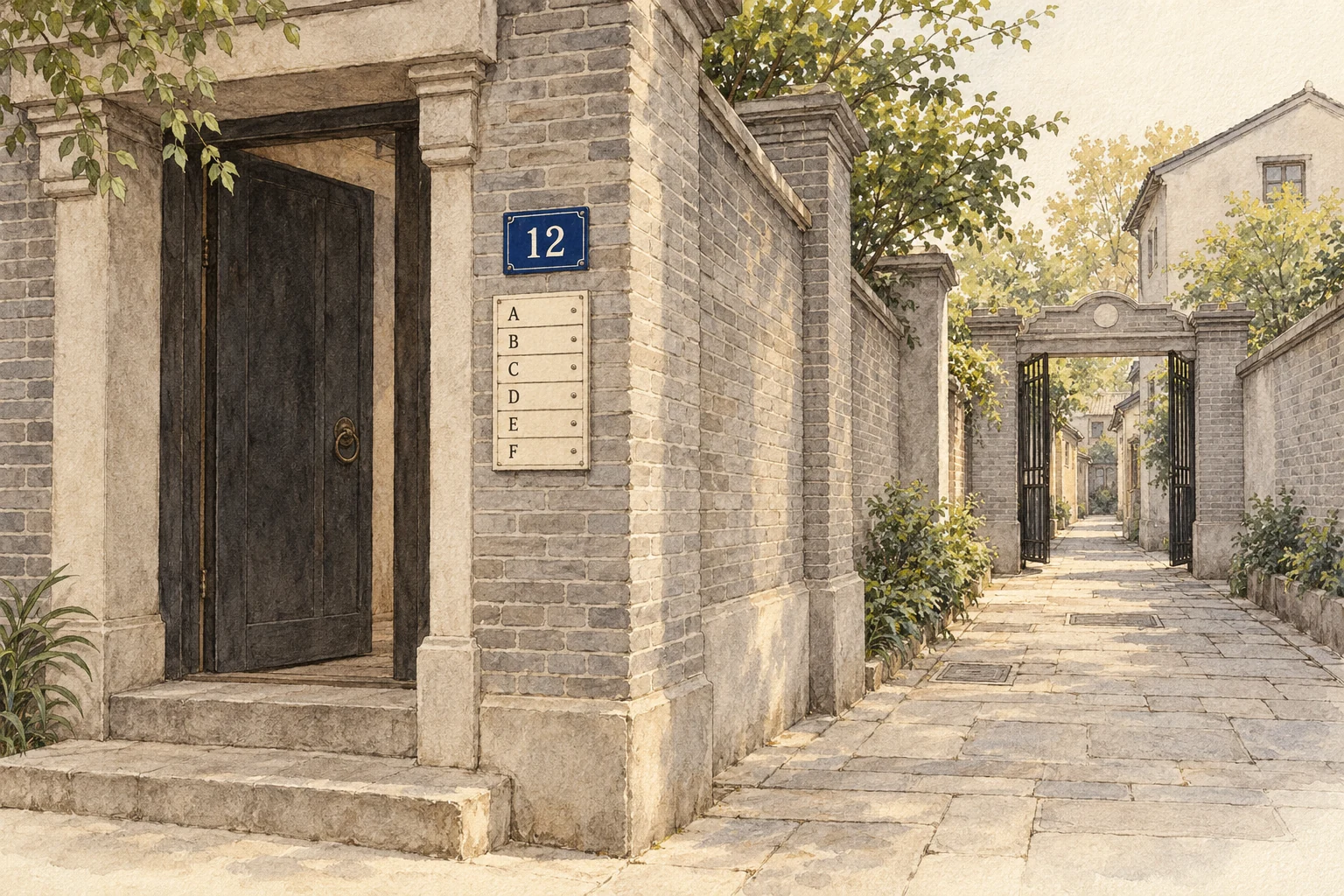
A Jing’an district account published on Shanghai’s municipal website in January 2026 describes this problem at Sun Court, near West Nanjing Road. Six building units use the Chinese sequence 甲、乙、丙、丁、戊、己. The community’s bilingual signs made the correspondence with A through F clearer; some residents added the relevant Roman letter to a door number.
The same account describes another decision at Kangle Compound. Participants selected compound for 邨 rather than village, to communicate the enclosed residential setting. The point was practical: a translation had to help people understand the place and find a route through it. Both examples come from the district’s published account of the signage project.
Keep the layers of an address together
For your own journey, retain the destination’s Chinese name, its street address and the entrance instructions supplied by the venue. Save them together on your phone before leaving. A translated business name may be easy to remember while the Chinese listing is more useful for matching a sign or confirming a map result.
If an appointment includes a lane or building number, do not discard it when shortening the address for a friend. Ask whether the meeting point is the street gate, a shop entrance or an upstairs room. A photograph supplied by the venue can clarify the last few steps better than repeatedly translating the same name.
A name is also a relationship to a place
When you encounter more than one version of a name, ask what each version is being used for. A display name, a map listing and a historical reference can serve different purposes. Match the current address and location before assuming the most familiar English spelling is the destination you need.
Translation also carries choices about what a visitor is expected to understand. The word compound gives one kind of spatial clue; a retained Chinese name gives another kind of continuity. Reading a sign closely can reveal the work needed to make a lived-in neighborhood intelligible to someone arriving for the first time.
Turn curiosity into a better question
On a city walk, ask how the place is named in the source being discussed and how that relates to the present sign. For directions, ask which entrance is intended. For history, ask who used the name and when. Keeping those questions distinct makes room for the city’s layered language without making every unfamiliar spelling into a mystery.