The designer behind the name
Uma Wang's Chinese name is Wang Zhi, 王汁. Her official biography records study at Donghua University in Shanghai and Central Saint Martins in London, followed by the establishment of her own brand in 2009. It places fabric and tailoring at the center of her work and records her entry onto the official Paris Fashion Week schedule in 2017.
That international context matters, but it should not turn the clothes into a box to tick on a list of Chinese designers. The more useful encounter is specific: one fabric, one shape, one way of layering. A designer's career gives you reasons to pay attention. The actual piece still has to earn the attention once it is in front of you.
Two looks show why volume needs precision
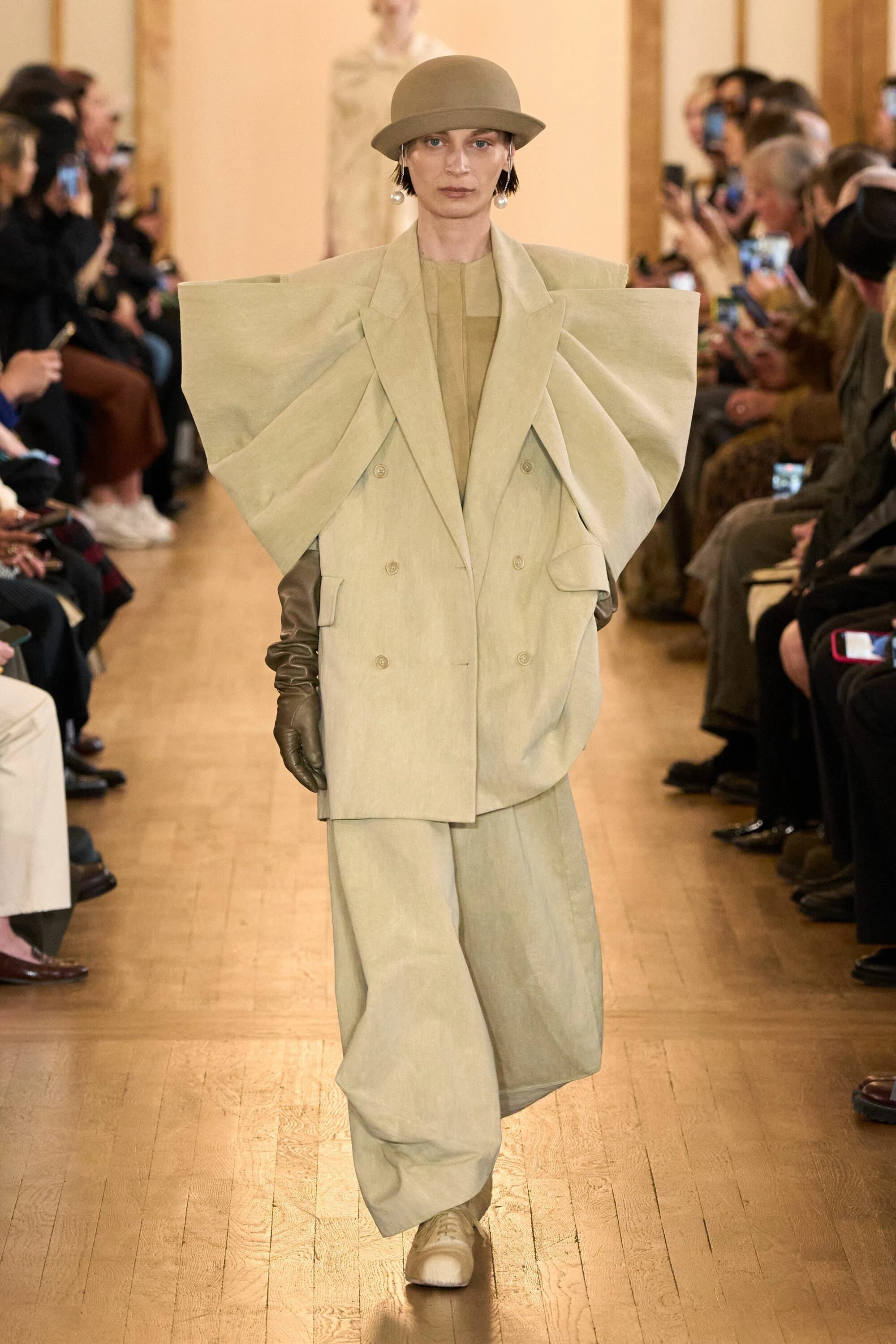
In the official Fall/Winter 2026 gallery, the opening look puts a pale double-breasted front beneath an emphatically expanded shoulder shape. Long gloves occupy the arm line below it, while the lower half stays long and relatively narrow. The effect is built through opposing widths, rather than through decoration spread evenly across the outfit.
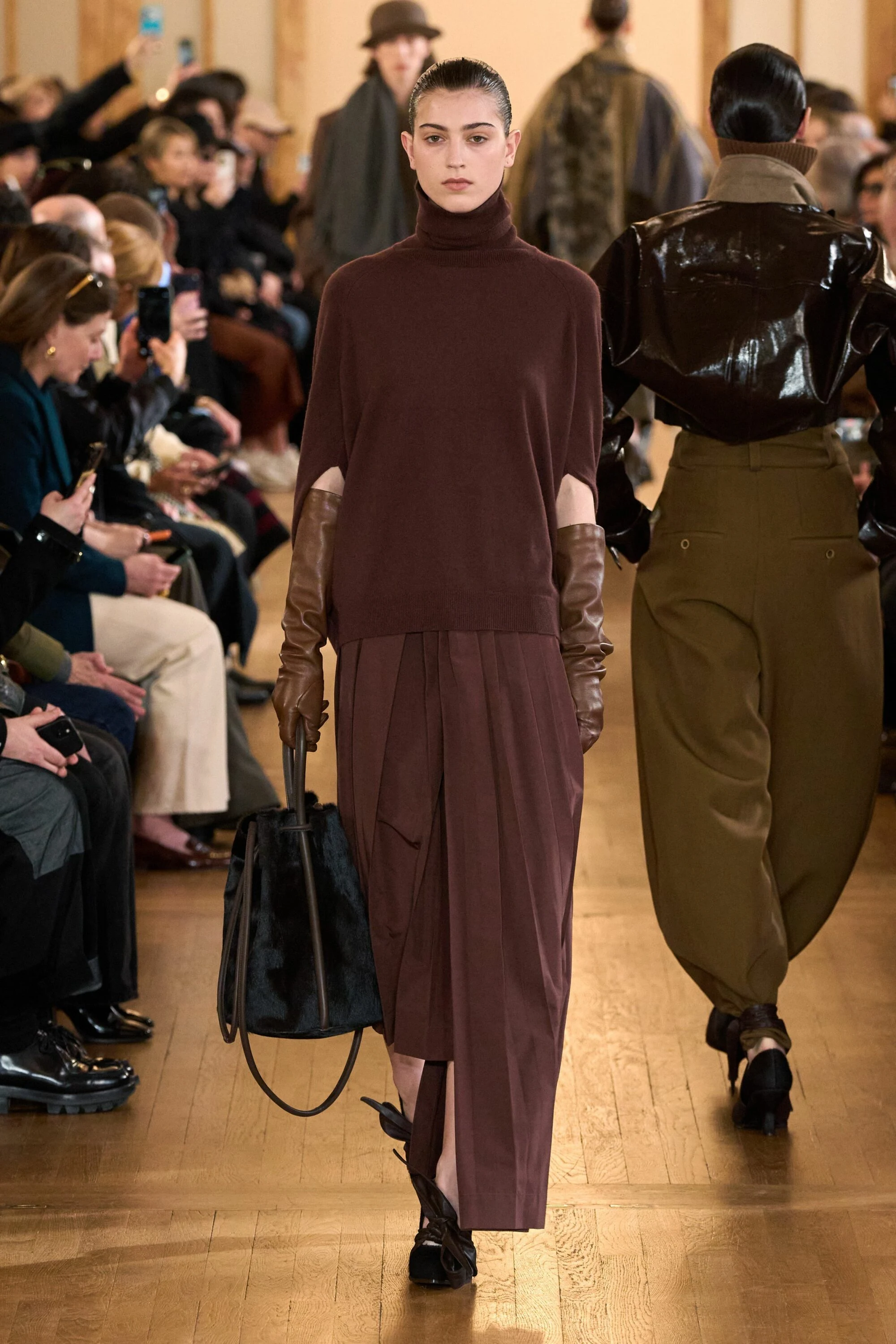
Look 10 offers a different proposition: a dark burgundy high-neck upper layer, broad through the body, above deeply pleated trousers with unequal visible lengths. Long brown gloves and a substantial black bag add another set of surfaces. These are specific styling decisions to study. The runway photograph shows proportion and layering; the composition label on a shop garment will answer a different set of questions.
Inspect the surface before reaching for a label
Ask permission to handle the garment and let the fabric settle. Look from near and far. Does the surface appear flat at a distance and complex nearby? Is the effect carried by the yarn, weave, print, finish or several of them? Ask staff rather than confidently assigning a technique from appearance alone.
An irregular-looking surface may be deliberate, but deliberate does not mean every mark is irrelevant. Ask what variation is expected and inspect the exact piece being purchased. Keep the explanation connected to the product information. The point is to understand a design decision, not to excuse any condition merely because the collection has an expressive atmosphere.
Volume needs a body
A large shape on a hanger can be misleading. Try it on with enough space to move, then let your arms rest naturally. Look at how the cloth falls from the shoulders and where the body becomes visible through motion. Generosity can be precise, and a smaller size can change the idea rather than simply improve the fit.
Walk and sit. A long hem that looks compelling while standing may need practical consideration for steps, chairs and wet pavements. Do not dismiss that as an unartistic concern. The interesting question is how to preserve the design while making it usable in your life. Ask about intended styling and whether alterations would disturb the balance.
One piece may be enough
A complete runway look carries a set of supporting decisions: shoes, layers, pace, lighting and a model's proportions. Trying to reproduce the whole arrangement can conceal whether you like an individual garment. Start with the piece that holds your attention and combine it with something familiar.
A textured top with ordinary trousers, or a fuller trouser with a simpler upper half, can clarify which part of the design you want to live with. There is no requirement to soften an expressive piece, either. The aim is a deliberate decision about how much of the collection's visual world you want to bring into your own.
Ask the boring questions while you still love it
Read composition, lining and care information. Ask whether the surface is expected to change with wear or cleaning, and what the maker recommends for storage. A garment can be visually persuasive and still be an unsuitable purchase if its care requirements conflict with the way you live.
Consider the climate and layers you will use at home. The piece may have been tried in an air-conditioned store over a thin base layer. That is only one condition. Bring the likely shoes or underlayers when practical, and ask for the time to assess them. The price should buy a garment you understand, not merely permission to own the label.
Keep Shanghai and the individual item distinct
Wang's Shanghai education and the label's Chinese identity give the visit a local connection. They do not establish the manufacturing origin of every piece. If origin matters to the purchase, ask to see the actual label and supporting product information. Contemporary fashion can involve several places without becoming less interesting.
Check the official store information and contact a store before planning a visit around a particular item. A designer profile is not a live inventory system. Avoid buying from a vaguely similar web address on the strength of an image alone. Product code, composition, seller identity and receipt should remain clear even when the design itself resists easy description.
The opinion worth taking into the shop
I would approach UMA WANG slowly and with fewer preconceived categories. Try something whose cut you cannot entirely read on the rail. If the fitting reveals a convincing relationship between texture, volume and movement, that is more valuable than a description full of atmospheric adjectives.
If the piece still feels like someone else's costume, leave it. Admiration does not create an obligation to purchase, and a designer visit can be worthwhile without a bag at the end. A guided shopping afternoon can place this kind of expressive work beside a quieter wardrobe label, making both easier to understand through direct comparison.