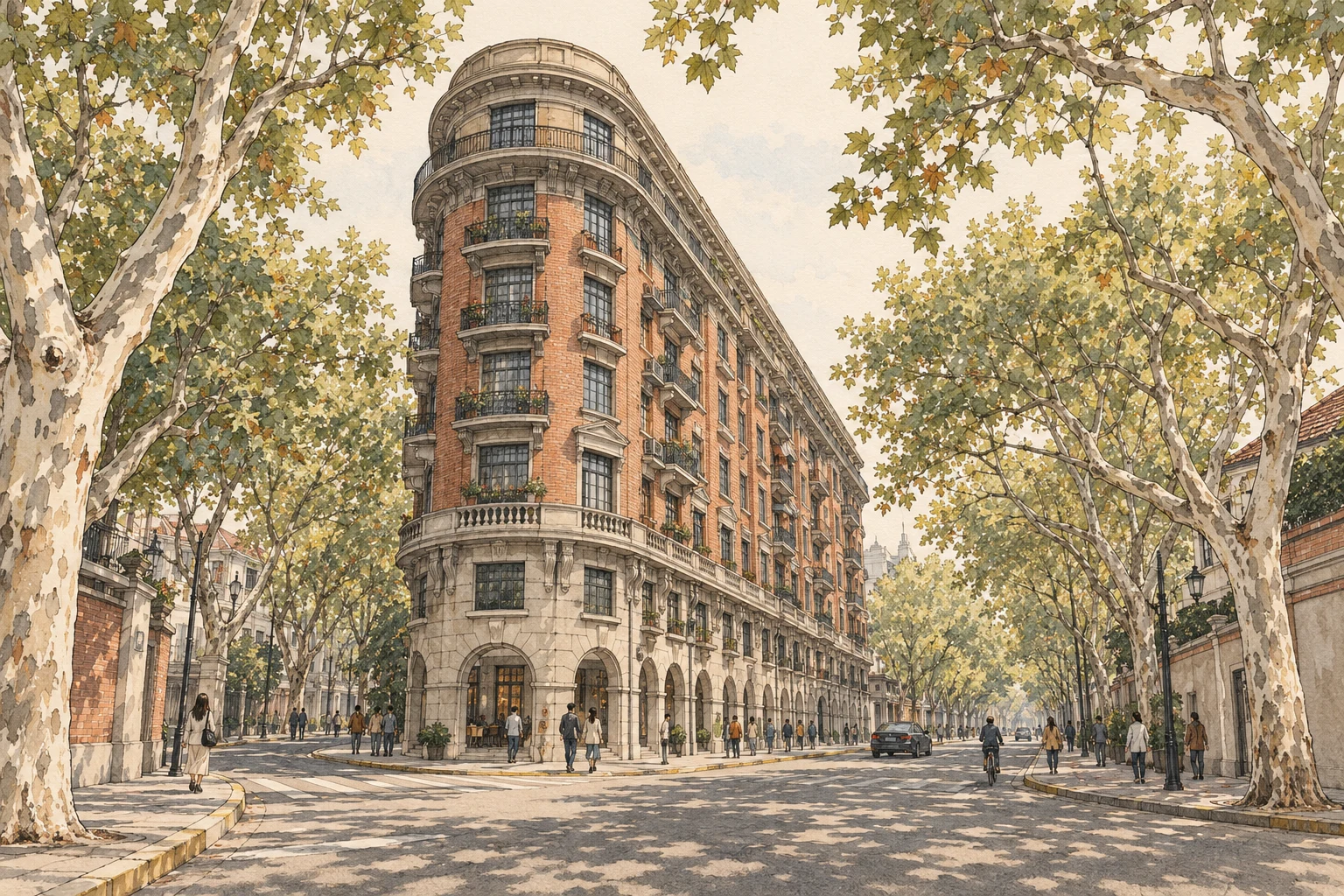
Choose one short stretch
Yongjia Road gives this kind of walk a concrete setting. Shanghai's 2024 municipal guide describes a street of plane trees, lane houses and garden residences, alongside businesses such as cafes and barbershops. It identifies the road as one of the city's 64 roads protected against widening to preserve their character.
Start with a short section rather than a route that requires you to hurry toward every named building. Stand at a safe point on the pavement and look along the row of trunks. Then look above them. The street has an upper structure of branches as well as a lower structure of walls, entrances and kerbs.
Let the facade appear in pieces
A canopy makes it difficult to take in some buildings all at once. Instead of treating that as an obstruction to the photograph, notice which parts emerge: a roof above the leaves, a balcony between branches, a doorway below them. The architecture is experienced through movement, rather than only as a flat elevation.
Change your viewpoint by a few steps while staying clear of driveways and crossings. Notice whether a gap reveals the whole building or only another fragment. There is no need to step into the carriageway for a clean view. A partial view can describe a tree-lined street more truthfully than a carefully emptied frame.
A pause has an address too
At 309 Yongjia Road, the municipal guide identifies a pocket park. Another 2024 city-walk guide includes this Jialanting site among a sequence of neighborhood green spaces. These are useful places to put on a map when you want the walk to include a pause, rather than relying on a cafe purchase for every rest.
From an available public seat, look back at the street edge. Where do people wait, pass through or turn into a lane? Do the trees, a low wall or a change of paving help define those movements? Observe what happens during your own visit without turning a brief encounter into a claim about how an entire neighborhood lives.
Return in another season
A leafy summer photograph and a winter photograph answer different architectural questions. One may show shade and enclosure; the other may reveal lines of windows or the branching structure itself. When comparing photographs, note their season before assuming that the street or building has changed.
Keep the walk modest: a few facades, one lane entrance seen from the street and a public place to sit. The reward is learning to see trees and buildings as parts of the same place. The canopy matters because the street continues underneath it, with all the movement, maintenance and ordinary uses that a beautiful photograph can leave outside the frame.