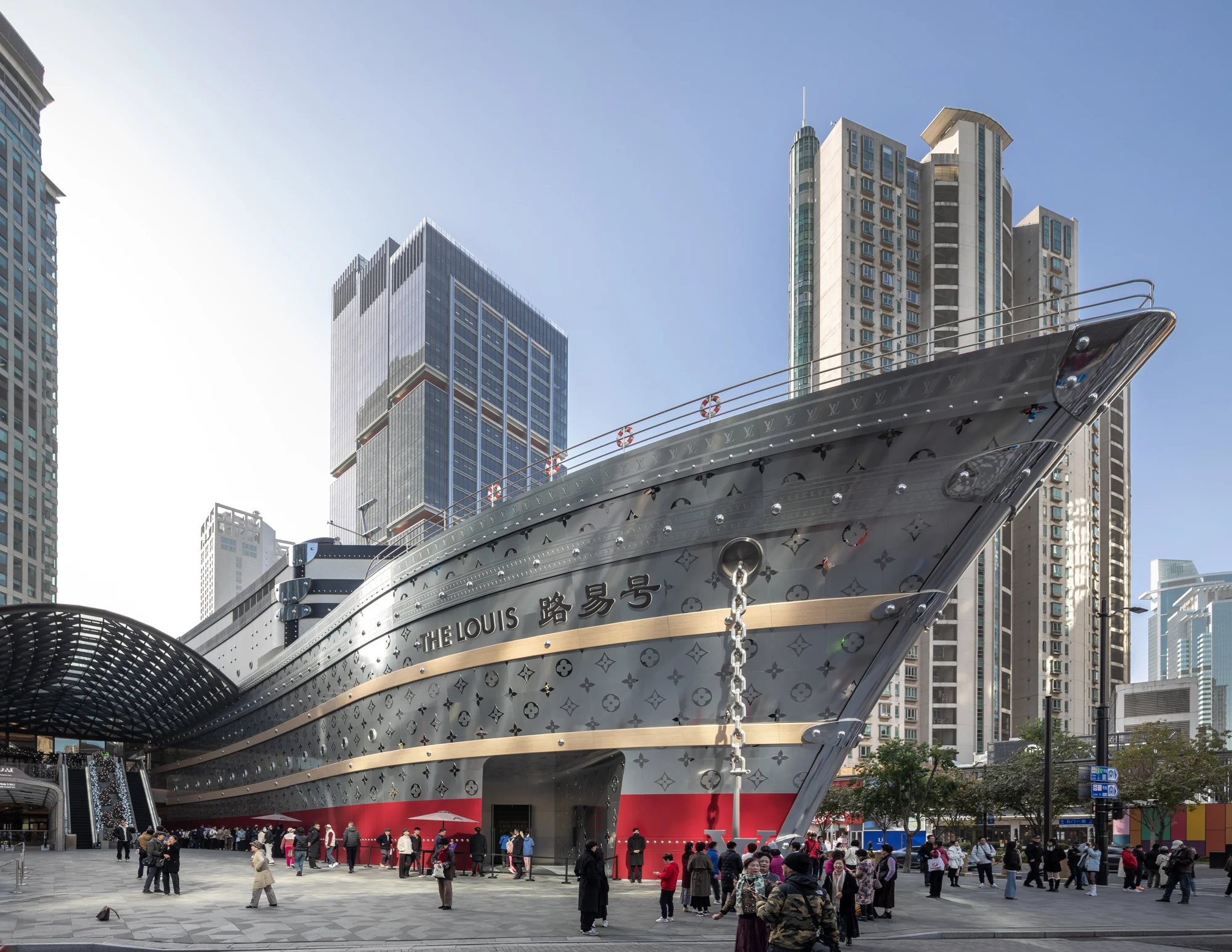

A ship in the shopping district
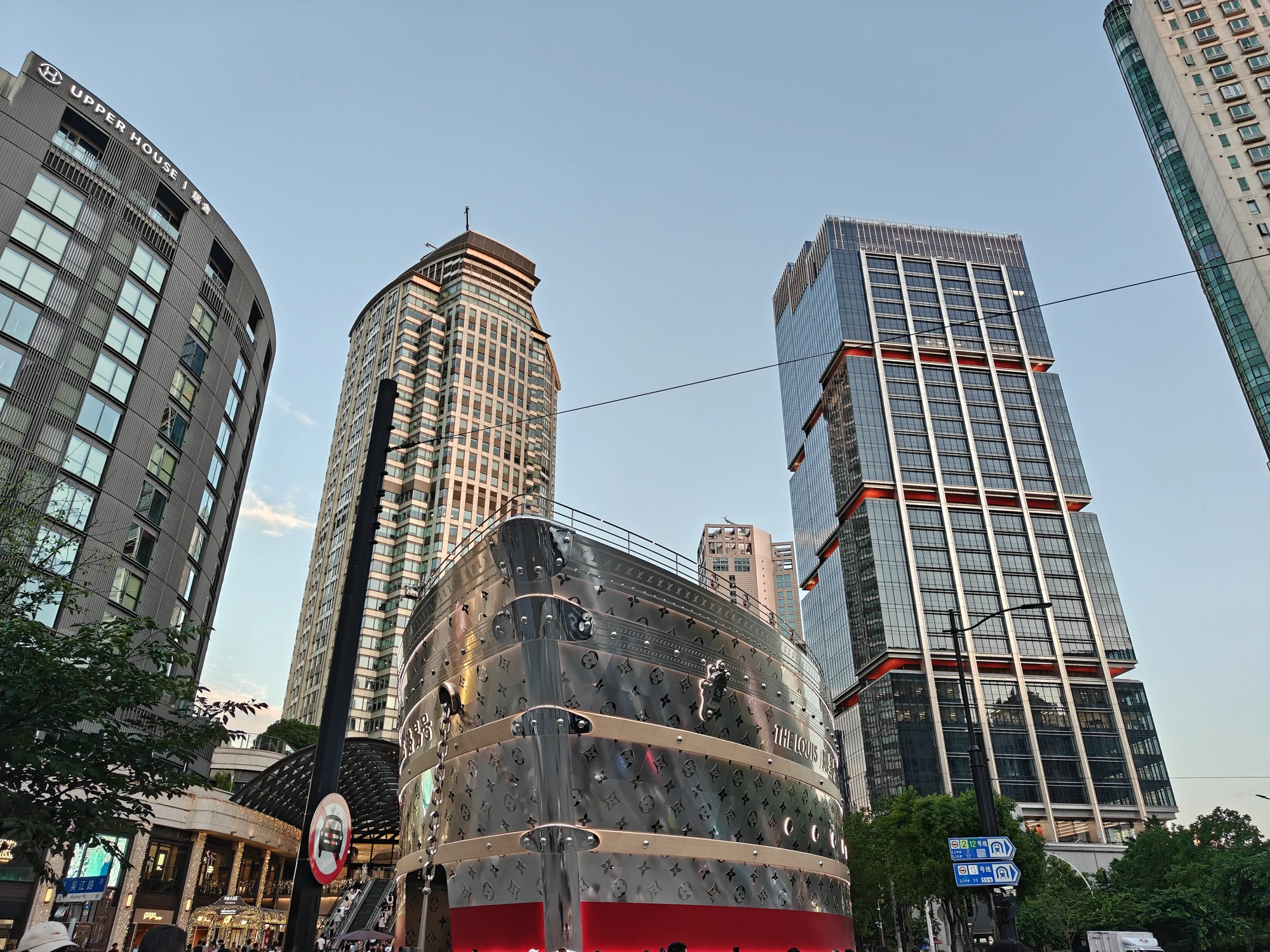
Louis Vuitton has put a ship on West Nanjing Road. The Louis combines an exhibition, a shop and a restaurant inside a structure whose upper levels resemble stacked travel trunks. It opened to the public on 28 June 2025 at HKRI Taikoo Hui. The Huangpu is some distance away; the voyage begins between office towers and shopping malls.
The exhibition, Visionary Journeys, occupies two floors. OMA’s Shohei Shigematsu designed the scenography, including an arch of Monogram trunks. Rooms take the visitor through luggage, perfume, books, sport, clothing and workshop practice. Upstairs, Le Café Louis Vuitton adds a different reason to stay, with a Shanghai menu developed by Leonardo Zambrino and Zoe Zhou.
The building supplies the photograph before the visitor reaches the merchandise. The displays then give the photograph a history: trunks, journeys, materials, makers. Shopping and lunch can follow. Those activities belong to one address, but they ask for different levels of commitment. A person can be interested in a building long before wanting a bag.
What the brands are buying
These projects purchase several things at once: a place in the city, time with an audience, and a setting in which the brand can explain its prices and its identity. A window display reaches people passing by. An exhibition can occupy an hour; a café gives someone a reason to return with a friend. A restored house becomes part of a neighbourhood’s cultural map.
That is my reading of the format, and it is close to how the companies describe their intentions to investors. Prada’s April 2025 presentation put Mi Shang in Shanghai and its Singapore café under the improvement of client experience through hospitality. LVMH’s 2025 results singled out The Louis among its investments in exceptional stores and cultural experiences.
The distinction matters when talking about how much money is being spent. Architecture, restoration, kitchens, staff and changing programmes are substantial commitments, but the public material does not disclose a comparable project budget or profit figure for each venue. A spectacular room is evidence of ambition; it is not a published return on investment.

Prada Rong Zhai: a longer relationship with the city
Prada’s Shanghai address makes the time involved particularly clear. Rong Zhai is a 1918 residence at 186 North Shaanxi Road. The group began restoring it in 2011 and inaugurated it in 2017, after six years of work involving Chinese and Italian craftspeople. Its decorative surfaces, woodwork and old rooms give it a cultural identity that predates the Prada name.
The restored house became a flexible venue for exhibitions and other cultural activity. That makes the building itself part of the relationship: Prada gains an unusually specific Shanghai setting, while visitors gain occasions to enter a historic residence. The house cannot be reproduced by fitting the same shop interior into another mall.
This is a different timescale from a fashion-week pop-up. Repeated programmes let an address acquire associations over years. The attraction can be an artist, a room, a film connection or the building’s restoration; the audience need not arrive with an intention to buy clothes.
Mi Shang: Wong Kar Wai, pastry and the restored house
Mi Shang Prada Rong Zhai opened on 31 March 2025, adding café, pastry and dining spaces to the house. Wong Kar Wai developed its concept around tête-bêche, the stamp arrangement in which neighbouring images face opposite directions. The idea gives Shanghai and Milan a visual relationship rather than leaving an Italian restaurant floating inside an unrelated old building.
The launch brought together Wong’s imagery, Chinese antiques, Prada’s art collection and woodblock works made with Duo Yun Xuan. Its rooms included a pastry shop, a café, a library and a dining room. Those are distinct social settings, with different reasons to linger and different demands on a visitor’s wallet.
A meal remains a commercial purchase. It can also give the restoration a role in daily life beyond occasional exhibitions. The interesting part is the combination: cinema, design, hospitality and a Shanghai house remain legible as separate contributions, while reinforcing the same address.
ZEGNA Caffè and Maison Margiela: the smaller encounters
ZEGNA Caffè sits beside the brand’s boutique at HKRI Taikoo Hui. Its design draws on Oasi Zegna, the landscape associated with the company’s origins, and its identity uses the road marked 232. Northern Italian food and drinks make that background part of a sitting-down experience. The city’s 2024 opening report credits Patricia Urquiola with the design.
The café offers an introduction to the brand through a space and a small purchase. That does not make its visitors future suit customers automatically. It does allow the house to be encountered repeatedly, outside the infrequent business of buying an expensive garment.
Maison Margiela announced its Shanghai café at the JC Plaza flagship in July 2022. The brand still lists the flagship at 1225 West Nanjing Road, in units 105 and 206; café service and hours should be confirmed with the boutique before a special trip. Its place in this story is also a reminder that a launch photograph and a current visitor recommendation are different things.
The fashion café needs a reason to survive after the opening crowd has taken its pictures. Comfortable seating, service, food and a useful location matter to repeat visits. A recognisable cup can start the relationship; the next afternoon has to be worth someone’s time.
Why Shanghai makes the combination work
The geography is unusually helpful. West Nanjing Road concentrates major boutiques, department stores, offices and transport connections. The Louis, ZEGNA Caffè, Rong Zhai and JC Plaza can be understood as parts of the same central district, rather than four isolated excursions. A museum, lunch and a shop can fit into an ordinary day in the city.
The smaller streets offer another scale. Around Wukang and Anfu, brand projects occupy houses and join an existing pattern of cafés, bookshops and architecture walks. A January 2026 municipal account described this directly, using a short Fendi café pop-up as one example. That event has ended; its placement shows why a fashion house might value a few rooms on a residential street as much as a highly visible mall frontage.
Shanghai also has an audience for different parts of the proposition. Residents can return for coffee or another exhibition. Domestic and international visitors can build a day around an unfamiliar address. People interested in architecture, photography, craft or food can enter the story without first identifying as customers of the label.
The city actively promotes first stores and debut formats. That creates competition for an opening that has something to say beyond another retail address. The attraction of Shanghai is therefore partly commercial scale and partly its capacity to turn a brand project into a broader outing. Local buildings, streets, cultural partners and habits supply much of the material.

The museum connection: put the making on view
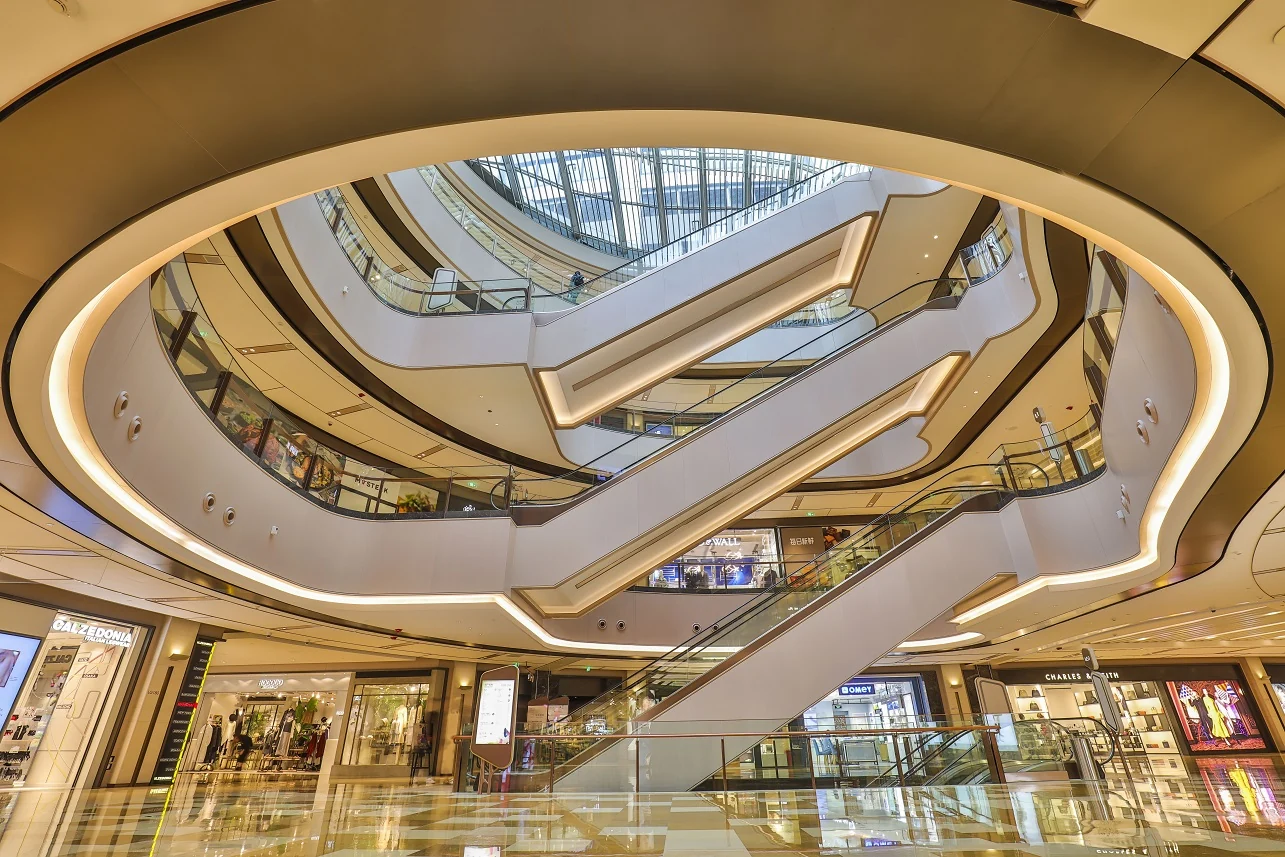
Fashion’s museum presence adds a different kind of authority. At Museum of Art Pudong, la Galerie du 19M SHANGHAI runs from 25 September to 15 November 2026. Founded by CHANEL in Paris, le19M brings specialist craft houses into a programme of exhibitions, talks and workshops. A Sense of Touch pairs Chinese and French creatives; a separate Lesage presentation follows embroidery and weaving.
Here, the useful subject is the work: the movement of a needle, the structure of a textile, the decisions that turn a material into a surface. Showing those processes can make an expensive finished object more intelligible. It can also offer something substantial to someone who will never buy that object.
A Sense of Touch is curated by Gong Yan, Lin Tianmiao, Zhang Lei and Christelle Kocher. Its materials extend beyond clothing to ceramics, woodcarving, lacquer and bamboo weaving. Alongside Lesage’s embroidery and weaving, that range places fashion’s specialist workshops in a wider conversation about what hands can make.
- Museum of Art Pudong: exhibitions, entrance and booking details
- Official la Galerie du 19M Shanghai programme and reservations

The commercial evidence and its limits
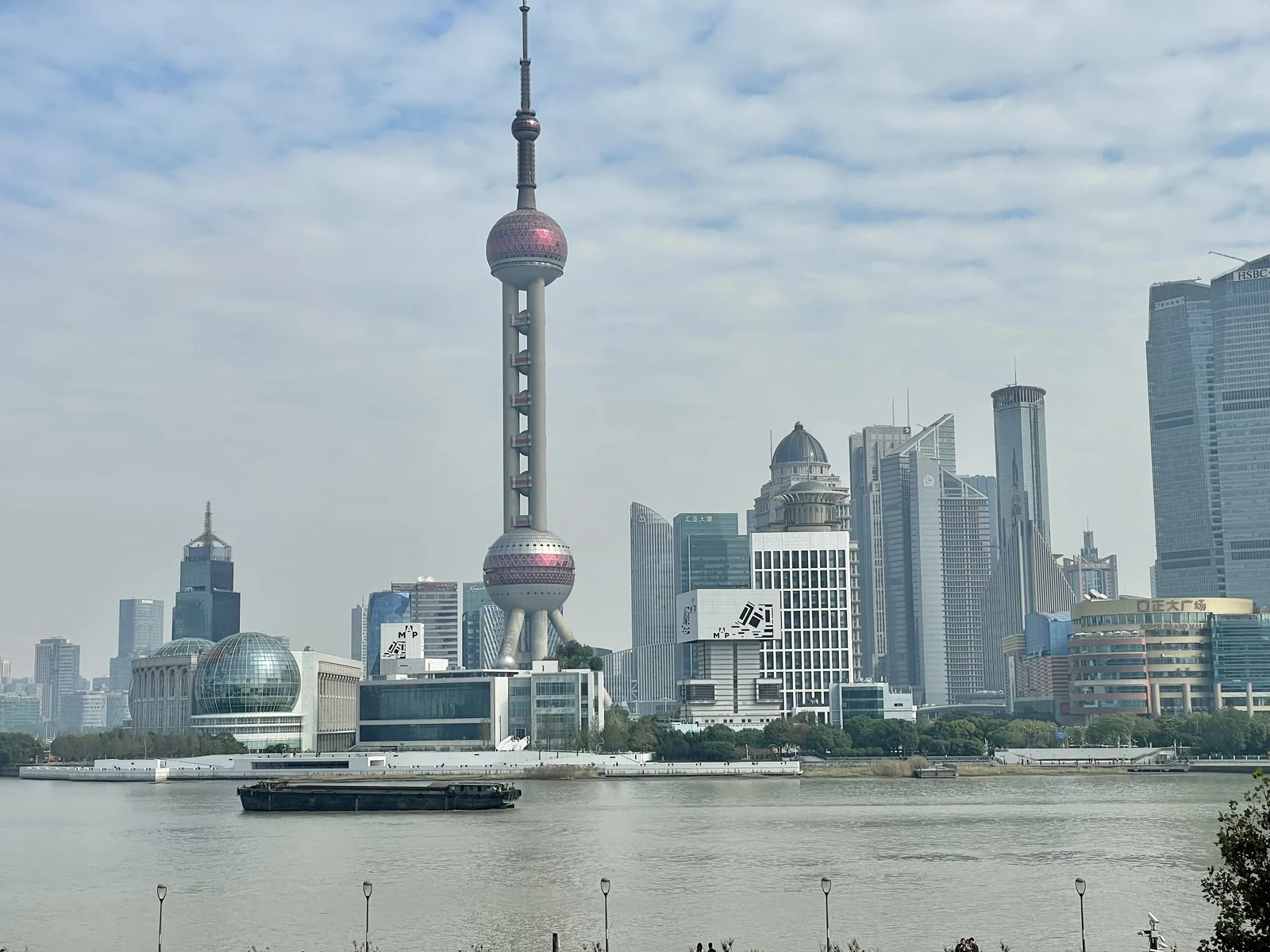
The landlord has a measurable interest in all this. In May 2026, Swire Properties reported that HKRI Taikoo Hui’s first-quarter retail sales had risen by more than 80 per cent year on year, while footfall had more than doubled. Its account highlighted The Louis and the established Starbucks Reserve Roastery as distinctive attractions at the development.
Those are figures for the development, reported by its owner. They are not Louis Vuitton’s sales, and they do not isolate the effect of one ship-shaped building. They nevertheless show why a landlord values a tenant that becomes a destination: people may visit for one attraction and spend time elsewhere in the complex.
The wider luxury market also supplies a reason to work harder for attention. LVMH reported a five per cent organic decline in its Fashion & Leather Goods revenue in 2025. That is a global business-group result, not a Shanghai statistic. It makes the continued emphasis on distinctive stores and cultural experiences more revealing: the objective is to strengthen demand and desirability in a demanding market, rather than assume that more shopfronts will be enough.
Distinctive to Shanghai, with relatives elsewhere
Louis Vuitton’s Visionary Journeys also has versions in Bangkok and Seoul. Prada’s 2025 investor material discussed hospitality in Singapore alongside Mi Shang. The combination of fashion, culture and food travels, just as the fashion houses do.
Shanghai’s particular contribution is the concentration and the local material: port-city imagery at The Louis, a restored Chinese residence at Rong Zhai, a filmmaker’s Shanghai–Milan conversation, museum craft programmes and the small streets where shopping becomes a walk. The more successful projects need the city to make sense. They offer a stronger reason to go than a branded backdrop that could have been installed anywhere.
A practical afternoon around West Nanjing Road
For a first encounter, I would pair The Louis with Rong Zhai and leave time for the streets between them. The former makes the brand’s architecture and exhibition strategy explicit; the latter supplies the older building and the slower cultural relationship. A café or meal can sit between those visits, rather than trying to fit every branded table into one afternoon.
The Louis / 路易号: HKRI Taikoo Hui, 789 West Nanjing Road — 南京西路789号兴业太古汇. The exhibition is complimentary with registration through the “My LV” / 我的专属LV WeChat mini-programme. Dining is a separate booking and purchase.
Mi Shang Prada Rong Zhai / 迷上 Prada 荣宅: 186 North Shaanxi Road — 陕西北路186号. The restaurant uses its own WeChat mini-programme for reservations; telephone 021 2218 0388. Restaurant bookings, exhibition entry and access to other rooms are separate arrangements.
ZEGNA Caffè / 杰尼亚咖啡: unit L128, HKRI Taikoo Hui, 288 Shimen Yi Road — 石门一路288号兴业太古汇L128. This is the same development as The Louis, using a different street address. Telephone 021 6268 2808.
Maison Margiela JC Plaza: units 105 and 206, 1225 West Nanjing Road — 南京西路1225号锦沧文华广场105、206室. Telephone 021 5299 5865 for the boutique and current café enquiries. For le19M at MAP, reserve through its mini-programme and buy a valid museum ticket for the same date. The cultural programme ends on 15 November 2026.