Begin with what is wrong now
Bring an example of a garment that works and, if useful, one that does not. Be precise about the problem: a shirt collar that fits while the body is too roomy, trousers that sit badly when you sit, a jacket that pulls through one shoulder. “Nothing fits” is understandable, but it gives the maker less to diagnose.
Separate fit from preference. A garment may accommodate your body perfectly well while offering a silhouette you dislike. Ask for a wider leg, a softer shoulder or a different balance if that is the aim. A tailor cannot infer your preferred appearance from measurements alone, and a flattering sample photograph does not establish how that cut will behave on you.
Alterations begin with a finished object
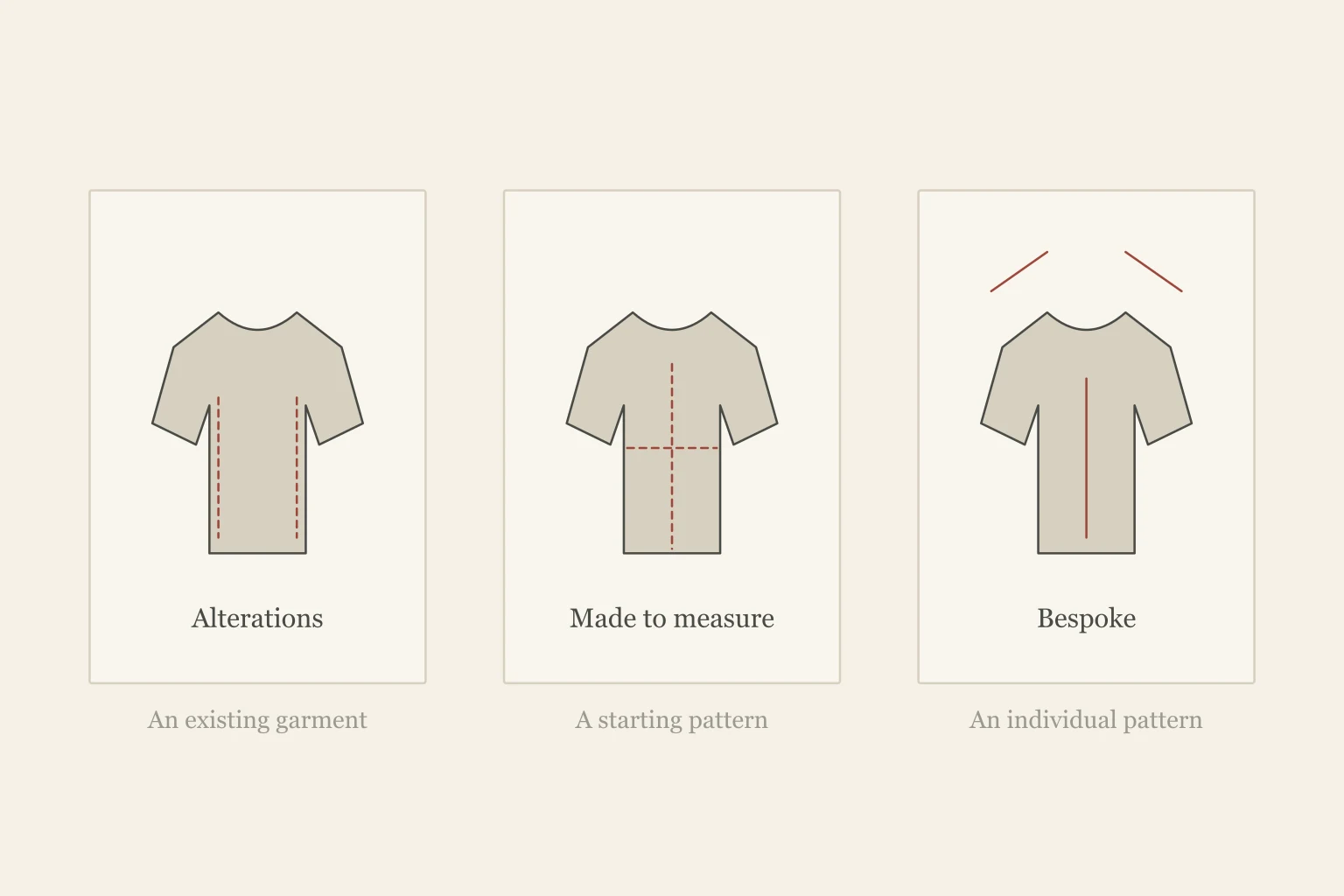
In an alteration, the starting point is an existing garment. Its cloth has already been cut, its seams made and its design established. That creates both an advantage and a limit: you can see much of what you are buying, but the available material and construction constrain what can change.
Shortening a straightforward trouser hem is not the same undertaking as changing a jacket shoulder or dress armhole. Ask the person who would do the work to inspect the piece before buying it as an alterations project. Pockets, linings, buttonholes, embroidery and limited seam allowance can make an apparently small change complicated. The sale price does not include the consequences.
| Process | Starting point | Useful question |
|---|---|---|
| Alterations | An existing garment | What can this garment’s seams and construction accommodate? |
| Made to measure | An existing base pattern | Which changes are made to the pattern, and what is left to fitting? |
| Bespoke | An individual pattern | How is the pattern developed and retained, and what fittings are included? |
Made-to-measure starts from a developed pattern
In the usual trade distinction, made-to-measure adapts an existing pattern to a customer. Jeff Banks Savile Row describes adjusting a standard pattern using measurements and observations of posture. This can be an efficient, thoughtful process when the starting shape is appropriate and the maker can accommodate the differences that matter to you.
Ask what can be adjusted in this particular service. Length, circumference, shoulder configuration and posture may not all have the same range. Ask whether you will try a sample first and what happens if the initial result needs correction. The word custom can describe a wide variety of systems; choosing buttons is not the same as changing the underlying shape.
Bespoke should invite a process conversation
The Savile Row Bespoke Association describes garments made from an individually handmade pattern under a cutter's supervision. Its detailed standard belongs to its members. It is a useful reference for asking a Shanghai maker about pattern development, fittings and construction, rather than a rule that lets a visitor certify every shop from the doorway.
Ask who drafts or cuts the pattern, whether it is retained and what stage you will fit. Establish which decisions remain open at that stage. A basted or otherwise unfinished fitting gives the maker a chance to assess work before final finishing, but its usefulness depends on what is observed and changed. An appointment alone is not proof of a meticulous process.
Construction is a separate axis
Pattern-making and internal construction are related decisions, not synonyms. A conversation about an individual pattern does not settle the chest structure, lining, seams or amount of handwork. Ask the maker to explain the construction they propose for the specific garment and why it suits the cloth and your intended use.
Avoid judging by a single decorative sign. An attractive buttonhole or visible stitch can coexist with problems elsewhere. Equally, a garment does not need every possible hand operation to serve its wearer well. Put the effort where it affects shape, comfort and longevity. If the answer is always a prestigious word rather than an explanation, keep asking.
Choose the process with the calendar open
A short Shanghai stay changes what is sensible. Work backward from departure through collection, possible corrections, fitting and measurement. Ask the maker to set out that sequence rather than promising a generic number of days. Fabric availability, the commission and their workload all matter. A time frame quoted for another visitor is not your agreement.
If there is no time for the process you want, use the visit for an initial conversation or choose a ready-made item with realistic alterations. Shipping later can be discussed, but remote correction is a different problem from returning to a fitting room. Establish the plan for an unsatisfactory fit before paying, not from another country after delivery.
Put comparable terms on the order
Write down the cloth identification and composition, design, construction, fittings, agreed changes, total price, deposit and collection arrangement. Include the person responsible for follow-up. A photograph can clarify a lapel or pocket, but written specifications should still identify which features you are asking the maker to reproduce or interpret.
Bring the intended shoes and underlayers to the appropriate fitting, and explain changes in how you expect to wear the garment. Switching from a thin shirt to a heavy sweater halfway through a jacket commission changes the brief. A useful commission is a shared specification that remains stable enough for the maker to refine.
The cheapest process can be the most intelligent one
If a ready-made jacket already sits well and needs a straightforward sleeve correction, commissioning a completely new one may add uncertainty without solving a larger problem. If every ready-made shoulder sits badly, repeated ambitious alterations may be the wrong economy. The right amount of making follows from the diagnosis, not the prestige of the service name.
My preference is to ask a good maker what they would change and what they would leave alone, then assess the explanation. A willingness to say that a garment is unsuitable for alteration can be valuable. On a shopping visit, send your dates and the exact fit problem in advance. That makes it possible to choose a useful conversation rather than merely a famous tailoring address.