Publication details
First published . Series dates place related notes together in the reading archive.
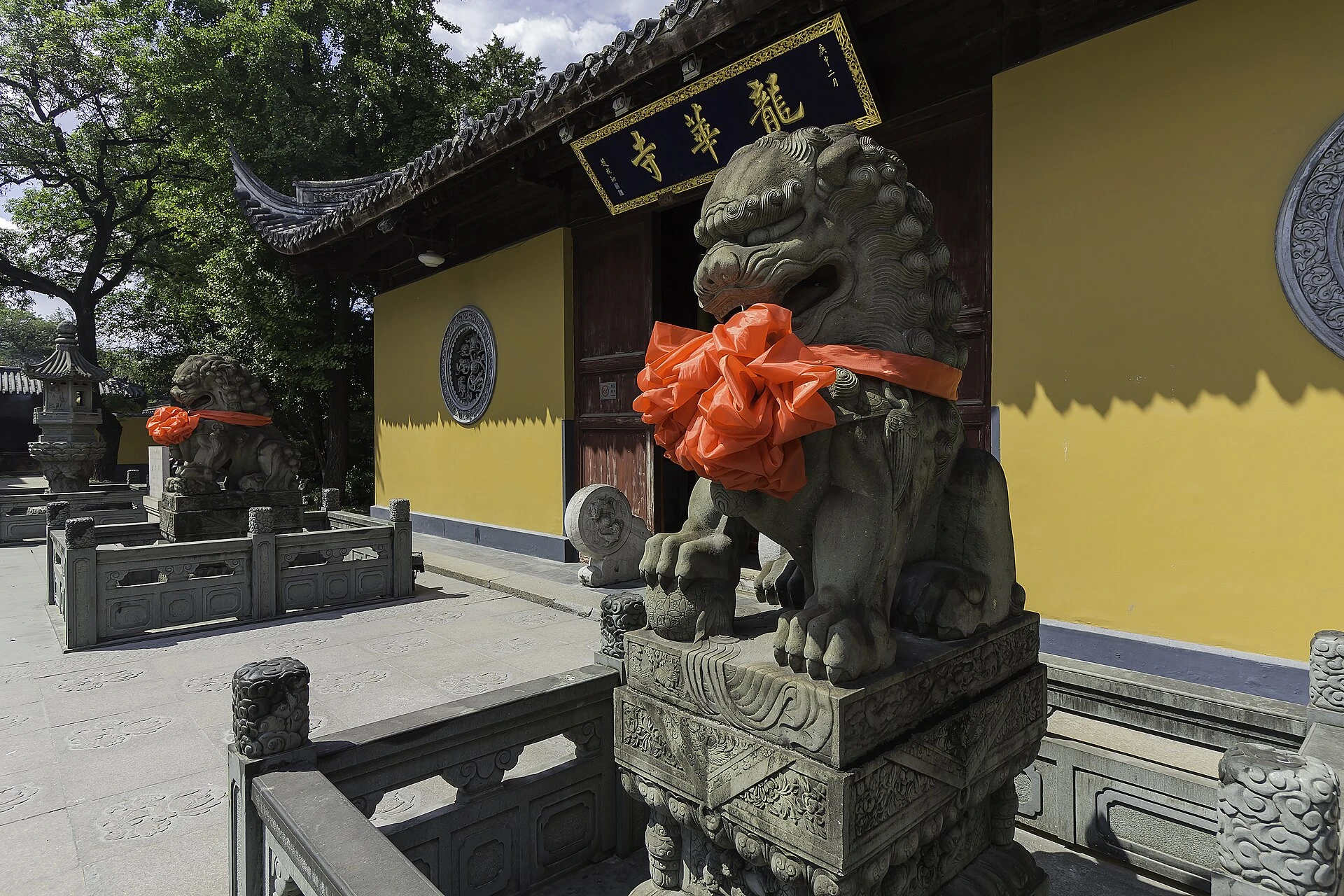

Start with the temple that exists now
Use 龙华寺 for Longhua Temple and 龙华路2853号 for its address: 2853 Longhua Road, Xuhui district. The historical quarter includes religious, revolutionary, industrial and commercial places. They are neighbours, not one attraction with a single ticket or set of opening hours.
Make the temple the main destination if you want a quiet religious visit. Do not assume that a museum, cemetery, restaurant and pagoda can all be entered through the same gate. Before setting off, identify the temple entrance in a current local map and read the latest entry instructions. The surrounding streets remain useful context even when a particular building is unavailable.
Ancient origins are not the age of every beam
Accounts of Longhua connect its foundation to a very early period in Chinese history. The surviving complex is a different question. Official tourism information describes many present halls as Qing-period buildings while noting the inherited organisation of the precinct. A foundation tradition does not make every visible roof or painted surface equally old.
That distinction makes the visit more interesting. Ask what has been repaired, renewed or maintained and what the layout preserves. Living religious architecture often survives through continued work. Treating every replacement as a loss of authenticity can miss the practices that allow a building to remain in use at all.
The pagoda is not an invitation to climb
The pagoda is a strong orienting landmark, but a view of it should not turn into an expectation of interior access. Do not plan a tower climb unless the operator explicitly confirms one. A distinctive silhouette can be studied from public permitted areas without searching for an unmarked route inside.
Look at the repeated levels, changing rooflines and the way the tower occupies space around it. Move a little rather than taking one picture from the first clear angle. The relationship between a tall marker and a low sequence of temple buildings is more instructive than a photograph cropped so tightly that the surrounding precinct disappears.
Let worship set the pace
Inside permitted areas, follow the movement of worshippers rather than stepping across it. Stand aside when someone is making an offering. If you do not understand a ritual, watching quietly is preferable to copying gestures for a photograph or asking a person to repeat what they have just done.
I would leave room here to stand still. A temple becomes less legible when every gate is treated as a task to finish. Notice the transitions between busy and quiet spaces, the direction of the main approach and the places where visitors naturally slow down. You do not need to take part in a practice to recognise the care it deserves.
Handle incense and photographs thoughtfully
Follow the temple’s current rules for incense and offerings. Do not bring an assumption from another Buddhist site and treat it as universal. If something is unclear, ask staff before lighting, placing or carrying anything. Keep a respectful distance from flames and from people moving through a crowded area.
Photography requires the same attention. Exterior architecture and a recognisable person praying are not the same subject. Check signs around halls and images, avoid flash, and never block an entrance for a posed shot. The aim is to leave with a clearer understanding of the place, not proof that you managed to photograph every room.
Keep revolutionary history distinct
The wider Longhua area also contains memorial spaces connected with twentieth-century political violence. A Buddhist visit and a revolutionary memorial visit ask for different forms of attention. If you want both, allow enough time to read the latter properly rather than using it as a convenient extra beside the temple.
Be careful with language. The fact that places are close together does not mean they share a single historical explanation. Read the date and identity of each site, distinguish the events commemorated from later memorial construction, and avoid collapsing several periods into a vague story of “old Shanghai”. The changes in use are part of the district’s substance.
Noodles are an option, not a guaranteed ritual
Vegetarian food is a reasonable interest around a Buddhist precinct, but an old restaurant recommendation is not a promise of today’s menu or access. Confirm the outlet, its opening arrangements and what it serves before planning a meal around it. Dietary requirements need actual ingredient questions, not the assumption that every vegetarian-labelled dish suits every restriction.
If you do find a suitable bowl, give it time. A simple lunch after a temple visit can be more satisfying than adding another distant attraction. If the restaurant is closed or crowded, choose somewhere else without treating the whole morning as spoiled. The religious visit should not depend on obtaining one photographed dish.
A useful half-day, without overloading it
Allow around ninety minutes for a selective temple visit, more if you intend to study the buildings slowly. That is a suggested pace, not a published route. Add the surrounding district only after checking distances, separate entrance times and the weather. Public transport directions should be based on your actual starting point rather than a copied “best” station exit.
Take the Chinese destination name, bring what the current entry process requires and keep the next appointment flexible. Longhua works best when it has room in the day. Its value lies in the relationship between a living precinct and a changing city, which is hard to see when you are already looking at the clock.