
Begin with the park as a public room
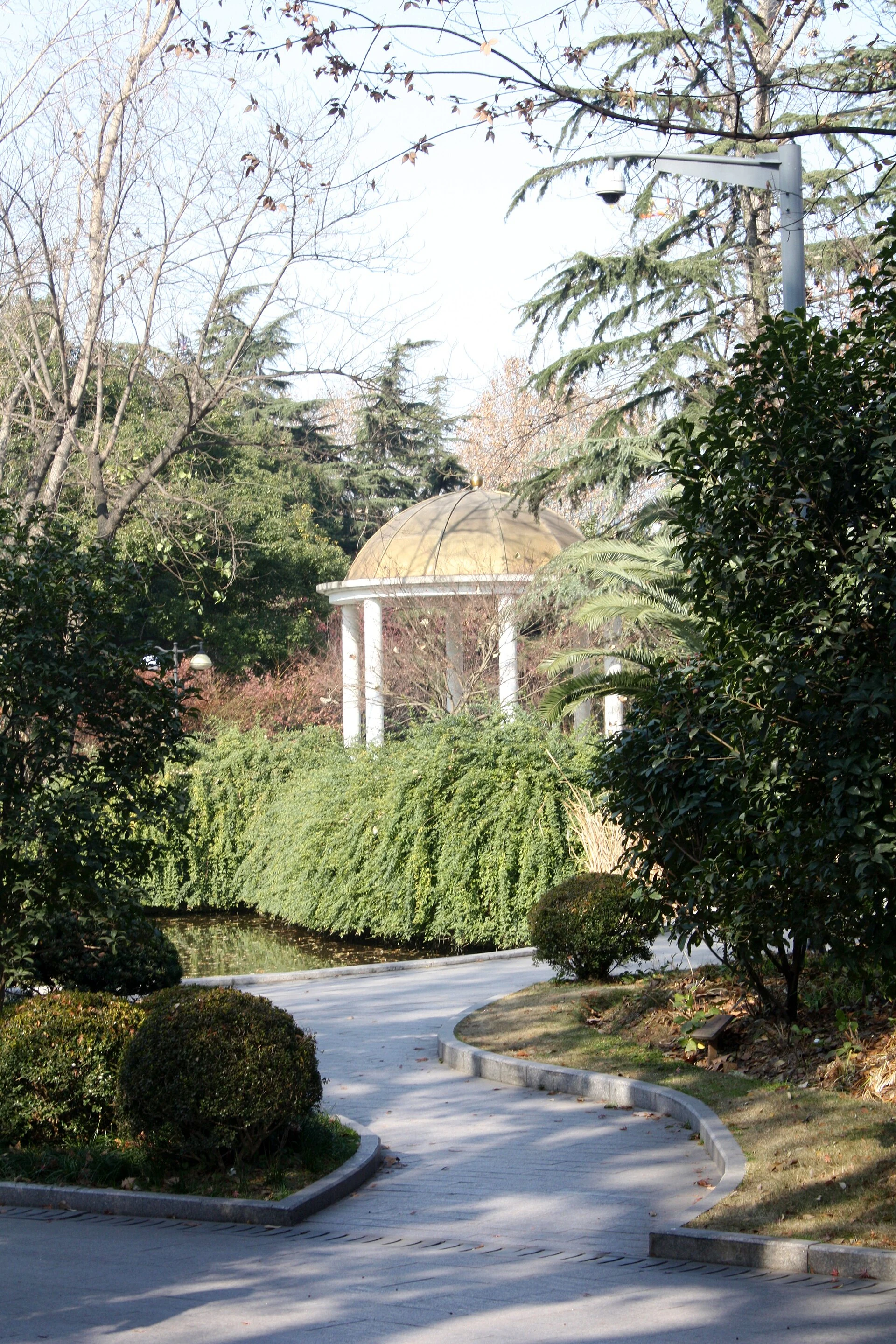
Fuxing Park opened in 1909 as Gujiazhai Park and became widely known as the French Park. Its rose garden, lotus pond, rockery and Marx-and-Engels statue give the grounds several quite different focal points. Instead of making a circuit simply to find all of them, compare a formal planted space with a looser path under trees. The city records a comprehensive renovation in 2007; this is a maintained and altered public garden, with a historical design rather than a frozen historical condition.
A useful approach begins at the Yandang Road side—the municipal park address is No 105—then takes the public paths toward the Middle Fuxing Road and Sinan area. Allow around two hours for a selective park-and-street outing, with more for a meal. In the park, notice whether a path points toward an object, carries you past it or invites you to stop before reaching it. Those are three distinct ways to organize a visitor's attention.
Look without assigning people a performance
A public park can be lively or quiet, and neither is a service offered to tourists. If people are playing a game, exercising or talking, you can appreciate the shared use without assuming that they want to explain it to you. Ask before making a close portrait or joining an activity. A camera held at a respectful distance can still be intrusive when it remains fixed on the same person for several minutes.
I would spend a little time on the physical setting around an activity instead. How does a bench face a path? Where does shade fall relative to a place to sit? What leaves enough open ground for a group? These details tell you something about why a space gets used, and they avoid reducing the park to a collection of photogenic residents. They also help distinguish a designed garden from a landscape enjoyed only as a view.
On Sinan Road, change from park to frontage
Once back on the public street, notice the change in boundaries. The park has entrances and an outer edge; the street has a sequence of doors, walls, gates and setbacks. A villa behind a garden wall addresses the passerby differently from a row of shops. You can study that relationship from outside. An elegant gate does not need to be open, and a closed one need not be treated as a loss to the route.
A setback changes the experience of an ordinary facade. Trees and a low wall create a middle distance between passerby and house; a shopfront meeting the pavement removes it. Look at how much of the lower floor remains visible from the street, then compare that with what you can see of the roof. A house can feel secluded while having a highly visible silhouette. That is a more precise description than simply calling the street leafy.
Sinan Mansions is a cluster with several uses
Sinan Mansions, at 523 Middle Fuxing Road, comprises 51 garden houses built in the 1920s and 1930s, according to the city's commerce listing. The same account includes independent garden houses, arcade buildings, new-style lanes, garden lanes and modern apartments. That range is the useful detail. A detached house is an object within a plot; a lane house is part of a repeating arrangement. Read the space between them and you can see why the cluster has several architectural scales.
From the authorized pedestrian areas, compare the spaces between the buildings with the view from the street outside. What connects one house to another now? Where do signs and shopfronts create a new route through what once read as a residential setting? I find this more revealing than ranking the houses by charm. The conversion of a place changes the paths a stranger can take through it; circulation is part of the design story.
An interior should add a subject
A nearby interior with a particularly clear change of use is Sinan Books at 16 Gaolan Road. The municipal architectural guide identifies the former church and draws attention to its yellow vaulted ceiling and narrow stained-glass windows. A bookstore in this kind of volume gives a useful comparison between architecture directed toward a focal point and the browsing patterns of a new use. Check its current visitor notice if you want to make it the fixed stop.
My preference is one purposeful pause. A drink with a seat, a meal or an exhibition gives the outing an interval rather than a string of interrupted glances. Check prices and what the order includes. There is no need to defend a modern cafe as an essential encounter with the old city. A present-day business can be interesting on its own terms, especially when you pay attention to how it occupies the building.
The park is the useful counterweight
After a commercial heritage district, the park gives you a different measure of value: space that can be used without selecting a product. That does not make one place virtuous and the other suspect. They serve different purposes. The comparison helps you see what a managed destination provides and what a public garden makes possible. An afternoon is richer when those differences remain visible rather than disappearing into the same phrase about Shanghai atmosphere.
Keep one practical boundary in mind: occupied homes, hospitality venues and exhibition spaces have different arrangements, so use designated public routes and confirm any interior you want to enter. Then let the comparison lead. Fuxing Park offers a shared room at the scale of the neighborhood; Sinan breaks space into a succession of plots and doors. I would keep this outing modest enough that you have time to feel that change, rather than adding another district as soon as the last house is photographed.