
Begin with the words
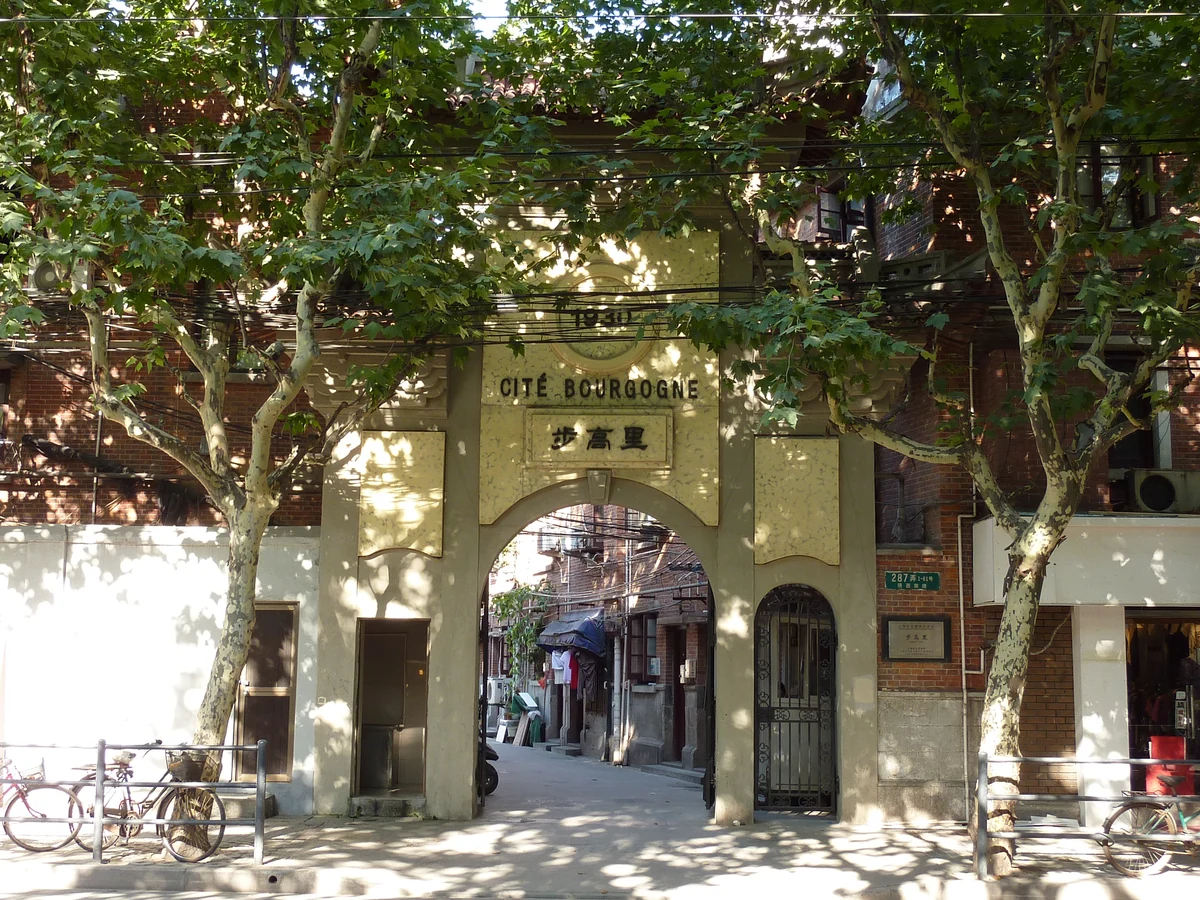
Bugao Li is written 步高里. Its French name, Cité Bourgogne, refers to Burgundy. Photographer Tao Da's 2018 architectural essay records the paired names on its gateway and dates the development to 1930, with French investment and design and construction by a Chinese real-estate company.
That is already a more precise starting point than calling a neighborhood simply 'French'. A name can recall an overseas place while the development itself involves Chinese firms and Shanghai residents. The lettering gives you evidence of how the site presented itself; it does not tell you the nationality or life story of everyone who lived behind it.
Read the frame around the lettering
Tao's photographic account identifies the entrance as a pailou-style gate. Follow the relationship between the opening, the roof form and the panels carrying the names. A gateway has to perform several jobs at once: mark an address, make a boundary and offer a recognizable face to the street.
Stand back far enough to see those elements together before concentrating on a character or decorative detail. A tightly cropped photograph can turn lettering into a floating emblem. Including the pavement and adjacent frontage helps explain how the sign belongs to a real entrance used by people moving through the city.
Keep a name, an address and a date distinct
When reading Shanghai buildings, separate the development's name from the numbered street address and any date displayed nearby. They answer different questions. A written year may be worth recording, but establish what it commemorates before treating it as the age of every visible surface.
The same care applies to translated names. Copy the original characters before relying on an English spelling, and keep the French wording if that is part of the entrance. A note that preserves both is easier to connect with an older map or photograph later. It also makes clear which words you actually saw and which explanation came from a source.
The threshold remains a threshold
The gate can be read from the public street. Looking at an entrance does not require treating the lane behind it as an attraction with unrestricted access. Keep clear of movement through the opening, respect any displayed restrictions and ask before photographing people or domestic spaces.
A five-minute stop can be enough: the two names, the form supporting them and the boundary they mark. Leave with that small set of observations rather than a story invented from the facade. Shanghai's doorways become more interesting when their inscriptions are treated as evidence that raises questions, instead of captions that explain everything.