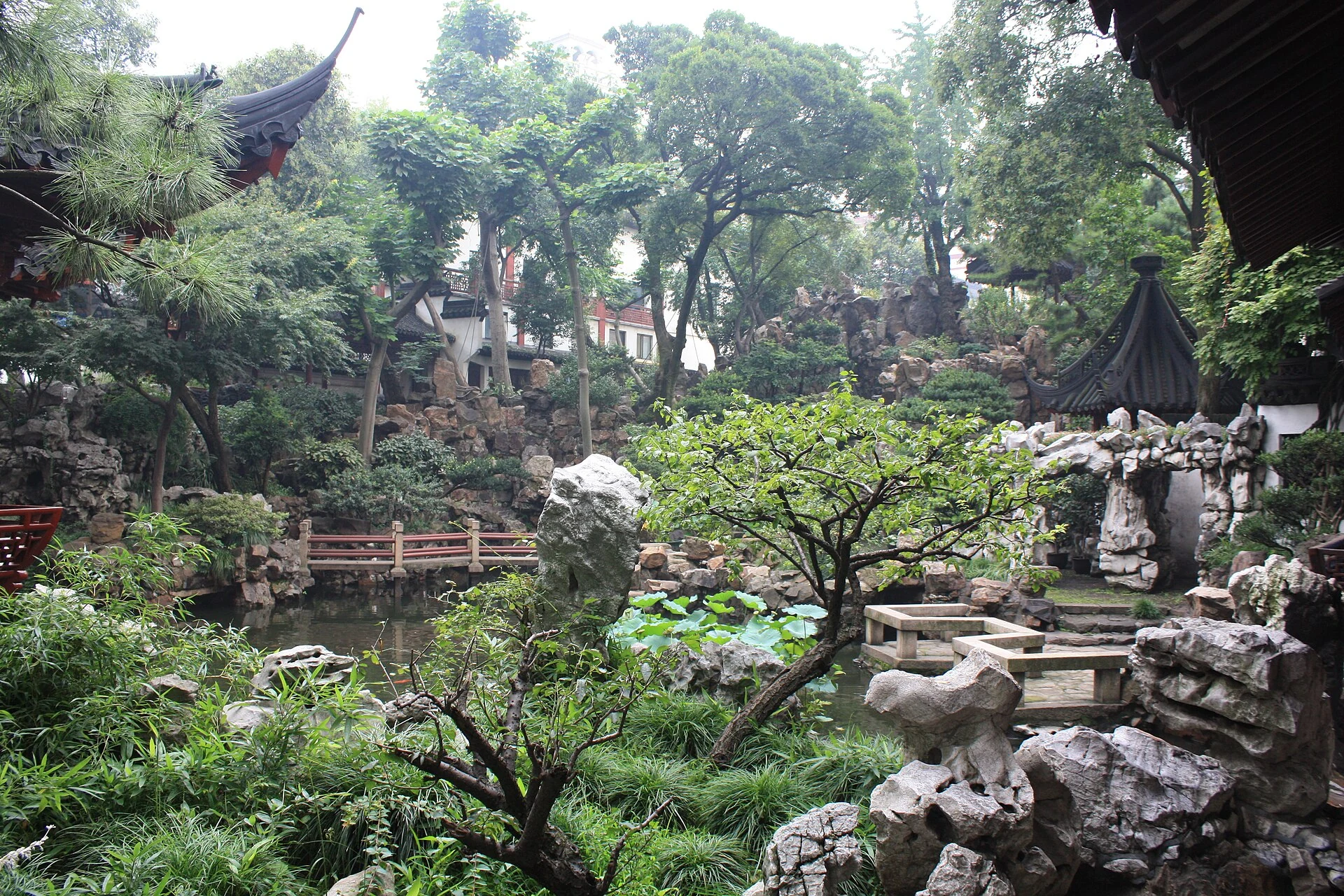

The garden is the garden inside the wall
Yu Garden, or Yuyuan (豫园), is the classical garden. Shanghai's municipal listing places it at 168 Fuyou Road and describes its origins as a private Ming-dynasty garden. Rocks, ponds, pavilions and walls organize a deliberately composed sequence of spaces. If this is what you came for, make the garden itself the fixed point of your visit rather than leaving entry until after an indefinite circuit of shops.
The garden is made to be encountered in parts. A wall can hide the next view while a window admits only a fragment of it; a corridor can make a small change in direction feel substantial. This is why the garden deserves time beyond the district's best-known photograph. The work lies in the sequence between things, not only in the number of attractive pavilions that appear on a map.
The bazaar is a commercial district
Yuyuan Bazaar, also described as Yuyuan Garden Malls, is the surrounding shopping and dining area. The municipal commerce listing gives 265 Middle Fangbang Road as its address. Shops, snacks, souvenir browsing and the highly recognizable roofscape belong to this part of the visit. A person can enjoy it without buying a garden ticket. Equally, walking between its shops does not mean that person has visited the classical garden.
I think the mistake is to ask whether the whole place is authentic or fake. That is too broad to be useful. A garden, a commercial building, a temple and a newly designed shopfront require different questions. In the bazaar, ask what is being sold, who made it and whether you want it at the quoted price. Historical-looking eaves cannot answer any of those questions for you.
City God Temple remains a religious place
Shanghai City God Temple, Chenghuang Miao (城隍庙), is the Daoist temple at 249 Middle Fangbang Road. Its own account explains the city god as a protector of the city and identifies Qin Yubo as Shanghai's city god. It lists twelve halls. That gives the visit a more specific subject than the generic idea of a Chinese temple: the religious place is tied to the identity and protection of this particular city.
Inside, make room for worshippers and follow instructions about photography, incense and movement. A religious building does not become a theatrical set because it is surrounded by shops. You need not share a belief to recognize the difference between watching a ceremony and interrupting it for a photograph. If you only want a street-food and shopping visit, say so when planning; there is no obligation to enter the temple as part of a checklist.
Choose which of the three has priority
For garden design, start with a confirmed garden visit and keep the commercial browsing flexible. For a short introduction to the district, choose the bazaar and a single additional destination rather than promising all three in a rush. For religious history, make the temple the subject and leave time to understand its layout. The fact that the entrances are near one another does not make the experiences identical in pace or purpose.
I would allow two to three hours for a selective visit, with more for a substantial meal. Protect time inside the place that interests you most. If garden design is the subject, a second circuit of souvenir shops adds less than another careful look at the way a wall frames water. If the shopping district is the subject, compare a real product and its price. Each option becomes better when it stops apologizing for not being the other.
In the garden, look at what each threshold withholds
Once inside a classical garden, try looking at the next opening before walking through it. What part of a rock, roof or stretch of water is visible? What does the wall keep out of view? Move a little and notice the difference. This gives you something concrete to do with the familiar phrase borrowed scenery without needing to assign a specialist term to every window. The sequence is the point, not simply the collection of attractive objects.
Two named features make a useful contrast: the Great Rockery and Yulinglong, the Exquisite Jade Rock, both identified in the garden's own materials. One invites you to think about a composed rocky landscape; the other draws attention toward a particular stone. Compare mass with perforation and silhouette. You do not need to resolve their entire histories to see how a garden can make stone work at different scales, as terrain in one encounter and as a concentrated object of attention in another.
Do not let a famous food queue become the entire visit
The bazaar is an obvious place to try a snack, but the size of a queue cannot tell you whether its contents match your appetite. Look at what a portion contains and how much time the line is taking. A large soup-filled bun, a basket of smaller dumplings and a full restaurant meal are different commitments. If you are hungry now, choose an order you can actually enjoy rather than preserving your appetite for a name.
For ingredients or dietary restrictions, speak to the particular kitchen. The general reputation of Shanghai dumplings is not an ingredient statement. For souvenirs, compare the item rather than just the packaging and ask whether the displayed price refers to one piece or a set. Food and shopping are part of the district's appeal; neither needs to be justified with a sweeping claim about ancient tradition.
Check special-event boundaries
Lantern festivals and other events can change access to parts of the commercial area. Shanghai's published arrangements for the 2026 lantern festival included timed and ticketed periods, which is enough reason not to describe the bazaar as unconditionally free and open every hour of every day. Check the current event notice if your dates coincide with a major festival. Normal shop hours, garden admission and an event perimeter are separate things.
For the practical check, consult each destination separately. The garden's official guide lists its ticket channels and regular Monday closure, with public-holiday exceptions; the temple has its own visitor notice. Event arrangements can alter the bazaar too. Keep the Chinese name of your actual destination and confirm the entrance before paying. Then let one of the three be the reason for going, with the other places supporting it rather than competing for equal time.