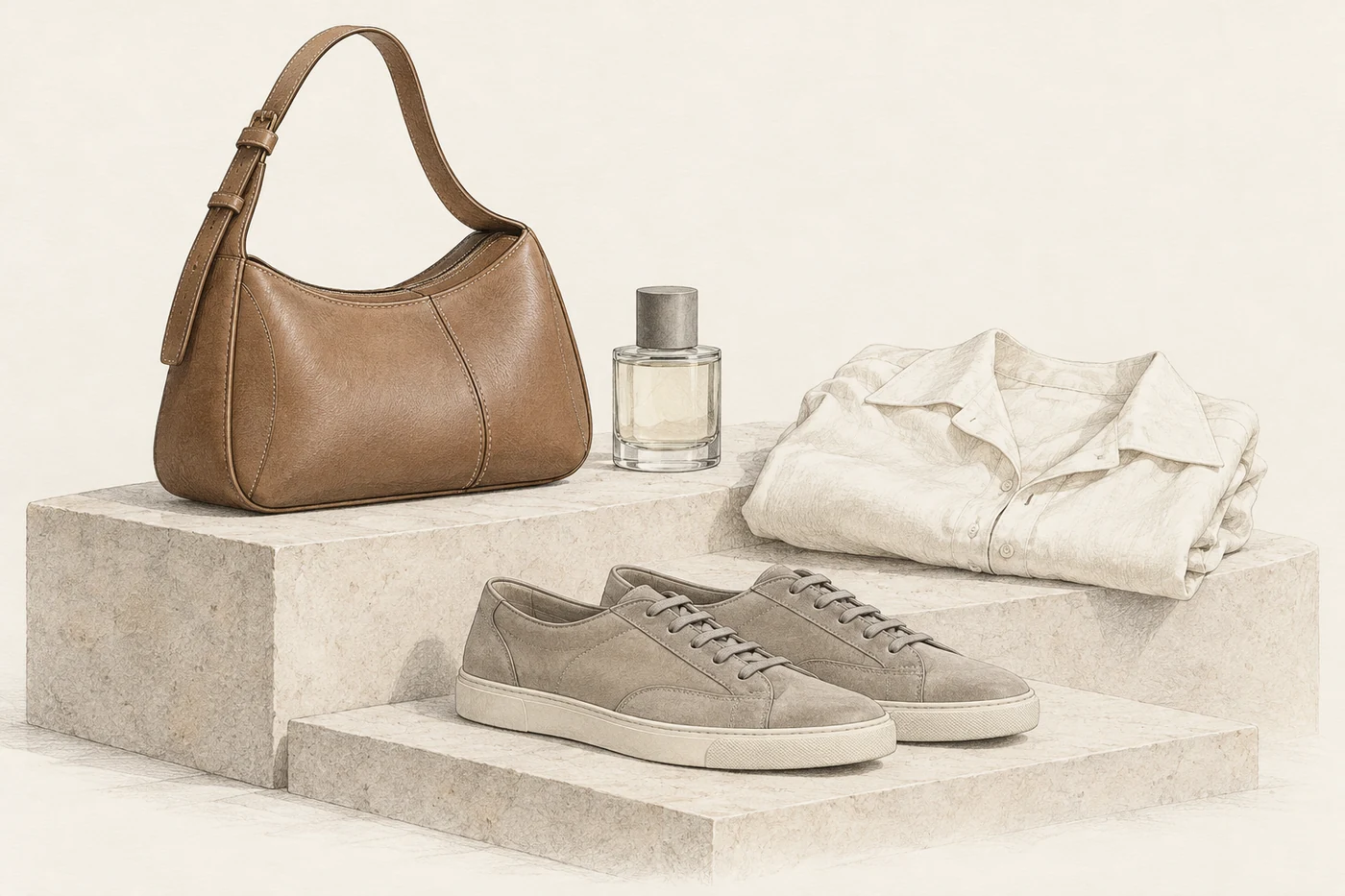
Give the object a destination
Before looking at labels, imagine where the purchase will live. Is there space in a small kitchen for another tea set? Does the recipient actually wear scarves? Would a large fragrance bottle be welcome in a shared apartment? A souvenir should not impose a new hobby or a storage problem on someone simply because you enjoyed buying it.
For yourself, name the job just as precisely. “A small bag for dinner” is a better brief than “something Chinese.” It allows you to reject a beautiful object that will never leave its packaging. That sounds unromantic. It is also what gives the purchase a chance to acquire a life beyond the receipt.
A bag can be a souvenir without a skyline
Songmont is one useful reference when the object should work every day. The official Medium Song description specifies a bucket shape and removable pouch; the Luna family explores a curved, changeable silhouette. Those are different ways to organise a day. The design choice is more interesting than buying whichever model happens to be circulating most often online.
Bring the things the bag must hold and ask before putting them inside. Test the opening, strap and closure with the bag in use. A phone fitting in a product image is not the same as retrieving your own phone with a wallet, glasses and keys already inside. For a gift, a small leather item may avoid some of the uncertainty of strap length and proportion.
A cup is only useful if someone wants to drink from it
SHANG XIA's official Bridge cup page describes fine bamboo woven closely over a porcelain body. The pairing makes a good design question: how does an outer material change the way a familiar vessel is held and seen? It is an example to study rather than a claim that every visitor needs an expensive tea object.
Handle a display piece with permission. Consider the rim, capacity, balance and cleaning instructions before the box. A tiny tasting cup and a large breakfast mug belong to different routines. Ask how a composite object should be washed and stored; do not assume bamboo-covered porcelain can be treated like the plain ceramic already in the dishwasher at home.
Scent requires more time than packaging
Shanghai's Chinese fragrance labels offer another compact purchase, but scent is a poor category for guessing. To Summer and DOCUMENTS have distinct presentations and ranges. A handsome store can make almost any bottle feel inevitable for fifteen minutes. Give the fragrance a second setting before deciding that its atmosphere belongs in your home.
For someone else, an appropriately sized discovery format, when available, can be more considerate than a full bottle chosen from a single strip. For yourself, record the exact name and test one candidate on skin if suitable. Walk away, let it develop and return to the decision later. Check the actual formula information and usage directions when sensitivities matter.
Textiles should survive the recipient's routine
A scarf is easy to pack and easy to choose badly. Look at composition, size and care, then consider how the cloth behaves when tied. The most elaborate pattern is not necessarily the most wearable one. A quiet color that works with several coats may carry more memories simply because it gets used more often.
Do not treat a soft touch as proof of cashmere or a glossy surface as proof of silk. Read the composition label and ask the seller to explain unclear wording. If the item needs care the recipient will never provide, it is an awkward gift even when the fiber is exactly as described. Keep the label and receipt with the object.
Chinese design is not a single visual style
A useful shopping afternoon can move between a restrained ICICLE shirt, a Songmont bag, a graphic independent label and a craft-led object without requiring any of them to display the same motifs. Treating contemporary Chinese design as a compulsory palette of red, dragons and decorative fastenings makes the selection much smaller than it needs to be.
Ask who designed the object and where the label is based, while keeping those questions separate from where an individual item was manufactured. Neither the look nor the location of the shop establishes every part of its origin. A clearly explained contemporary object is a better purchase than a vague heritage story attached to an otherwise unremarkable item.
Leave room for the trip home
Ask for protective packing suited to the actual object, and consider whether you can carry it safely. A box that looks impressive on a counter can become a problem in a full suitcase. Before buying liquids, fragile ceramics or scented home products, check your carrier's current restrictions and the rules for your destination. The shop cannot determine every border rule for you.
Keep an intelligible receipt, the product name and any care information. If a gift is being shipped, clarify insurance, tracking and what happens after damage before paying. Do not spend the entire budget on the object and discover afterward that getting it home costs more than you allowed. The complete purchase includes the journey.
A shorter shopping list makes a stronger afternoon
Choose two categories rather than eight. Compare a few serious options, take a break and return to the one you can still describe without looking at a photograph. If all you remember is the brand, you may not yet have a reason to own the object. Leaving a shop empty-handed is a legitimate outcome of paying attention.
For a guided shopping visit, send the recipient, intended use and approximate budget. A request for one daily bag and two small gifts is more actionable than a list of twenty famous stores. The aim is a small set of purchases with clear reasons behind them, and perhaps one surprise that earns its place.