What the dish name tells you
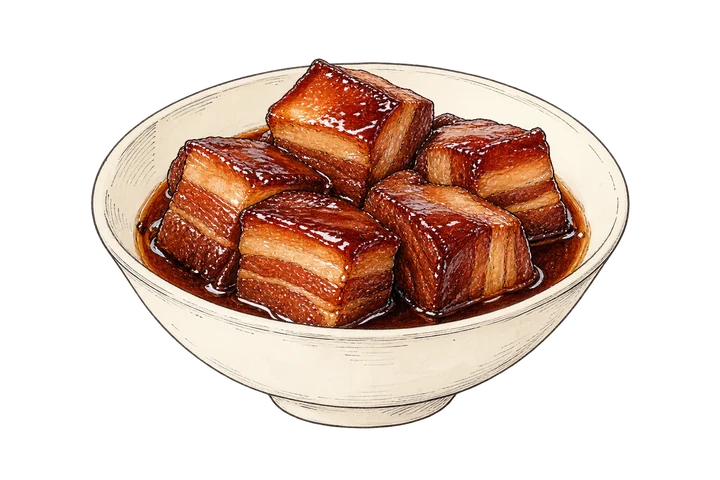
Hongshaorou means red-braised pork. In the Shanghai version discussed here, the cut is pork belly, with its alternating layers. The color comes from the braising approach and seasonings, rather than a requirement that the finished dish be bright red. Recipes differ between households and restaurants, so the name identifies a family of preparations rather than one compulsory formula.
Dark soy gives the Shanghai braise its deeper color; sugar supplies part of its sweet-savory balance. Long cooking softens the belly, and reducing the liquid concentrates the coating. More sugar and more reduction do not automatically improve it: they can leave a sticky, dominating sauce around meat you can scarcely taste.
My preference is for enough sauce to coat and season the pork, with some left for rice. A deep pool is not automatically generous. It can make a portion appear larger while telling you little about the meat itself. Ask about the portion and accompanying ingredients before treating the size of the serving bowl as value.
Taste the three layers separately
Begin with a modest piece that includes skin, fat and lean meat if you are comfortable eating all three. The layers are the point of using belly. You are not obliged to enjoy them equally, but separating them conceptually helps explain what works and what does not.
The skin should be judged as skin, with its own resistance. The fatty layer contributes richness; the lean meat should still have a reason to be there. A piece that collapses at a touch may be pleasant, yet collapse alone is not proof of good cooking. If the lean section feels dry while the sauce supplies all the moisture, the gloss has concealed a weakness.
Try another piece before delivering a verdict. Belly varies across a serving. A corner may be leaner; another cube may carry more fat. The question is whether the variation is enjoyable, rather than whether every piece behaves like a standardized product. This is also why cutting the portion into anonymous slivers for a photograph can miss much of the experience.
Rice is part of the argument
Order plain rice if you want the simplest comparison. A small amount of sauce on rice gives you a second way to taste the seasoning without taking another large piece of pork. It also shows whether the sauce remains appealing when its concentration changes.
Start with less sauce than you think you need. Pouring everything onto the rice immediately removes your ability to adjust. The ideal amount is personal, but it should leave you wanting to eat the rice as well as the sauce. When a rich dish needs a neutral companion, neutral is a useful quality rather than an absence of flavor.
I would not add fried rice automatically. It can be excellent in another context, but a fully seasoned starch competes with a rich braise. If the table already has several assertive dishes, plain rice creates space between them. It also helps you understand which dish you actually want more of.
Choose a table that changes the next mouthful
For two diners, make the pork the central rich dish and ask for a contrasting vegetable. The best choice depends on what the kitchen has and how it prepares it. Do not infer lightness from the word vegetable: a deep-fried or heavily sauced preparation may repeat the same richness you already ordered.
A simpler soup can give the table another direction, but confirm the size and stock. A large casserole may make sense for four and be excessive for two. An ordering strategy is useful only if it reacts to the restaurant's actual portions. There is no virtue in leaving three nearly full dishes because the menu promised they were all signatures.
If one person dislikes pork fat, discuss that before choosing hongshaorou as the centerpiece. Asking for a version without fat may remove the very feature that makes the dish work. Another pork preparation can be a better choice than commissioning an unhappy approximation of this one.
What is worth asking, and what is not
Bean-curd knots, bamboo shoots or eggs may share the pot. They change the serving: a knot holds sauce differently from a cube of belly, and an egg adds another substantial mouthful. Ask what is included before ordering a second dish that repeats those ingredients. Clarify cooking wine and sauces when dietary requirements make them relevant.
I would spend less energy asking whether the restaurant's version is the single most authentic one. A family dish with many household versions is poorly served by that contest. Ask instead whether this is the style the kitchen is known for, and what they recommend alongside it.
The dish earns its place when a second piece still tastes complete and the rest of the meal makes room for it. That is a higher standard than a shining photograph. A plate of rich pork should be a reason to sit down to dinner, rather than a trophy ticked off before moving to the next restaurant.