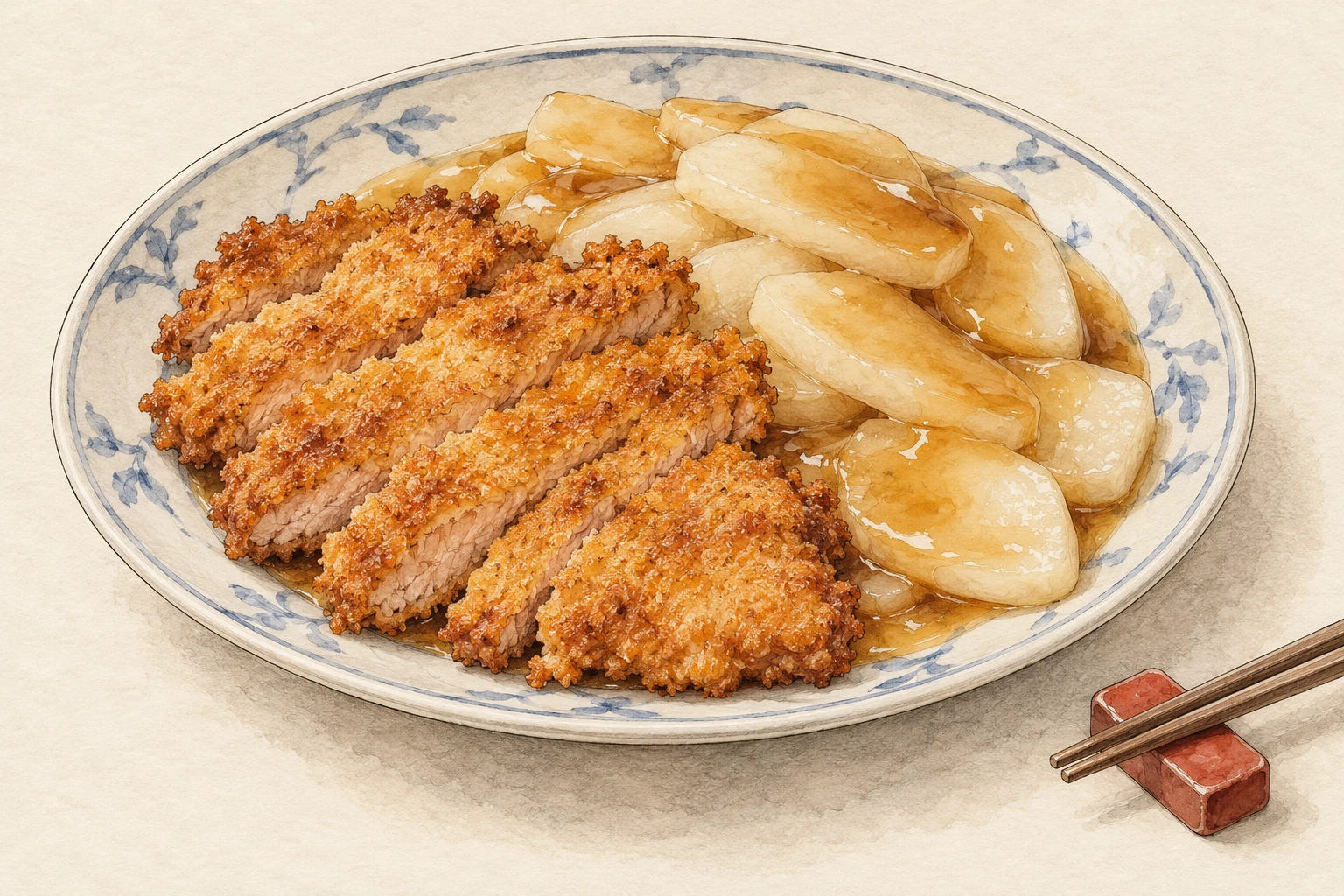
Do not translate paigu too literally
Paigu often appears in English as ribs, but the Shanghai dish discussed here is commonly described as pork chop and rice cakes. The name alone may not tell you the cut or whether a bone remains. Look at the restaurant's version and ask if that matters to you.
Niangao are rice cakes. They are not a garnish in the way a scattering of fried crumbs might be. They form a substantial part of the plate, and their chew is one of its main attractions. If you order it alongside a large bowl of noodles, you have chosen two starch components, not a meat course with a decorative side.
I would begin with the plate as a self-contained small meal, then add only what appetite requires. This gives the rice cakes a chance to register. Treating them as something to push aside while eating the pork misses why the combination has endured.
A breaded cutlet is a related, different order
Shanghai also has zhazhupai (炸猪排), deep-fried pork chop, associated with the city's adaptation of Western cooking. A breaded cutlet offers one style of crisp coating. The municipal guide describes the pork in paigu niangao as using a thinner batter rather than the same breadcrumb treatment.
That distinction matters when you order from a photograph. If what you want is a dry, crunchy breaded cutlet cut into strips, the rice-cake dish may deliver something softer and more integrated with sauce. Neither version has failed by being the other one.
The English word crispy is particularly unhelpful here. Ask what coats the pork and how the sauce is served. You will learn more from that answer than from an adjective applied to every fried dish on the menu. A related dish can be an excellent alternative when it matches your preference more closely.
Taste the rice cakes before dismissing the texture
Rice cakes bring a deliberate chew. Take a manageable piece and let the texture be part of the meal rather than expecting a potato-like side. Notice whether the surface seasoning and the center belong together. A thick piece and a thin slice will feel different even when the sauce is the same.
The Huangpu tourism description of the longstanding Xian De Lai version describes rice cakes cooked in seasoned liquid before their final sauce. That gives one documented example of preparation, not a universal recipe for every shop. Your plate may use another method, and the menu should be read accordingly.
My preference is for rice cake that gives some resistance without becoming a task. A sauce-heavy exterior cannot rescue an unpleasant center. Likewise, a pleasant cake does not need a flood of sauce to justify itself. Try a bite of cake alone, pork alone, then together. The combination should add something.
The local sauce needs its own explanation
Lajiangyou (辣酱油) is frequently rendered as spicy soy sauce, but Shanghai's version belongs to the Worcestershire-style condiment family. The literal translation can mislead someone expecting ordinary soy sauce plus chili. Its sharper, tangier direction makes sense beside fried pork.
Check which sauce belongs with the dish you ordered. A restaurant may serve a sweet sauce on the rice cakes and a separate condiment for the pork, or arrange the plate differently. Taste before pouring. Keeping the condiment in its dish gives you control over both flavor and the way the coating softens.
Ask about the condiment's ingredients when dietary needs make that relevant. A familiar-looking brown bottle is not an ingredient declaration, and the name Worcestershire-style does not specify one universal recipe. The same caution applies to the pork's marinade and batter.
How to order it without making lunch excessive
For two people interested in comparing dishes, ask whether a plate can be shared and how substantial the serving is. Add a soup or vegetable only after understanding the portion. The rice cakes already give the plate a filling base; rice on top may be unnecessary unless someone wants it.
I would keep the next course restrained. Following fried pork and rice cakes with another large fried snack can make their differences harder to appreciate. A contrasting dish or simply a break may be the more useful choice. There is no requirement that a food walk move continuously from one queue to the next.
Eat enough of the pork and cake in combination before ranking them separately. The dish has a bluntly practical structure: meat, starch, sauce. A good version makes those parts work together without relying on novelty or nostalgia. That is a respectable ambition for lunch.