Publication details
First published . Series dates place related notes together in the reading archive.

Start with a public-space question
The useful question is not only “What does this sculpture mean?” It is also “What does it do to this place?” A work may frame a path, change a sightline, create a place to gather or make you aware of the scale of a lawn. You can begin looking before you know its title.
Take a first view from the route you were already using, then notice whether the work asks you to move. Do not immediately search for the angle that matches an online photograph. The way an object meets an ordinary walk is part of what makes public art different from an isolated image in a catalogue.
Save the park, not the museum ticket
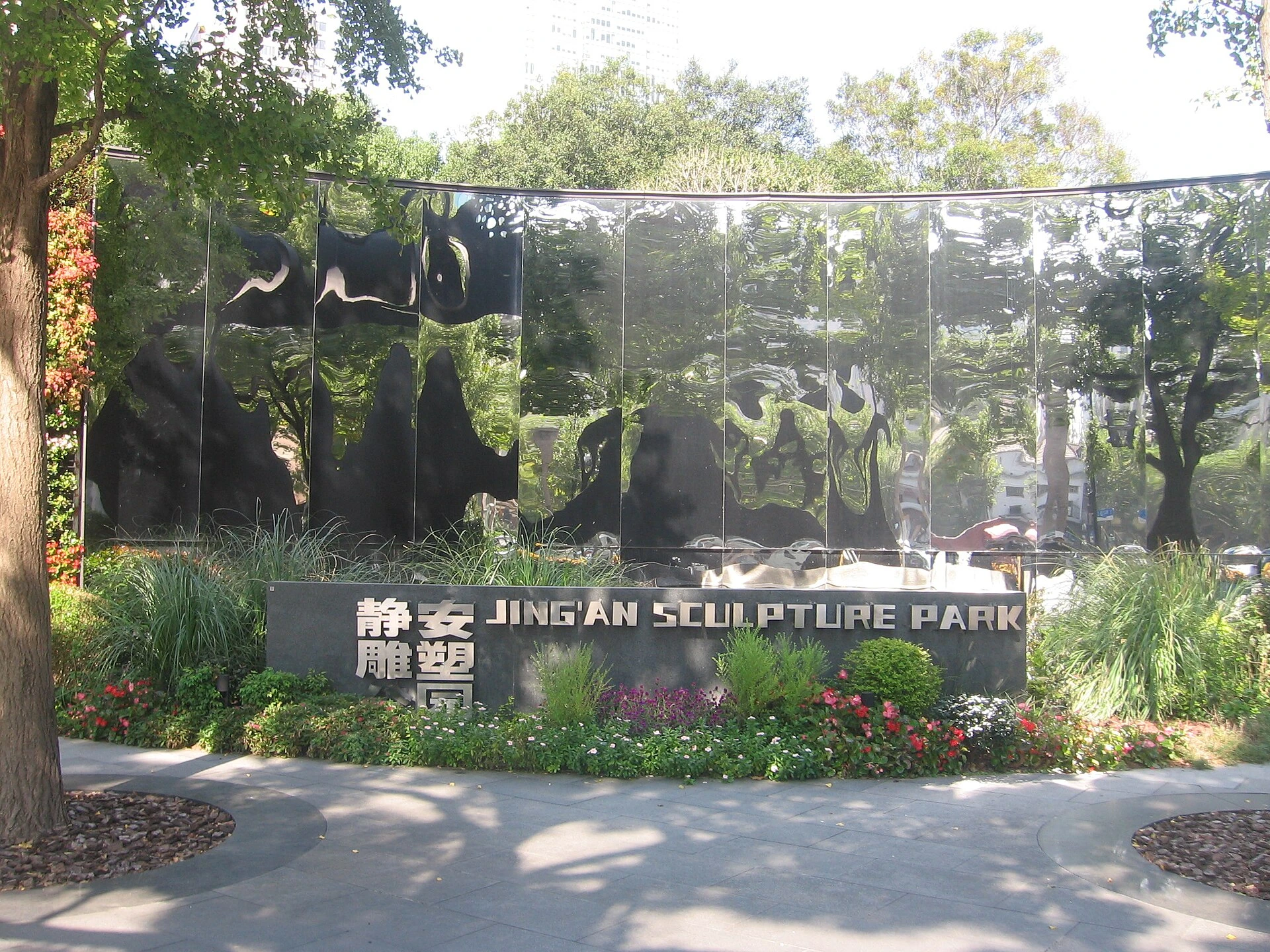
Jing’an Sculpture Park / 静安雕塑公园 has a useful address lead at 500 Beijing West Road / 北京西路500号. The Natural History Museum is a separate destination in the same broader setting. A park visit does not include museum admission, and the museum’s opening rules should not be applied to every outdoor path.
Check the entrance and current access notices for your approach. Municipal reporting describes the park’s open, 24-hour public-space arrangement, but particular areas can still be affected by maintenance, installation or event management. A public park is not a guarantee that every surface and every work can be reached at any hour.
Read the label after a first look
Choose one work and give it a few minutes before reading the explanation. What material can you identify? Where does its weight appear to sit? Does the surface absorb light, reflect it or change as you move? Those are observations you can make without needing to solve a hidden message.
Then read the label and let it complicate the first response. Note the artist, title and date correctly if you plan to discuss or photograph the work. Do not attach a famous name to an object because it resembles something you have seen elsewhere. A careful uncertainty is more useful than a confident but wrong caption.
Two works make a better comparison than twenty
Find a second work that behaves differently. It might be lower, more enclosed, more reflective or more dependent on the view through it. Compare how far you need to stand away from each and how other park users move around it. The contrast gives your looking a structure.
This is where I would slow the walk. An outdoor exhibition can tempt you into counting objects, but quantity is a weak measure of attention. Two works studied carefully may leave a clearer impression than a full circuit completed at the pace of a camera shutter. You are allowed to dislike one, provided you can say more than that it was strange.
The 2026 exhibition is a dated addition
The ninth China Shanghai Jing’an International Sculpture Exhibition, 2026 JISP, was announced under the theme “Space Emergence” / 空间涌现. Municipal September and October 2026 reporting confirms the current edition and describes public programming and night-time presentation. This is current context, not a claim that a previous biennale’s installation is still standing unchanged.
For a particular temporary work or activity, use the exhibition’s current information and on-site labels. Do not assume that a workshop, light sequence or guided event runs continuously because it appears in a launch announcement. Public access to the park and attendance at a programmed activity are separate questions.
Daylight and darkness are different visits
A reflective surface, a deep opening or a work placed beside planting can change substantially with light. In daylight, materials and the relation to the wider park are often easier to read. At night, specific lighting may draw attention to another aspect, while surrounding details become less visible.
Choose the visit that suits your interests and the current programme rather than assuming night is automatically more dramatic. Keep to lit permitted paths and do not step into planting to reproduce an effect from a promotional photograph. If an artwork uses sound or light, allow it to unfold without turning every moment into a demand for the brightest possible image.
Public does not mean touchable
Follow the signs for each work. Some art is designed for interaction, while other surfaces or structures are not. The fact that an object is outdoors does not make it climbing equipment, and the absence of a gallery guard at your shoulder is not permission to test its strength.
Leave room for walkers, children and people who are simply using the park. If you want a photograph, wait for a clear moment rather than directing strangers out of the frame. Ask before taking a recognisable portrait. Public art works within a shared space; your own use of that space is part of the encounter too.
Let the walk continue without another checklist
Allow around an hour for a selective visit, more if two works hold your attention. That is a suggested pace rather than an official exhibition duration. Add a nearby street walk only if it fits the weather and your energy. The museum, if you want it, deserves its own confirmed ticket and time.
Before leaving, write down one thing a work made you notice that you would otherwise have passed. It might be the width of a path, the colour of a tree or the speed of other people’s movement. That is a good return from a public sculpture visit. The art has changed how you look at a piece of the city.