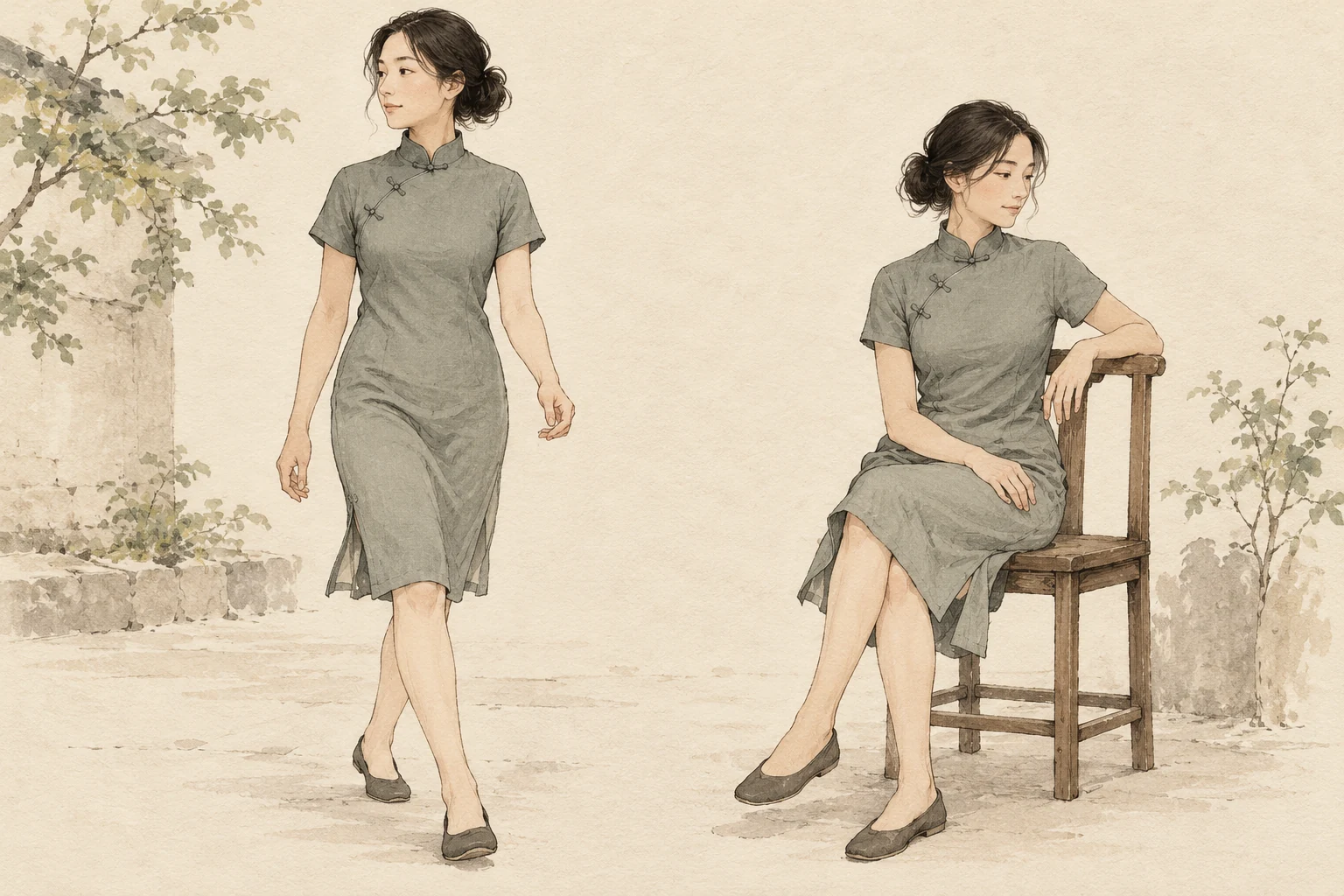
Everyday dress has a history here
Shanghai’s intangible cultural heritage introduction, published in December 2023, describes qipao being worn both for ordinary household activity and formal occasions in the 1920s. It also describes Shanghai tailors’ experiments with Western tailoring in the 1930s, including shaped busts, defined waists and shoulder seams.
That account offers a useful corrective to treating one very tight silhouette as the only authentic possibility. The city’s own heritage narrative records a changing garment and different uses. That public history makes room for a practical discussion of how you want a contemporary dress to work.
Describe a day, then discuss a shape
Tell the maker what everyday means for you. Will you commute, sit at a desk, climb stairs or wear the dress to dinner? How long will you keep it on? Bring the shoes and underlayers you intend to use so that measurements and fittings refer to a complete outfit.
Discuss length, sleeve shape, neckline and fastening as connected choices. Ask how your preferred outline will allow the movements you described. If you bring a photograph, identify what you like about it: a collar, a line through the waist or the fall of the hem. A picture captures an appearance, but may not show the construction or movement behind it.
Use the fitting for ordinary movement
With the fitter’s guidance, take normal steps and sit as you would at a table. Notice whether the dress asks you to change your posture or restrict your stride. Describe what you feel rather than prescribing a repair. Ask which changes are possible at the present fitting stage and which choices affect the entire cut.
Try the fastening yourself if invited. Consider whether you can put on the dress comfortably without assistance and whether that matters for its intended use. Ask about pockets if they are important, and how adding them might affect the chosen silhouette. Everyday convenience is a legitimate design request, not an interruption to a discussion of craft.
Include care in the commission
Ask for the exact composition and care instructions of the selected fabric, including any lining or decoration. Confirm how much time is available for fittings and whether the finished dress can be checked before you leave Shanghai. A carefully chosen garment should fit your routine after the trip as well as a photograph taken during it.
The most interesting outcome may be quieter than an occasion dress: something whose shape, fabric and movement make you want to wear it again. Keep the maker’s explanation of those choices with the finished piece.