Publication details
First published . Series dates place related notes together in the reading archive.
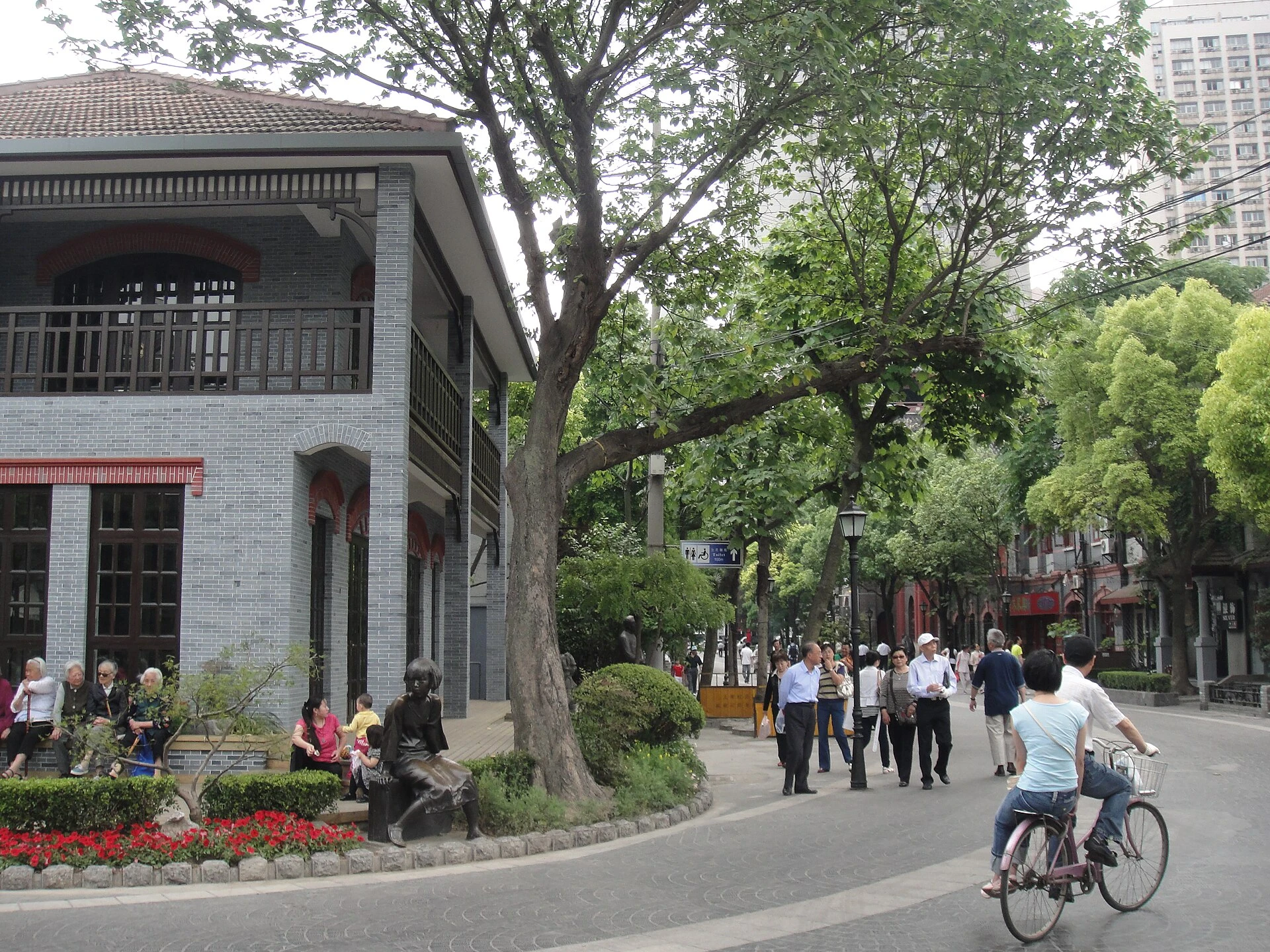

Start with a writer, not a facade
Choose a short text before you go. Lu Xun is an obvious starting point, but the aim is to bring an actual piece of writing into the walk rather than recognise a name on a plaque. A few pages read with attention can give the street more substance than an hour of looking for matching historical photographs.
Think about what the text notices: a voice, a social habit, a moment of embarrassment or a conflict over language. You do not need to locate the exact scene on Duolun Road. The text supplies a way of paying attention, not a treasure map. That is a more flexible companion for a neighbourhood that has changed repeatedly.
Know what the street is commemorating
Hongkou’s district account connects Duolun Road with the Left-Wing Writers’ League and figures including Lu Xun, Rou Shi, Ye Shengtao and Mao Dun. These names do not all describe the same relationship to every building. A writer might have lived nearby, attended meetings or become part of a later commemorative landscape.
Read the wording on each marker carefully. “Former residence”, “memorial” and “site of a meeting” are different claims. A sculpture in the street is a later act of remembrance, not evidence that the person stood at that exact spot. Keeping those categories separate makes the history clearer without requiring you to become a specialist before taking a walk.
Remember that literary life needed rooms
Writing is solitary in one sense and highly social in another. People need publishers, meeting places, readers and conversations. A literary street becomes more interesting when you ask how those relationships worked rather than imagining each author alone at a desk, producing a masterpiece detached from the city.
Look at the relation between street-facing rooms and more private spaces behind them. Do not invent a historical use for an attractive window; use verified signs where available. The useful question is practical: what kinds of places allowed people to meet and exchange work? A small room and an ordinary table may matter more to a literary history than the grandest building on the walk.
A recreated cafe is not an untouched survivor
Hongkou reported the return of the Coffee Cafe and a bookstore at the end of 2020, connecting the new venue to earlier literary and political associations. That report describes a revival. It should not be read as proof that a present interior has remained intact since the 1920s, or that the venue is still operating unchanged in 2026.
If you find a cafe or bookstore there today, enjoy it on its current terms. Check the name and opening arrangements before planning a stop. A reconstructed atmosphere can be interesting, but it offers a different kind of evidence from an original document or a surviving structural element. You can appreciate the interpretation without mistaking it for a preserved time capsule.
Former residences need boundaries
A named historical residence may be a museum, an exterior-only stop or a building with restricted access. Never treat a district heritage list as permission to enter every doorway. If people still live or work in a place, their ordinary use takes precedence over a visitor’s wish to see the staircase.
Stand on public ground, read the marker and keep the entrance clear. If an interior is officially open, follow its booking and photography rules. If it is not, leave it there. An accurate account of what you could see from the street is more valuable than a dramatic story obtained by wandering into somebody’s space and hoping nobody objects.
Pay attention to the present-tense street
A literary walk should include what is happening now. Look at deliveries, small businesses, repair work and how people move through the space. These are not distractions from the historical subject. They remind you that the neighbourhood is a place with ongoing uses, not merely a container for famous names.
At the same time, avoid claiming that a current shop expresses the same social world as a century-old account. Continuity needs evidence. A better observation might be that the street now presents a particular version of its literary past, through signs, sculpture and commercial interiors. Ask what that presentation makes easy to see and what it leaves harder to understand.
Pair it with Lu Xun Park selectively
Lu Xun Park offers another kind of literary commemoration, with a tomb and a museum inside a public recreational landscape. Duolun Road and the park can make a useful comparison, but they do not have to be fitted into one rushed circuit. Check the walking connection and the separate museum arrangements if you intend to combine them.
One is not a substitute for the other. A street connects writing to rooms, meeting places and urban change; a memorial park connects a writer’s public image to a different civic setting. Thinking about that contrast can give the second visit a reason beyond “it is nearby”. If you are tired, make the comparison another day.
Leave with one thing to read next
Allow about an hour for a selective street walk, longer for any confirmed interior. Save 多伦路 in your map, choose a public approach from your starting point and keep a current local map available. Do not rely on a fixed route through buildings whose access you have not checked.
Before leaving, choose one writer or question to follow up. Perhaps it is the relationship between fiction and political organising, or the difference between a memorial image and a difficult text. That is a better result than a complete set of photographs of author statues. The street has done its job if you want to read after you get home.