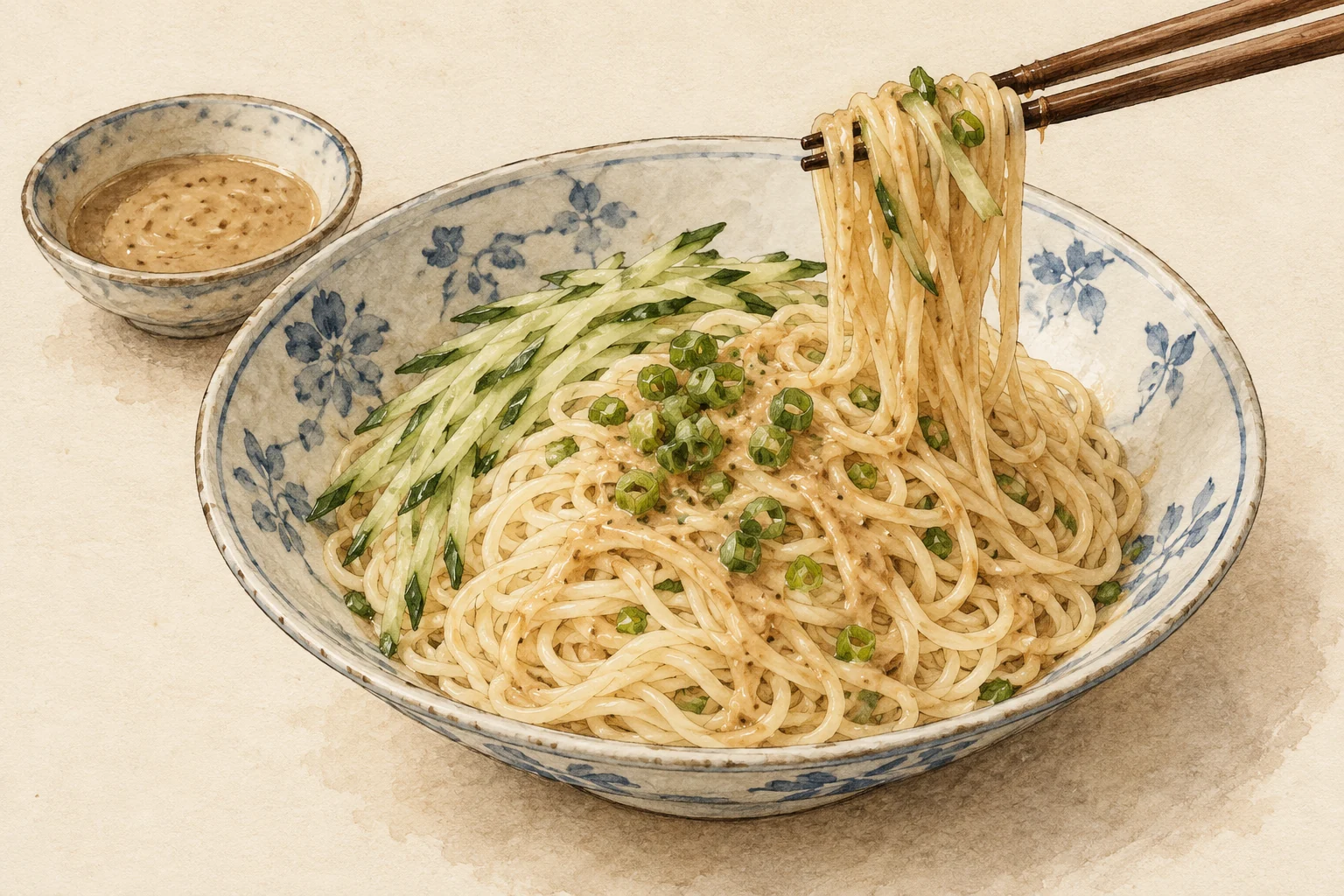
The fan is part of the preparation
Shanghai's municipal food guide describes a local technique in which cooked noodles are lifted and mixed as an electric fan cools them, with scallion oil added. It credits chef Zhu Yonggen of Si Ru Chun with developing the approach. This is a reported history of a method, rather than a claim that every cold-noodle shop uses identical equipment.
The detail is a useful reminder that cold food can involve careful work before service. Temperature is only one part of the result. When the bowl arrives, notice whether the strands separate easily and how much dressing they carry. You can learn more from that relationship than from asking whether the noodles are cold enough to deserve their name.
Find the sauce before choosing every topping
The same municipal guide describes peanut sauce as a familiar accompaniment, with toppings offered in small dishes. A short menu can therefore involve several decisions: the basic noodles, their dressing and the additions you choose. Establish what is already in the bowl before ordering several extras.
Mix enough to reach the lower strands before your first full mouthful. A coating sitting at the bottom can make the top seem plain and the last bites disproportionately strong. Taste, then decide whether you want more dressing. Begin with a simple combination if you want to understand the noodle's texture rather than have every bite become a different topping.
Cold noodles are their own category
Do not use a picture of a different regional cold-noodle dish as a complete ordering guide. The Chinese name lengmian tells you something about temperature, but it does not specify every sauce, topping or preparation. A Shanghai bowl deserves the same ingredient questions as any other noodle order.
Peanut sauce makes peanuts an obvious consideration. Ask separately about sesame, wheat, soy, meat or seafood when they matter, and about shared preparation for an allergy. A meatless-looking dressing is not an ingredient list. A restaurant's account of its own bowl is more useful than guessing from a photograph.
Give the weather a say
For a hot-weather lunch, a bowl and one accompanying dish may be enough. Look at the portion before automatically adding dumplings or another noodle order. A lighter plan also leaves time to sit indoors and recover between walks instead of turning every pause into a large meal.
Ask the kitchen whether lengmian is being served that day and which toppings are available. If cold noodles are off the menu, scallion-oil noodles offer another way to enjoy the strands, dressing and pleasure of a compact bowl.